What began as a futile search for space to warehouse tons of stuff literally dug out of the ground over several decades resulted in the Florida Department of Transportation developing a new specialty – museum curating.
[Above photo by Florida DOT]
Florida DOT’s Archaeological Collections & Curation is just getting started as the museum only exists online for now. But the agency is building a template other state departments of transportation could potentially follow as more road and bridge projects uncover more artifacts as part of the National Environmental Policy Act or NEPA process.
It started in 2016, when Florida became the fourth state to accept an assignment of NEPA responsibilities on federal-aid projects from the Federal Highway Administration. The agreement with FHWA meant Florida DOT could save time and money on projects, but it also meant the department would have to assume some other responsibilities.
In the past, materials that had been excavated during the NEPA process would go to the Florida Bureau of Archaeological Research. Since 2017, all those pottery shards, arrowheads, cooking utensils, and anything else that had historical or cultural significance had to be stored by Florida DOT.
Some was housed in backrooms and closets in district offices, and some in consultants’ offices. The bulk of it continued to accumulate across the state, with no plan of what to do with it.
Florida DOT decided to offer the materials – no one knew exactly how much there was – to Florida museums, which specialize in making such raw materials available to the public. But there were no takers.
“Then we tried the museums along the east coast,” explained Lindsay Rothrock, the agency’s state cultural resources coordinator. “Then, we just looked anywhere in the country that had space that met federal requirements.”
No one wanted it.
“It came to the forefront that we would have to start curating our archaeological materials,” Rothrock said. “We had to be a bit more formal in our archaeological collection.”
Rothrock said she and her colleagues “felt comfortable managing the physical collection because that’s something we’re trained to do. We wanted to go a step further because, hey, there’s some interesting and cool things here.”
In 2023, Florida DOT started the slow process of moving all the materials that had been gathered since 2016 to a space in the central office complex in Tallahassee. As the boxes arrived, teams would document the contents into a database.
Three years later, the boxes are still coming in, but now Florida DOT has a dedicated curation room where everything that comes into headquarters is recorded and stored. The new space also includes an archaeology lab to process artifacts.
So far, the agency said it has recorded about 111,000 artifacts, with “a couple of hundred boxes we’re still going through,” Rothrock said. “We’ve realized we have some interesting things.”
Top of the list for Rothrock was an excavation for a road project at the site of an old turpentine camp. From the mid-1800s through the 1920s, such camps collected pine resin and tar to support the ship-building industry popped up across the state.
Those camps, notorious for their rough treatment of workers, were thought to be populated almost exclusively by nomadic men looking for work. But archaeologists learned the camps were home to a much broader community of people, Rothrock said.
“We found evidence of kids at the site, of whole families at these camps,” Rothrock said. “There were pieces of porcelain dolls, metal jacks – these small little things talk to us about a larger population living there.”
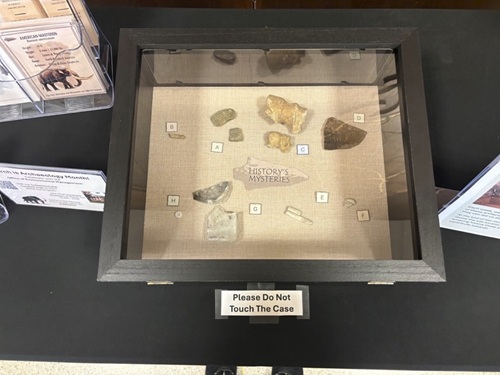
The online museum, which is hosted on Florida DOT’s Office of Environmental Management page, contains a section called “History’s Mysteries,” a virtual set of items collected from the department’s projects. Each item tells a story, and Rothrock and her colleagues are eager to share those stories with the public.
“We’ve got plans coming out of our ears,” she said. “We’re going to need to nail down more space.”
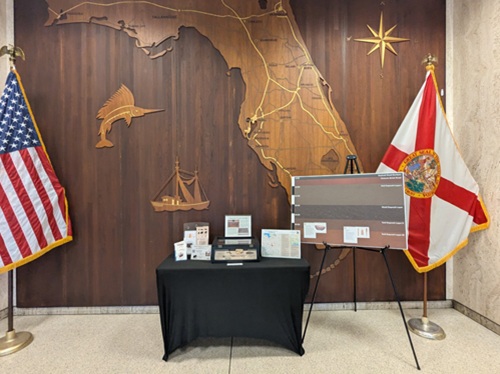
For now, as part of its commemoration of “Archaeology Month” in March, Florida DOT featured artifacts in the main lobby of its headquarters building in Tallahassee to educate people about how archaeologists interpret what they discover during field work. A display case in the lobby also contains “mystery artifacts,” the nature of which are revealed week-by-week.
The agency added that it is also planning to hold an “open house” in the near future to showcase its new curation room and archaeology lab.
 Archaeology
Transportation Archaeologists Dig into History: Part 2
January 28, 2026 Archaeology