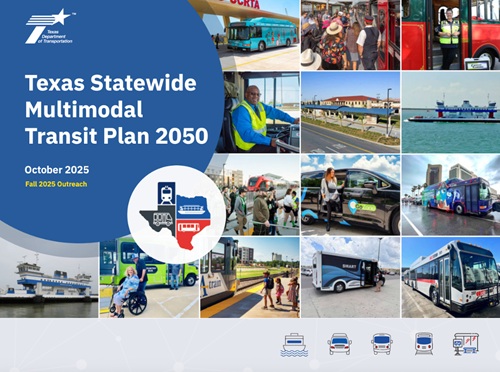
The Texas Department of Transportation has unveiled a plan to improve and expand transit within and among urban, suburban, and rural areas through a multimodal transit network.
[Above photo by TxDOT]
The impetus behind TxDOT’s Statewide Multimodal Transit Plan is to meet the mobility needs of a population expected to grow 40 percent by 2050 in a large, rural state dotted with sprawling metropolitan areas. While TxDOT is building plenty of roads – investing nearly $12 billion worth in road-related construction in the last fiscal year – the plan says the Lone Star state will have to include more transit options in the future to accommodate a growing and changing population.
Most growth will be in the metropolitan areas of Houston, Dallas-Fort Worth, Austin, and San Antonio. “This mega-region is anticipated to grow in population by approximately 50 percent and will include nearly 80 percent of the total state population by 2050,” the plan noted.
Officially, the document is a draft plan and is subject to tweaks from an advisory committee and agency personnel before the administration rolls out a final version in early 2026, according to Adam Hammons, TxDOT’s media relations director. The 90-page document is the result of more than two years of stakeholder input, public meetings, and citizen surveys, he added.
The plan is a fact-filled survey of the Texas transit scene, overlayed with demographic information that will largely shape future needs. The sobering conclusion it reaches is that the transit systems are straining to meet current needs and face considerable challenges in planning for future demands.
“Transit in Texas is at a crossroads,” the plan noted. Rural and smaller urban transit districts don’t have enough money or workforce to maintain services and vehicle fleets, and big-city systems “are struggling to respond to growth beyond existing service boundaries.”
Nearly all transit in Texas is provided by 77 districts or authorities, collectively offering commuter rail, light rail, streetcar, bus rapid transit, fixed-scheduled bus, and on-demand services. About 90 percent of the 230 million transit trips a year in Texas are handled by eight Metropolitan Transit Authority agencies that are primarily locally funded.
Inter-city transit options in Texas are limited to commercial bus services and three Amtrak routes.
The Statewide Multimodal Transit Plan is “an acknowledgement that our economy and our population are growing exponentially, and we have to plan now for the future,” Hammons explained.
That future is partly based on “generational differences in transit needs, attitudes, and preferences,” the plan noted. Younger generations “show a greater desire for mobility options that include transit.”
One challenge is that wide expanses of Texas’ sparsely populated areas make it “difficult to provide efficient transit services without the density to support higher levels of use.”
The plan also carries a big price tag, as the capital costs of connecting every Texas municipality with a population of more than 10,000 by rail or bus could be $50 billion, with an estimated $5 billion in annual operating costs.
That doesn’t include the estimated capital costs of bus rapid transit ($30 million to $65 million per mile) or light rail transit ($200 million to $250 million per mile).
The plan does not specify how the system would be funded because it is meant to be a “conversation starter,” Hammons said.
“This is intended to be a way to get everyone to the table and talk about how we adapt to change and connect people in the future,” he said.
Hammons added that the agency is “kind of surprised” at implications that TxDOT isn’t involved in public transit. He noted that TxDOT has had a public transportation division since 1978 and sends more than $200 million to transit districts each year. That’s why he said this plan is further proof of TxDOT’s steadfast commitment to working toward a better transit system for Texas.
“A majority of people, 86 percent, said public transit is important in the state,” Hammons noted, referring to public surveys conducted in advance of the plan. “We heard what people said they want – better transit vehicles, shorter waiting periods. We heard where those gaps are and where those challenges are in terms of where we can grow in the next 30 years. The biggest thing now is to expand what we already have.”
Hammons emphasized that the plan is intended to be “a guide” to facilitate further discussion among stakeholders across Texas, and that no specific proposals for funding have been submitted to the legislature.
“We are an advocate for expanding transit in the future to meet that demand,” he said. “We are an advocate to adapt what we are doing and meet those needs. At the same time, this is a Texas plan, not a TxDOT plan. What we are saying is, ‘Let’s work together and build on what we have to prepare for the next 30 years.’”
 Infrastructure