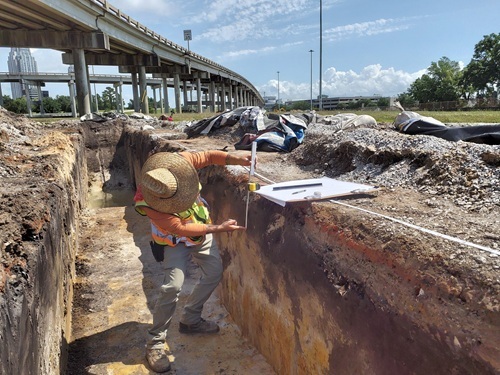
As the Alabama Department of Transportation plans to start work on the long-awaited $3.5 billion Mobile River Bridge and Bayway project to replace an outdated and overused tunnel and bridge along I-10, key archeology work is being completed. (To read part 1 of this story, click here.)
[Above photo courtesy of the University of South Alabama Center for Archaeological Studies.]
While different generations of the project have been on the drawing board for nearly three decades, ALDOT had to yield the site to a team of archaeologists to preserve any significant historical resources of Mobile – a city founded in 1702 that once served as the capital of French Louisiana.
It’s a scene repeated across the country as state department of transportation engineers work side-by-side with archaeologists to preserve the history beneath us before major infrastructure is built.
“All [state] DOTs make every effort to avoid any area with historical sensitivity,” explained Tony Harris, chief of the ALDOT Media and Community Relations Bureau. “When you can’t do that, it’s important to identify the history in the area, explore it and preserve it to the greatest extent possible.”
Because of the significance of the area, ALDOT called on the University of South Alabama Center for Archaeological Studies to manage the exploration. The archaeology team eventually excavated 15 sites, uncovering geographic changes along the Mobile River, long-forgotten buildings, and tons of artifacts, some dating back more than 2,000 years.
“We’re hoping that this project not only gives us a picture of the past, but tells us, ‘How did that past inform the present?’” said Dr. Philip Carr, director of the center. “We’re looking explicitly at that, even at what that past may tell us about the future. Decisions that were made in the 19th century about land filling have a lot to do with why Mobile floods today.”
Erica Schneider – assistant environmental administrator for the Ohio Department of Transportation, who also serves as chair of the Cultural Resources Subcommittee within the Committee on Environment and Sustainability for the American Association of State Highway and Transportation Officials – added that state DOT archaeologists work closely with their states’ historical preservation office to avoid shutting down transportation projects.
“If we find out a project will have an adverse effect on a site, we’ll work to develop mitigation efforts,” she said. “A lot of times, we can do data recovery, so we can go in and excavate the site. There’s often a public education component, too.”
In Alabama, Dr. Carr’s team eventually uncovered more than 400,000 artifacts from the site, including old military cadet uniform buttons, a dinner plate from the French Colonial period, thousand-year-old pottery shards, and Quin Dynasty coins from China. The center has created a website for the public to see some of the treasures.
Dr. Carr also said he received “great cooperation” from ALDOT during the process.
“They have been proactive, they have made sure the resources we needed…fencing, silt fencing, access to the properties, anything, that gave us access to the resources so we could do it right.”
The construction project – the largest in Alabama history – will include a 215-foot cable-stayed bridge, which would be the second-tallest cable-stayed bridge in the country, after the Golden Gate Bridge. Crews also will build a new bayway bridge over Mobile Bay that will be 10 feet taller and carry double the traffic of the old bayway.
A design-build team has been identified, and construction should get underway in 2026. Even though the archaeological work may have kept some construction from being done sooner, Harris said preserving the history of an area is “much more than a requirement” of the environmental process.
Sometimes, as in the Mobile project, work can continue once the cultural resources have been identified, catalogued, and preserved. Occasionally, sites prove to be too significant to be disturbed, and the only option is a no-build option.
Schneider was part of an assessment team in 2015, when Ohio DOT was planning a large corridor project in southwestern Ohio. The project footprint included several Native American sites, including a village that pre-dates European contact.
“It is essentially a multi-component prehistoric habitation, which means people lived there on and off during multiple prehistoric periods over hundreds of years,” she said. “We also know, based on previous excavations by others, that there are burials related to those occupations in this area. Based on geophysical surveys we conducted, we suspected the potential for hundreds of burials in our project area, alone.”
The archaeological finding was a big reason Ohio DOT chose the no-build option. The department later developed smaller, more targeted projects in the region, a decision that wound up serving the transportation needs of the region while respecting the history of the land.
“I think it’s important that we understand or try to understand the history of the people who came before us,” said Schneider, “I think we have an obligation to make that available to the public, to the masses. It’s like any other finite resource. When it’s gone, it’s gone.”
Dr. Carr said he was especially proud that his archaeological team was able to accomplish so much in less than two years of excavation.
“Not slowing down construction – that’s a point of pride for me,” he said. “I’m a Mobilian, and we need a new bridge. I didn’t want to slow it down.”
 Archaeology
Transportation Archaeologists Dig into History: Part 1
January 21, 2026 Archaeology