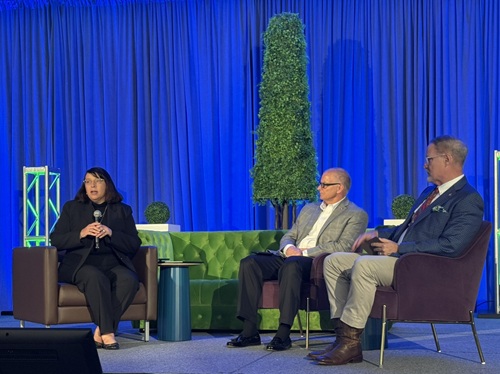
In mid-March, staff from the American Association of State Highway and Transportation Officials attended ResCon, an annual conference in New Orleans focused resilience and disaster response and recovery, to learn about different tactics and tools state departments of transportation can use to improve their risk management strategies.
[Above photo by AASHTO]
Originally launched in 2012 as the International Disaster Conference and Expo, ResCon attracts a diverse group of chief resilience officers and practitioners, emergency management officials, policy and decision makers, academia, and leaders from both the public and private sector to its yearly gathering.
The conference agenda explored a range of topics central to resilience, including coastal protection and restoration, flood and stormwater management and recovery, innovative technologies, homeland security, the impact of potential reforms to the Federal Emergency Management Administration, and the fundamentals of resilience, response, recovery, and mitigation.
One of the key tactics discussed at the 2026 ResCon meeting revolved around the use of “parametric insurance” for risk management. Parametric insurance does not rely on a complex loss adjustment process and provides greater transparency by using pre-agreed physical parameters and payout structures that can cover multiple locations and assets – payouts made in a matter of days after an event, eliminating delays in available liquidity.
Speakers at ResCon explained that deploying parametric insurance for public assets is more popular outside of the United States, most commonly in the Caribbean; however, it has been used to insure public assets against floods along the Florida coastline.
With the rapidly increasing intensity and frequency of extreme weather events, parametric insurance can help infrastructure sectors recover from risks like extreme weather that are known, but hard to quantify – risks otherwise known as “grey swan” events.
However, extreme weather is not the only hazard for which state DOTs must plan and prepare, as the threat scope state agencies face includes geological events, wildfires, and cyberattacks, among many others. Those threats can become particularly acute during large-scale planned events, such as the upcoming 2026 FIFA World Cup soccer tournament and the 2028 Summer Olympics in Los Angeles and 2034 Winter Olympics in Salt Lake City.
ResCon presenters noted that there is no single strategy or practice that will work for every state, nor can a state deploy a single practice or strategy to counter all possible threats. Rather, state DOTs should work to improve their collaboration, both nationally and regionally, holding emergency management peer-exchanges and workshops to advance common risk management frameworks.
In that role, AASHTO works to assist states to identify gaps in data and capabilities, remove barriers to implementation, share emergency management practices, and execute shared resilience priorities – a major reason why AASHTO remains a committed participant of conferences like ResCon and will continue advancing those response and recovery lessons learned.
 AASHTO