
Major Hawaiian Airport Renews Carbon Accreditation

In October, the Hawaii Department of Transportation celebrated the Daniel K. Inouye International Airport’s successful renewal of its Level 3 Airport Carbon Accreditation or ACA, reaffirming its leadership in sustainable aviation.

[Above photo by Hawaii DOT]

For the second consecutive year and five years ahead of schedule, the airport continues to exceed its 2030 goal of reducing airport-controlled carbon emissions per passenger by 50 percent from 2009 levels.

It also continues to advance clean transportation through the pilot deployment of autonomous electric shuttle buses, the replacement of fleet vehicles with electric vehicles or EVs and the installation of additional EV charging stations serving operational areas.

“Hawaii’s airports are demonstrating what electrified transportation leadership looks like,” said Hawaii DOT Director Ed Sniffen in a statement. “Through collaborative efforts with our airport partners, the Daniel K. Inouye International Airport is demonstrating how electric infrastructure can support ground and air operations, while remaining affordable and reducing emissions.”

[Editor’s note: In coordination with the launch of the second segment of the city’s Skyline rail service in mid-October, which includes a station at the Inouye airport, Hawaii DOT also highlighted a range of modifications to the airport’s ground transportation operations.]

Administered by Airports Council International, the ACA program is the only global standard for carbon management in the airport industry, Hawaii DOT noted – and the Level 3 designation recognizes airports that have significantly reduced emissions within their control.

To ensure accuracy and transparency, the emissions inventory is independently audited by a third-party verifier under the ACA program, the agency said.

Hawaii DOT said it has “actively engaged” with partners such as airlines, ground handlers, and tenants in collective carbon reduction initiatives. That includes engaging in ongoing sustainability efforts such as the deployment of solar panels, as well as active collaboration with federal, airline and concession partners to lower emissions from all aspects of airport operations. These efforts are saving money, improving efficiency and reducing air pollution — benefiting travelers, employees and the surrounding community, while protecting Hawaii’s environment.

Hawaii DOT added that it remains committed to achieving net-zero airport-controlled carbon emissions by 2045, in alignment with the state “zero emissions” targets.
Environmental News Highlights – October 29, 2025

Oregon DOT Reopens Key Scenic Highway

The Oregon Department of Transportation recently reopened a landslide-damaged segment of a road known as American’s first scenic highway – reconnecting a century-old route enjoyed by motorists, bicyclists, and pedestrians.

[Above photo by Oregon DOT]

About 800 feet of the 73-mile Historic Columbia River Highway crosses an active section of the Larch Mountain Slide. In March, geotechnical engineers noted accelerated land-shifting that caused structural issues for the road, as well as guardrails and the embankment beside it.

Oregon DOT closed part of the two-lane road for two weeks to seal the asphalt cracks and install orange barrels along the sinking guardrail. But a longer-term solution was needed for the road – one supporting the embankment and repairing the road’s drainage system, all of which were damaged by the active landslide.

The agency’s project team faced several issues – including the mountainous terrain and environmental considerations – as they sought to finish repairs to the damaged roadway before mid-October, when the rainy season begins.

“The topography is challenging, with steep cliffs to the south, and the railroad, Columbia River, and I-84 to the north,” said Terra Lingley, Columbia River Gorge National Scenic Area coordinator at Oregon DOT. “The location of the work zone required getting crews, equipment, and heavy metal materials down a steep slope for installation.”

On July 7, Oregon DOT closed a 0.8-mile section of the Historic Columbia River Highway and started work. To repair and improve the drainage, the agency’s team employed a pully system to lower three pipe outfalls about 100 feet to the site. Crews improved the embankment’s stability by adding geo-grid mesh in layers to the wall and adding soil anchor nails and wire mesh below the wall.

Because the Columbia River Gorge is a National Scenic Area – a federal designation given to only 10 sites across the country – specific environmental regulations governed Oregon DOT’s construction efforts.

For example, the road project could not negatively affect the natural, cultural, recreational, or scenic resources in the area, Lingley said.

The project was substantially completed in late September, with just a few punch list items expected to be completed by November.

“This was a quick-build project from design, bid, construction and finish before the rainy season,” noted Jason McNeil, an Oregon DOT engineer, in a news release about this road repair endeavor.

Bicyclists welcomed the re-opening of the road, which is popular “due to the relatively gradual hills, as the roadway is no steeper than 5 percent,” Lingley said. “The waterfalls along the corridor are a large draw for folks seeking both a longer ride and to view the sights along the way.”

The Historic Columbia River Highway is one of the most honored and recognized roads in the country. It is listed as a National Historic Landmark, a National Historic Civil Engineering Landmark, an All-American Road, and is on the National Register of Historic Places.

Completed in 1922, the road was designed specifically to feature stunning views of the Columbia River Gorge chronicled by Lewis and Clark in the early 19th century. The road was immediately popular, but by the mid-20th century, railroad realignments, the need for wider and straighter highways, and the construction of I-84 left the winding, two-lane road pretty much an afterthought for most travelers.

Much of that began to change in 1986 with the signing of the National Scenic Area Act, which Oregon DOT invoked to begin rebuilding parts of the old highway for recreation purposes. The agency refurbished and rebuilt tunnels and bridges, and some parts of the road were designated for non-motorized vehicles.

Today, the Historic Columbia River Highway Trail starts in three places where the old road ends for motor vehicles, forming a full alignment that is fully accessible by bicycle, Lingley said. Bicyclists especially enjoy riding “the waterfall corridor” between Troutdale and Ainsworth State Park.

“Some folks ride the full length of the Historic Columbia River Highway…and some do a loop using county roads,” Lingley said. “In my opinion, it’s especially popular due to the views, the destinations/sights along the way, and the experience riding on a scenic byway.”

Tennessee DOT Issues New ‘Rocco’ Trash Patch

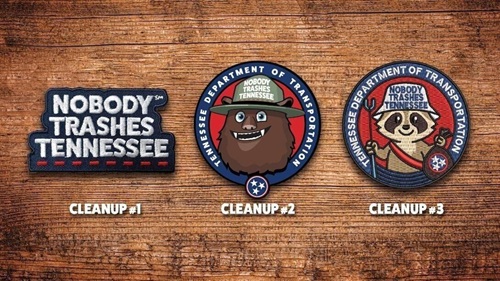
The Tennessee Department of Transportation recently rolled out its third Nobody Trashes Tennessee litter prevention campaign patch in its scouting and youth patch series.

[Above image by Tennessee DOT]

Launched in 2023, the agency’s “Patch Program” offers litter prevention and educational resources while recognizing scouts and other youth groups that participate in community litter cleanups or organize their own group cleanup events.

Image by Tennessee DOT

The newest “Rocco the Raccoon” patch – awarded for a scout’s third cleanup – joins the “Nobody Trashes Tennessee” logo patch (awarded for a scout’s first cleanup) and the “Trashsquatch” patch (awarded for a second cleanup). Tennessee DOT noted in a statement that these patches help celebrate the continued commitment by youth groups to keeping their communities safe, clean, and beautiful.

[Editor’s note: The Georgia Department of Transportation “Extra Mile” blog recently highlighted a similar initiative in the Peach State entitled “Keep it Clean Georgia.”]

The Tennessee DOT issued this new patch ahead of its 5th annual “No Trash November” initiative, which aims to remove at least 75,000 pounds of litter from the state’s roadways and waterways in a single month. In 2024, more than 2,400 volunteers – including scouts and youth groups – participated in over 175 cleanup events, collecting a total of 69,000 lbs. of litter, the agency said.

Tennessee DOT added that all three Girl Scout and all six Scouting America councils in the state are active partners with the “Nobody Trashes Tennessee” initiative through its litter prevention education and patch program. The program is open to all youth groups and organizations statewide, with patches provided at no cost to participants who complete cleanup service projects.

Environmental News Highlights – October 22, 2025

Podcast: Mountain Lion Habitat Preservation Efforts

The latest episode of “The Stream by AASHTO” podcast features Dan Medeiros, senior field representative for the Conservation Fund, regarding the organization’s current efforts in California to support the safety and growth of mountain lion populations and their habitats.

[Above image by AASHTO]

This podcast series is part of the AASHTO Environmental Management technical service program operated by the American Association of State Highway and Transportation Officials. It explores a wide array of environmental topics that affect state departments of transportation and the infrastructure programs they oversee.

During this podcast episode, Medeiros discusses how mountain lion conservation efforts interconnect with transportation infrastructure needs; especially how large barriers and quick-moving cars are two of the main culprits behind mountain lion deaths.

He also points to specific examples, including the death of “54M” – a mountain lion tracked by the Conservation Fund that was tragically killed by a vehicle when trying to cross a major highway.

Medeiros also explains the importance of stakeholder input on large infrastructure projects that involve mountain lion populations, including state departments of transportation, local residents, and private organizations – offering insights on the importance of quality data collection, advocacy, and conversation when working with big stakes.

To listen to the full podcast episode, click here.

Hawaii DOT Finalizes Statewide Energy Security Plan

The Hawaii Department of Transportation has finalized its Energy Security and Waste Reduction Plan following a 65-day public review process and after incorporating extensive stakeholder feedback.

[Above image by the Hawaii DOT]

The plan provides a roadmap for Hawaii’s transportation sector to meet statewide emissions reduction targets established by Hawaii’s legislature in 2018. The 2030 target is to cut greenhouse gas or GHG emissions by 50 percent from 2005 levels, with the aim by 2045 of capturing more carbon than the state emits; thereby achieving net-negative emissions.

During the public comment period on the draft of its Energy Security Plan, issued in late June, the agency said it conducted six virtual public presentations, met with many stakeholders, and received 310 public comments.

Comments ranged from calls for more walking and biking paths, concerns about the cost of transitioning to clean fuels and electric vehicles, as well as demands for equitable investment to benefit disadvantaged and rural communities, Hawaii DOT noted.

Key revisions incorporated into the final plan include use of updated data, including the most recent State Greenhouse Gas Inventory from 2022 that shows 50 percent of emissions come from transportation, with 85 percent of those transportation emissions coming from domestic aviation.

Other revisions include allowing cruise operators to continue operating as long as they use ships that burn cleaner fuels, as well as prioritizing emissions reduction strategies that will lower the cost of transportation for the most vulnerable, such as by adding bus stops or routes.

The plan also sets forth immediate actions which should guide the state’s transportation investments over the next five years, which include expanding electric vehicle or EV public charging; incentives for cleaner fuels; filling critical gaps in pedestrian, transit and bicycle networks; and investing in carbon sequestration projects. The plan is a living document that will be adjusted annually with changes in law, technology and commitments.

“[We are] grateful for the public’s comments and thank residents, businesses, and stakeholders who have all contributed to shaping the final Energy Security and Waste Reduction Plan. It will guide us as we work to lower emissions and increase our energy security, while meeting Hawaii’s transportation needs,” said Ed Sniffen, Hawaii DOT director, in a statement.

“[We] can take immediate actions by expanding EV public charging and having incentives for cleaner fuels. We will continue to work on the dynamic plan which will be updated annually with community input, new data, and analysis,” he added.

Environmental News Highlights – October 15, 2025

Colorado’s ‘Safe Routes to School’ Celebrates 20th Year

The Colorado Department of Transportation recently celebrated the 20th year of its “Safe Routes to School” program by hosting a “Walk and Roll to School Day” for kindergarten through 12th grade students on October 8; one of the many ways the agency seeks to promote active transportation as a way to create healthier, more connected, and safer communities.

[Above photo by Colorado DOT]

Established in 1997 as part of the “International Walk to School Day” program, Colorado’s “Walk and Roll to School Day” is also part of a global initiative where children from more than 40 countries who all walk to school on the same day.

For the 2025 “Walk and Roll” event, Colorado DOT distributed 20,000 free stickers upon request along with commemorative 20th anniversary posters printed double-sided in English and Spanish.

“This is the 20th year for Colorado’s Safe Routes to School program, which has encouraged students to be more physically active and helped motivate them to instill healthy habits that can also translate into enhanced performance in the classroom,” said Shoshana Lew, Colorado DOT’s executive director, in a statement.

“Safe Routes to School also improves safety through our grant program, which provides funding to improve infrastructure around schools, like for new sidewalks and signage, signalized crosswalks, and better lighting,” she added. Those efforts dovetail with the agency’s updated Statewide Active Transportation Plan that seeks to beef up safety and convenience for pedestrians, bicyclists, and others engaged in non-motorized mobility. That plan – a draft of which was offered for public review in July – is viewed as an ambitious update to the agency’s 2012 Statewide Bicycle and Pedestrian Plan. Meanwhile, across the country, state departments of transportation support a wide variety of active transportation initiatives, including “Safe Routes to School” endeavors. For example, in September, the Maryland Department of Transportation issued 26 grants totaling $8.2 million for 25 bicycle, pedestrian, and trail projects statewide; funding the agency said will help state and local partners improve safety, enhance sustainability, and boost economic development.

Maryland DOT added that those fiscal year 2026 grants include more than $6.2 million in federal funding for 14 projects through the Transportation Alternatives Program and Recreational Trails Program and nearly $2 million in state funding for 12 projects through its Kim Lamphier Bikeways Network Program. In August, the Washington State Department of Transportation issued a total of $15.8 million to support 15 active transportation projects statewide via its Sandy Williams Connecting Communities Program or SWCCP, named for the late community organizer who worked to reconnect her East Central neighborhood in Spokane after the construction of I-90 split the community in half.

The agency said that SWCCP grants aim to help communities develop and build infrastructure that enables safer walking, biking, and rolling along and across current and former state highways while reducing greenhouse gas emissions. This spans everything from constructing sidewalks, bike paths, and biking trails to developing community engagement processes, WSDOT noted. The program, now in its third year, prioritizes communities and tribes most affected by environmental health disparities and by barriers to opportunity, the agency said.

Finally, the Ohio Department of Transportation plans to issue nearly $52 million in grants over the next four years to improve safety for bicycle and pedestrian traffic through the state’s Transportation Alternatives Program; supporting 44 projects in 33 counties.

Nebraska DOT Seeks More Environmental Review Duties

The Nebraska Department of Transportation is moving forward with an effort to take on additional environmental review responsibilities for infrastructure projects; ones currently assigned to the Federal Highway Administration.

[Above photo by Nebraska DOT]

That effort stems from a letter of intent signed in July 2025 by Governor Jim Pillen (R) to pursue an agreement with the federal government to allow Nebraska DOT to assume more environmental review duties for federally funded transportation projects.

Under the National Environmental Policy Act or NEPA, FHWA can assign environmental review and compliance responsibilities to individual states.

As a result of the governor’s letter, Nebraska DOT – which currently has limited NEPA review authority – has now formally initiated the process of seeking full NEPA assignment duties.

The agency said full NEPA assignment would remove unnecessary bureaucracy and administrative burdens, while strengthening project-delivery consistency.

“Governor Pillen has made it clear that state agency leaders must continue to find more efficiency in government,” said Vicki Kramer, Nebraska DOT director, in a statement.

“For Nebraska DOT, this means looking for new ways to streamline and expedite the delivery of key transportation projects,” she added. “Full NEPA assignment will allow Nebraska highway users to see a better return on investment, while federal environmental standards will continue to be upheld.”

As of September 2025, states with a full NEPA assignment program with the FHWA include Alaska, Arizona, California, Florida, Ohio, Texas, and Utah – and those states report “significant benefits” from having full NEPA duties, Nebraska DOT said; including faster project delivery and cost savings.