



PA Turnpike Opens NEVI Funded EV Charging Stations
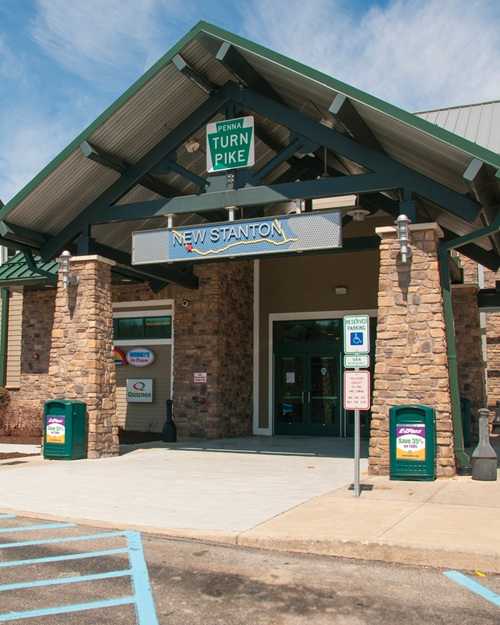
The Pennsylvania Department of Transportation recently opened the first of two federally-funded electric vehicle charging stations on the Pennsylvania Turnpike built using funds from the National Electric Vehicle Infrastructure or NEVI program.
[Above photo via PennDOT]
The first new station is located at the Blue Mountain Service Plaza at Exit 202 westbound on the Pennsylvania Turnpike. The second NEVI-funded EV charging station is at New Stanton, located at Exit 77 westbound.
This project was awarded from Alternative Fuel Corridor Round 1 of the PennDOT NEVI program. The next stage of NEVI funding, Corridor Connections, focuses on implementing EV charging stations along major roadways to strengthen long-distance travel outside of previously designated Alternative Fuel Corridors.
The two new EV charging stations are part of the PA Turnpike’s systemwide EV charging initiative. In partnership with Applegreen Electric, this program looks to add 80 new universal EV stations at all 17 service plazas by the end of 2027.
Beyond those new additions funded through the NEVI program, the PA Turnpike recently opened up new electric vehicle charging stations at North Somerset, South Somerset, and Hickory Run service plazas funded through the Pennsylvania Department of Environmental Protection’s “Driving PA Forward” program. All of those sites offer high-speed chargers, with a total of four charging ports per location, that support all EV types without the need for adapters.
“The Shapiro Administration’s goal is to use federal NEVI funds to build out an accessible and reliable EV charging network by meeting EV drivers where they are,” explained Mike Carroll, PennDOT secretary, in a statement.
“The Pennsylvania Turnpike is one of the state’s busiest roads for long-distance travelers, especially over the holiday season, and opening the first NEVI-funded charging station on the Turnpike exemplifies that goal,” he said.
“We are excited to continue offering more options for customers who want accessible, on-route EV charging,” added Mark Compton, CEO of the PA Turnpike.
“Our EV charging program offers reliable and convenient options along our roadway, improving customer experience while also reflecting our long-term commitment to being a good neighbor across the Commonwealth,” he noted. “Beyond meeting customer demand, supporting electric vehicle adoption enhances infrastructure resilience, supports renewable energy goals and reduces vehicle emissions.”
Tennessee DOT Heralds Success of ‘No Trash November’
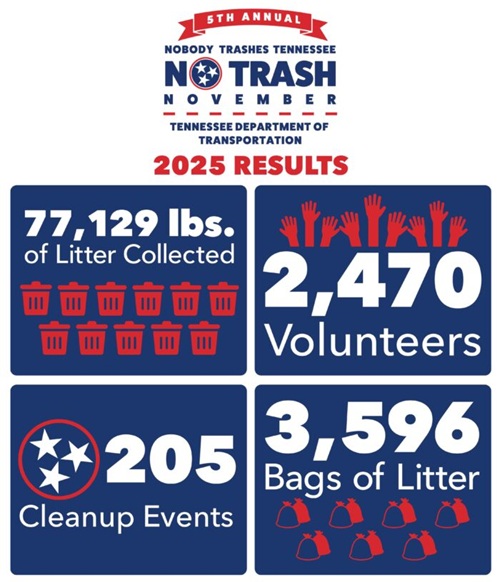
More than 77,000 pounds of litter were removed from roadsides and waterways statewide as part of the 5th Annual “No Trash November” month-long campaign sponsored by the Tennessee Department of Transportation.
[Above image by Tennessee DOT]
Throughout the month, 2,470 volunteers participated in 205 cleanup events, the agency said in a statement – collecting 3,596 bags of litter weighing a total of 77,129 pounds.
This annual cleanup initiative also brings together Tennessee DOT’s litter prevention partners and organizations, including Keep Tennessee Beautiful affiliates, Litter Grant recipients, Adopt-A-Highway groups, youth organizations such as Girl Scouts and Scouting America, and many others.
Tennessee DOT noted that youth groups can earn patches for their cleanup efforts through its Youth Patch Program: receiving a “Nobody Trashes Tennessee” logo patch for a scout’s first cleanup; the “Trashsquatch” patch, awarded for a second cleanup; and now the “Rocco the Raccoon” patch, for Scouts who complete their third cleanup service project.
The agency added that litter cleanup participants aged 13 and older may earn rewards for their litter prevention efforts through the Trash Masters Rewards program, which offers points for attending cleanup events, completing litter prevention quizzes, and spreading awareness. Points may be redeemed for discounts at local businesses and exclusive “Nobody Trashes Tennessee” merchandise, Tennessee DOT said.
Environmental News Highlights – December 17, 2025
Latest Dual-Language Wisconsin Highway Signs Unveiled
The Wisconsin Department of Transportation recently helped unveil the latest set of dual-language highway signs for placement on state highways to welcome travelers to Wisconsin’s tribal communities in both English and native languages.
[Above photo by Wisconsin DOT]
The sign unveiling took place at the Ho-Chunk House of Wellness in Baraboo with Governor Tony Evers (D) and Ho-Chunk Nation President Jon Greendeer. The event is part of a statewide dual-language sign initiative launched by Wisconsin DOT in 2021. Through this sign program, the Wisconsin DOT collaborates with the state’s tribal nations to install road signs on tribal lands in both English and Indigenous languages.
The new signs identify Ho-Chunk Nation communities and the Mississippi River in both the Ho-Chunk and English languages. The Ho-Chunk Nation is the ninth tribe in Wisconsin to install dual-language signs. In total, Wisconsin is home to 12 native nations, the agency said.
“We are honored to join the Ho-Chunk Nation in celebration of these dual-language signs and share the pride in their rich language and heritage,” said Kristina Boardman, Wisconsin DOT secretary, in a statement. “Our dual-language sign program is more than a transportation initiative; it’s a commitment to tribal sovereignty, cultural revitalization, and visibility.”
The sign-unveiling event builds upon ongoing work with the Ho-Chunk Nation, as earlier in 2025, Gov. Evers and Boardman joined the tribe to celebrate the designation of I-90 between La Crosse and Tomah as the “Ho-Chunk World War II Code Talkers Memorial Highway,” placing commemorative markers recognizing the individual Ho-Chunk Nation Code Talkers at the La Crosse and Sparta safety rest areas.
Arkansas DOT Building ‘Anti-Littering’ Highway Displays
The Arkansas Department of Transportation is building new “anti-litter displays” that will be rotated among several highway locations statewide in the coming months.
[Above photo by ARDOT]
Travelers along Arkansas highways will see a series of blue highway signs – made in-house by ARDOT employees – with anti-litter messaging. The first sign will read, “ARDOT spends over $8 million per year combatting litter.” A second one will say, “Are you part of the problem or the solution?” The third sign will read, “Please help us keep Arkansas natural.”
At the end of the three signs, the public will see five-foot-tall wire mesh letters spelling out “NATURAL?” The wire letters are hollow and will be filled with litter that has been picked up by crews in the area, the agency said.
“The average taxpayer may not know how much ARDOT spends each year picking up litter from our highways,” noted Steve Frisbee, ARDOT assistant chief engineer for maintenance, in a statement. “Our goal is to raise awareness for all Arkansans and travelers in our state.”
“Arkansas is ‘The Natural State,’ and we, as the Arkansas DOT, have a unique responsibility to help preserve the beauty that surrounds our infrastructure,” added Jared Wiley, ARDOT’s director. “In addition to the money we spend on litter pickup each year, we are always exploring new ways to combat the litter problem. We hope these litter letters resonate with the traveling public and spur positive change.”
Environmental News Highlights – December 10, 2025
TxDOT Prepares for Future with Statewide Transit Plan
The Texas Department of Transportation has unveiled a plan to improve and expand transit within and among urban, suburban, and rural areas through a multimodal transit network.
[Above photo by TxDOT]
The impetus behind TxDOT’s Statewide Multimodal Transit Plan is to meet the mobility needs of a population expected to grow 40 percent by 2050 in a large, rural state dotted with sprawling metropolitan areas. While TxDOT is building plenty of roads – investing nearly $12 billion worth in road-related construction in the last fiscal year – the plan says the Lone Star state will have to include more transit options in the future to accommodate a growing and changing population.
Most growth will be in the metropolitan areas of Houston, Dallas-Fort Worth, Austin, and San Antonio. “This mega-region is anticipated to grow in population by approximately 50 percent and will include nearly 80 percent of the total state population by 2050,” the plan noted.
Officially, the document is a draft plan and is subject to tweaks from an advisory committee and agency personnel before the administration rolls out a final version in early 2026, according to Adam Hammons, TxDOT’s media relations director. The 90-page document is the result of more than two years of stakeholder input, public meetings, and citizen surveys, he added.
The plan is a fact-filled survey of the Texas transit scene, overlayed with demographic information that will largely shape future needs. The sobering conclusion it reaches is that the transit systems are straining to meet current needs and face considerable challenges in planning for future demands.
“Transit in Texas is at a crossroads,” the plan noted. Rural and smaller urban transit districts don’t have enough money or workforce to maintain services and vehicle fleets, and big-city systems “are struggling to respond to growth beyond existing service boundaries.”
Nearly all transit in Texas is provided by 77 districts or authorities, collectively offering commuter rail, light rail, streetcar, bus rapid transit, fixed-scheduled bus, and on-demand services. About 90 percent of the 230 million transit trips a year in Texas are handled by eight Metropolitan Transit Authority agencies that are primarily locally funded.
Inter-city transit options in Texas are limited to commercial bus services and three Amtrak routes.
The Statewide Multimodal Transit Plan is “an acknowledgement that our economy and our population are growing exponentially, and we have to plan now for the future,” Hammons explained.
That future is partly based on “generational differences in transit needs, attitudes, and preferences,” the plan noted. Younger generations “show a greater desire for mobility options that include transit.”
One challenge is that wide expanses of Texas’ sparsely populated areas make it “difficult to provide efficient transit services without the density to support higher levels of use.”
The plan also carries a big price tag, as the capital costs of connecting every Texas municipality with a population of more than 10,000 by rail or bus could be $50 billion, with an estimated $5 billion in annual operating costs.
That doesn’t include the estimated capital costs of bus rapid transit ($30 million to $65 million per mile) or light rail transit ($200 million to $250 million per mile).
The plan does not specify how the system would be funded because it is meant to be a “conversation starter,” Hammons said.
“This is intended to be a way to get everyone to the table and talk about how we adapt to change and connect people in the future,” he said.
Hammons added that the agency is “kind of surprised” at implications that TxDOT isn’t involved in public transit. He noted that TxDOT has had a public transportation division since 1978 and sends more than $200 million to transit districts each year. That’s why he said this plan is further proof of TxDOT’s steadfast commitment to working toward a better transit system for Texas.
“A majority of people, 86 percent, said public transit is important in the state,” Hammons noted, referring to public surveys conducted in advance of the plan. “We heard what people said they want – better transit vehicles, shorter waiting periods. We heard where those gaps are and where those challenges are in terms of where we can grow in the next 30 years. The biggest thing now is to expand what we already have.”
Hammons emphasized that the plan is intended to be “a guide” to facilitate further discussion among stakeholders across Texas, and that no specific proposals for funding have been submitted to the legislature.
“We are an advocate for expanding transit in the future to meet that demand,” he said. “We are an advocate to adapt what we are doing and meet those needs. At the same time, this is a Texas plan, not a TxDOT plan. What we are saying is, ‘Let’s work together and build on what we have to prepare for the next 30 years.’”
DDOT Begins Speed-Management Pilot for Popular Trail
The District Department of Transportation, which oversees transportation for the City of Washington, D.C., recently launched a new pilot project to promote safety on the Metropolitan Branch Trail or MBT, one of the District of Columbia’s most popular multi-use trails.
[Above photo by DDOT]
The Lab @ DDOT, the agency’s in-house research team, is piloting two speed feedback signs at high-congestion points on the MBT: Alethia Tanner Park and the Rhode Island Avenue Metro entrance. Donated by Safer Streets Solutions, the signs use radar to anonymously detect vehicle speeds.
This pilot will test whether speed feedback signs can help slow vehicle speeds, reduce the concern for collisions, and enhance the experience for people using the trail – especially during busy hours.
As one of the District of Columbia’s most heavily used trails, the MBT plays a vital role in Washington, D.C.’s transportation network. As trail usage grows and faster, heavier e-bikes and e-scooters become more common, the risk of collisions and injuries – especially during peak hours – also increases.
In October, sensors detected approximately 5,000 trips per day during peak hours at high congestion points on the MBT from people walking, biking, and using micromobility devices. DDOT also noted that one out of five of those users travelled more than 15 miles per hour during that period.
The signs being used in this pilot test will display real-time messages to encourage users traveling faster than 15 MPH to slow down during peak hours. The Lab @ DDOT is measuring vehicle speeds before and after sign installation to assess the signs’ impact. They are testing different message formats such as text prompts like “SLOW DOWN” and visual icons like a frowny face to determine which are most effective in slowing vehicle speeds.
The belief is that promoting safer speeds can help ensure the trail remains a comfortable, accessible, and welcoming space for all users, explained Sharon Kershbaum, DDOT’s director.
“Expanding the MBT has been a huge priority and a major accomplishment for DDOT,” she said in a statement. “This pilot gives us an opportunity to test a simple, community-informed solution that could help reduce speeds and improve safety in some of the trail’s busiest areas.”
DDOT noted that this pilot program builds on insights gathered through interviews with trail users conducted over the summer by The Lab @ DDOT.
More than 40 trail users offered insights on how they felt about vehicle speeds on the MBT, how that influenced their sense of safety and wellbeing, and what they felt was their responsibility in keeping themselves and others safe on the trail. They also provided feedback on speed feedback signs and suggestions for messages that might resonate with trail users.
The DDOT said this pilot program will run through the end of 2025, with results expected in early 2026. If the signs are found to be effective at reducing speeds, DDOT said it may expand their use along the MBT and other multi-use trails across the District of Columbia.