WSDOT Wrapping Up Purdy Creek Fish Passage Project
The Washington State Department of Transportation is putting the finishing touches on a two-year fish passage project at Purdy Creek near Gig Harbor along State Route 16, which will help salmon migrate to spawning areas with greater ease.
[Above photo by WSDOT]
The agency noted in a statement that its fish passage work improves or replaces areas where roads and culverts hamper fish moving through waterways across the state.
This project is part of WSDOT’s extensive work to remove barriers to fish as part of federal court order issued in 2013; work that entails removing state-owned culverts that block habitat for salmon and steelhead fish species, allowing them to pass more freely through waterways to breeding areas, by 2030.
The agency noted that major work wrapped at the Purdy Creek project site in late 2024, with agency work crews observing in October and November pink and chum salmon in the creek near State Route16. Those crews are currently completing landscaping work at the site, WSDOT said; work that includes placing native plants along the stream to provide important nutrients into the ecosystem.
The department noted that the Purdy Creek project rebuilt the streambed under State Route 16; work that included realigning the stream, building a new embankment, and adding large tree trunks to the stream to provide refuge and resting areas for the fish.
The project also included a new bridge on State Route 302 Spur/Purdy Drive that was built in 2023 to replace a second culvert in the creek.
Federal Funds Help Nebraska Align Transportation Projects
The Nebraska Department of Transportation and the Omaha-Council Bluffs Metropolitan Area Planning Agency, known as MAPA, recently received a $2 million grant from the Federal Highway Administration to launch the “Transformative Regional Investment Prioritization System” or TRIPS to better align transportation projects with community needs.
[Above photo of Nebraska DOT’s Vicki Kramer by Nebraska DOT]
The Nebraska DOT said that the TRIPS program will change how transportation projects are “selected and prioritized” in the Omaha region; using a four-tiered assessment process to create a “transparent and equitable decision-making framework” to ensure those projects align with regional priorities and address the needs of the community for generations to come.
The agency added that the TRIPS program will also emphasize enhanced public engagement, empowering local communities to have direct influence on the region’s transportation future, with Nebraska DOT providing technical expertise and resources to ensure the program is successful.
“We are excited to collaborate with MAPA on this important project,” noted Vicki Kramer, Nebraska DOT director, in a statement. “TRIPS will help us make informed decisions that improve Nebraska’s transportation system and enhance residents’ quality of life.”
Several state departments of transportation have entered into similar partnerships in recent years to better align a variety of infrastructure projects with regional and/or local needs.
For example, in October 2024, the Maryland Department of Transportation in partnership with the Maryland Economic Development Corporation or MEDCO recently launched a new joint strategy to spur development along the Maryland Area Rail Commuter or MARC Penn Line; laying out a vision for denser, mixed-use communities around transit hubs between Washington and Baltimore.
The agency said this new transit-oriented development or TOD plan provides a “blueprint” for unlocking economic opportunities at six train stops within the MARC’s Penn Line corridor. The plan offers the potential to create at least 2,600 new housing units, generate some $1.7 billion in annual retail sales, and yield more than $800 million in tax revenue for the state over the next 30 years.
Environmental News Highlights – January 2, 2025
Oregon DOT to Build First I-5 Wildlife ‘Overcrossing’
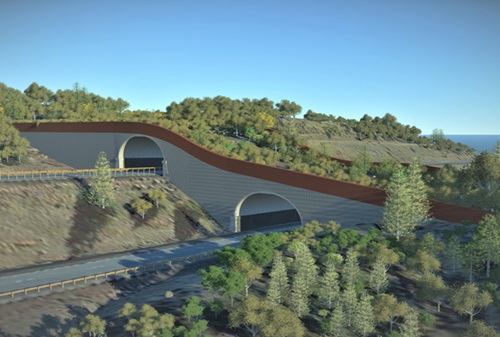
The Oregon Department of Transportation plans to build the first wildlife overcrossing of Interstate 5 in the wildlife-rich Mariposa Preserve in the Cascade Siskiyou National Monument, thanks to a $33.2 million federal grant.
[Above photo by Oregon DOT]
The agency said it has been planning the crossing for years to help reduce vehicle-wildlife collisions. Now, with the help of a grant from the Federal Highway Administration, the Oregon DOT can move to the environmental stage of the project, noted agency spokeswoman Julie Denney.
Image via Oregon DOT
“We have completed the design, and we are scheduled to begin construction in the 2028 construction year,” she said; noting that the agency will be contributing $3.8 million to this project.
“With this significant investment of federal funding, [we] can now provide a new connection for wildlife in an ecologically diverse area,” added Oregon DOT Director Kris Strickler in a statement. “This will improve safety for drivers on I-5 by reducing wildlife collisions. I want to thank our federal partners for making this project possible by fully funding ODOT’s grant request.”
The crossing will be about two miles north of the California border; a mountainous area inhabited by elk, deer, bear, and mountain lions. Existing culverts and areas under bridges on I-5 were poor candidates for development as wildlife underpasses, so Oregon DOT said it opted for an overcrossing, the state’s first such project.
“We’ve had successes with wildlife underpasses, most of which are in central Oregon along U.S. 97,” Denney noted. In those areas, she explained, “it’s much easier to tunnel beneath a highway there than it is in the mountains, which is a lot of rock.”
Image via Oregon DOT
There are about 6,000 vehicle-wildlife collisions each year on Oregon roads, the agency noted, and underpass wildlife crossings in Oregon have reduced those collisions in those areas by 86 percent; saving not only the animals, but significant money for the vehicle owners.
According to Oregon DOT, a collision with a deer can cost about $9,000; a run-in with full-sized elk can cost $24,000 in repair costs, towing, and medical expenses.
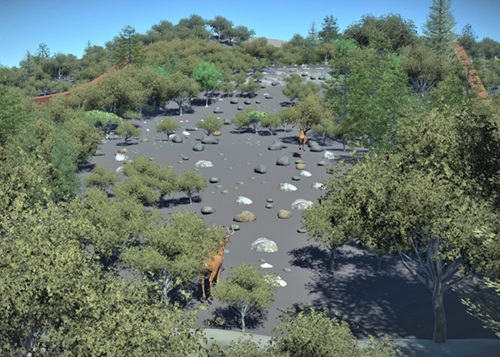
The I-5 crossing will be designed to resemble the natural surroundings, with trees, rocks and animal trails, according to an artistic rendition. Along each side of I-5, the project will include several miles of north-south fencing to funnel the wildlife to the crossing.
“We are excited about this project,” Denney said. “We feel we are catching up with other states and countries on crossings to protect these animals.”
ODOT worked with the Southern Oregon Wildlife Crossing Coalition, a group of governmental, nonprofit and tribal partners, that supported the wildlife crossing. The coalition produced a video about the crossing last year.
The grant to Oregon DOT was one of several the FHWA issued to state departments of transportation via its Wildlife Crossings Pilot Program in December 2024; a program funded by the Infrastructure Investment and Jobs Act of 2021. Other state DOTs that received grants include:
$626,659 to the Alaska Department of Transportation and Public Facilities to conduct a study that will develop a comprehensive solution to preventing vehicle collisions with moose along Glenn Highway; the state’s busiest highway.
$565,800 to the Arizona Department of Transportation to develop an online Geographic Information System or GIS mapping tool that will help identify wildlife-vehicle collision hotspots, analyze data about collisions, identify wildlife corridors for habitat connectivity, develop and prioritize projects, and build cost estimates to support future wildlife mitigation projects.
$6.1 million to the Florida Department of Transportation for a wildlife crossing and fencing along US-27 in southern Highlands County near the community of Venus.
$2.2 million to the Georgia Department of Transportation to develop an institutional framework that will integrate wildlife-vehicle reduction measures and habitat connectivity goals into transportation project planning and construction.
$21 million to the Idaho Transportation Department for three wildlife underpasses with eight-foot-tall fencing along six miles of US-30 at Rocky Point in rural Bear Lake County.
$9.3 million to the Maine Department of Transportation for a wildlife crossing using a pre-cast concrete arch culvert to provide passage for moose, deer, and other large wildlife in the city of Caribou.
$387,424 to the Maryland State Highway Administration – a division of the Maryland Department of Transportation – to develop a comprehensive plan designed to reduce wildlife-vehicle collisions statewide.
$1.7 million to the Massachusetts Department of Transportation to fund pre-construction design and permitting for a wildlife crossing project along the Appalachian Trail over Interstate 90 through western Massachusetts.
$467,376 to the Michigan Department of Transportation to collect ecological and transportation data needed to identify roadways that present the greatest risk to motorists and wildlife.
$900,000 to the Missouri Department of Transportation to design and construct multiple wildlife vehicle mitigation projects along Interstate 70 and Interstate 64.
$424,242 to the Montana Department of Transportation to study and develop plans to reduce wildlife vehicle collisions along 30 miles of US-93 from the Idaho border to Darby, MT.
$16.8 million to the Nevada Department of Transportation to build 61 wildlife crossings along US-93 and install 68 miles of barrier fencing aimed at reducing wildlife-vehicle collisions while connecting critical habitat for the federally- threatened Mojave Desert tortoise.
$323,850 to the New York State Department of Transportation to conduct a two-phase study about wildlife-vehicle collisions and ways to improve habitat connectivity.
$25 million to the North Carolina Department of Transportation for multiple wildlife underpass structures and fencing along US-64 in the Alligator River National Wildlife Refuge in Dare County.
In 2023, the FHWA issued $110 million in grants via the first round of disbursements through this program to 19 wildlife crossing projects in 17 states, including four projects overseen by Native American tribes.
State DOTs Kick Off Youth-Focused Litter Campaigns
The Missouri Department of Transportation (MoDOT) and Oklahoma Department of Transportation recently initiated litter prevention campaigns targeted at elementary through high school students.
[Above image via Oklahoma DOT]
MoDOT began encouraging students statewide in kindergarten through 12th to participate in the agency’s 2025 “Yes You CAN Make Missouri Litter-Free” trash-can-decorating contest. The contest is part of MoDOT’s annual “No MOre Trash!” statewide litter campaign, which will be held in April.
Image via MoDOT
The contest – which requires no entry free – encourages school-aged kids to join in the fight against litter by decorating a large trash can with the “No MOre Trash!” logo and a litter prevention message using a variety of creative materials. The agency said in a statement that schools, or home school programs, may submit one trash can entry in each competition category: grades K-2, 3-5, 6-8 and 9-12.
MoDOT said that participating school groups must submit a completed entry form online with up to three photos and a release form by March 14.
Entries are judged based on creativity, adherence to the contest rules and effective use of the theme and logo, MoDOT noted, with first-place winners from each competition category receiving a $200 award for the sponsoring schools. All first-place winners are then eligible for a grand prize of $600 and a trophy awarded to the sponsoring school, the agency added.
Image via OKDOT
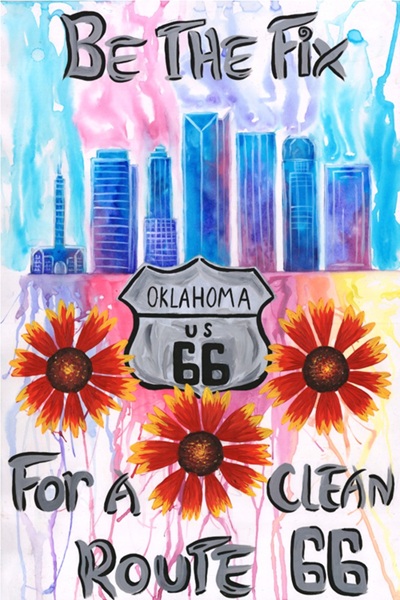
Meanwhile, the Oklahoma DOT recently kicked off its statewide Trash Poster Calendar contest, where winning artwork from kindergarten through 12th grade students will be included in the agency’s 2026 Oklahoma Trash Poster Calendar.
The agency said in a statement that its annual calendar showcases 14 student creations that promote litter reduction, especially along state highways.
Those winners will be rewarded with cash prizes: $300 for first place, $300 for the State Promotional Poster of the Year, $200 for second place, $200 for the Contest Entry Form Poster, and $150 for third place in each of the four grade divisions.
Students can enter in one of four categories based on their grade – K-2nd, 3rd-5th, 6th-8th, and 9th-12th – and must submit entries by January 31, 2026, to their local county Department of Environmental Quality office.
Local judging will take place in February or 2026 and winning entries will advance to the state competition in March 2026.
Environmental News Highlights – December 18, 2024
AASHTO Releases 5th Edition of Comprehensive ‘Bike Guide’
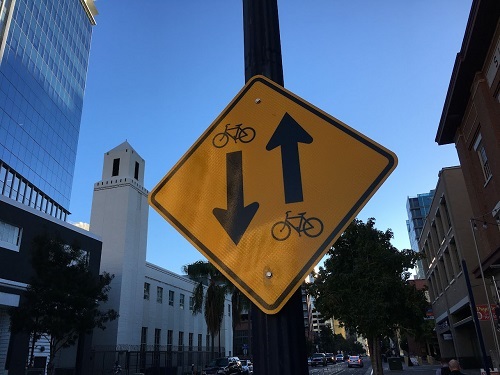
The American Association of State Highway and Transportation Officials recently released its “Guide for the Development of Bicycle Facilities, 5th Edition,” which provides information on the planning, design, and operation of bikeways along streets, roads, and highways, as well as on off-street paths in urban, suburban, and rural settings.
[Above image by AASHTO]
Developed by AASHTO’s Committee on Design and the Technical Committee on Non-motorized Transportation, the latest edition of what is colloquially known as the “AASHTO Bike Guide” provides preeminent engineering design guidance on the physical infrastructure needed to support bicycling for travel and recreation in the United States.
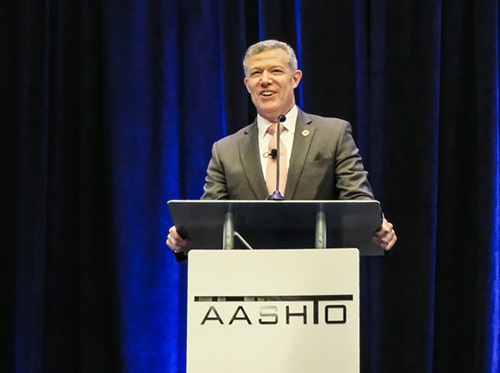
Jim Tymon. Photo by AASHTO.
“AASHTO and its members are focused on delivering safety, mobility, and access for everyone on our nation’s transportation networks and the AASHTO Bike Guide is one tool state DOTs and other transportation agencies can use to facilitate that,” said AASHTO Executive Director Jim Tymon.
“Communities across the country are all different, but the AASHTO Bike Guide allows each of those communities to learn how to grow, maintain, and operate their bicycle infrastructure – allowing for more transportation options for those who cannot or choose not to drive,” he said.
The guide encourages a flexible approach to design bikeways and emphasizes the role of the planner, designer, and engineer in determining appropriate bikeway types and design dimensions based on project-specific conditions and existing and future performance.
It provides information to assist in choosing the appropriate combination of features, design values, and materials to create the design, while considering the context of the project area and surrounding environment, AASHTO said.
This fifth edition of the “Bike Guide” features significant revisions and updates compared to the fourth edition published in 2012.
Photo by AASHTO
It contains a total of 16 chapters, including nine new chapters and seven revised chapters. Revised chapters include those on bicyclist operation and safety; bicycle planning; design of shared use paths; design of shared lanes and bike lanes; maintenance and operations; and bicycle parking, bike share site location, and end-of-trip facilities.
Meanwhile, AASHTO said the new chapters include guidance on choosing specific bikeway types; elements of design for all bikeway types; design of shared use paths; design of separated bike lanes and side paths; bicycle boulevard planning and design; design of shared lanes and bike lanes; traffic signals and pedestrian hybrid beacons; bicycle facility design at interchanges, alternative intersections, and roundabouts; rural area bikeways and roadways; structures; and wayfinding systems for bicyclists.
The new “Bike Guide” is available to order in paperback, as a PDF download, or in a set that includes both the paperback version and the single-user PDF download. To order a copy of this new publication, click here or visit the online AASHTO Store and search by the guide’s item code: GBF-5.
Publication of the nationally-focused “Bike Guide” is but one of the many ways AASHTO is working on behalf of state departments of transportation across the country to help develop and support more bike-focused travel options.
For example, state DOTs across the country develop bicycle routes, which AASHTO then officially designates within the U.S. States Bicycle Route System or USBRS.
In February 2021, AASHTO and the Adventure Cycling Association signed a memorandum of understanding or MOU to formalize their now 17-year partnership to create a national 50,000-mile bicycle route network.
Twice each year, AASHTO’s U.S. Route Numbering Special Committee reviews and recommends to the AASHTO Board of Directors revisions, additions, or deletions to the U.S. numbered routes and Interstate Highway System.
The special committee also reviews and recommends the approval of new and revised U.S. bicycle trails that are critical to the expansion of the USBRS.
Also, in October 2021, the AASHTO Council on Active Transportation began implementing a “research roadmap” finalized in July of that year to “prioritize and categorize” state DOT pedestrian and bicycle infrastructure investments in the near future.
That roadmap – developed via the National Cooperative Highway Research Program or NCHRP – seeks to focus on six specific areas:
Applying and integrating active transportation data into planning and operations;
Using minimum accommodations versus alternative approaches to increase active transportation;
Determining context-driven optimal spacing between marked crosswalks;
Addressing barriers to integrating active transportation throughout planning and engineering practice;
Racial and economic disparities in pedestrian and bicyclist safety; and
Speed management solutions and strategies to improve pedestrian and bicyclist safety on arterial roadways.
AASHTO Comments on Noise Abatement Proposals
The American Association of State Highway and Transportation Officials recently submitted a detailed six-page letter to the Federal Highway Administration commenting on the agency’s proposed revisions to “Procedures for Abatement of Highway Traffic Noise and Construction Noise” regulations issued in October.
[Above photo by FHWA]
AASHTO recognized in its letter that FHWA’s notice of proposed rulemaking or NPRM results from “years of FHWA research and feedback received from AASHTO in 2015 and 2019” on appropriate and effective noise standards to protect the public’s
health, welfare, and livability in the planning, design, construction, and operation of highways.
However, while AASHTO said it supports the proposed update to the federal noise abatement program, the organization stressed it is “concerned that the lack of detailed language” in the new definitions and clarification of rule changes will create challenges for state departments of transportation in implementing the final rule.
Graphic by AASHTO
[Editor’s note: A recent two-part series on “The Stream by AASHTO” podcast illustrated how state DOTs are working to minimize the impact of roadway noise in their respective areas of the country.]
“Additionally, AASHTO believes the proposed implementation timeline will impact the ability to develop state noise policies in compliance with this rule,” the organization added in its letter. “AASHTO supports restructuring [of the regulations] to better follow a state DOT’s noise abatement process and decision-making and clarify new and existing definitions.”
Also, while AASHTO supports increased flexibility for state DOTs to use modern abatement techniques and flexibility for screening and modeling, the association “believes the flexibility as framed in the NPRM is too vague and can result in downstream issues related to FHWA approvals and litigation. Therefore, AASHTO requests FHWA to include clear and concise guardrails on this flexibility in supplemental guidance documents.”
Many state DOTs are already experimenting on ways to reduce roadway noise via a number of infrastructure initiatives.
For example, in February, the Connecticut Department of Transportation began installing “quiet pavement” as part of a road resurfacing project.
The three-lane (each way) 6.7-mile stretch of I-95 from the New York state line to Stamford carries about 135,000 vehicles a day, much of it commuter traffic to and from New York City. This particular Connecticut DOT interstate paving project included a special asphalt mix designed to absorb more noise than concrete and last longer than traditional asphalt.
The impetus behind using this “quiet pavement” material derived from feedback from people who live and work in the area; they asked the agency to do something about the interstate noise, noted Connecticut DOT Commissioner Garrett Eucalitto at the time.
“We seek out resident, business, and stakeholder input when any project is undertaken,” said Eucalitto, who also serves as the 2024-2025 president of AASHTO. “These groups know the needs of the area and their insights are valued and appreciated.”
Maine DOT Offers New Online Safety Resource
The Maine Department of Transportation recently launched a new online resource aimed at cataloging its roadway safety efforts while buttressing the agency’s overall vision of a safe and equitable transportation system.
[Above photo by Maine DOT]
The new “2024 Safety Initiatives” online story map includes information regarding Maine DOT’s efforts to utilize “context-specific decision-making” in how the agency sets speed limits, manages roadway speeds, and implements its updated Complete Streets policy to ensure all transportations system users can get where they are going.
[Editor’s note: In a separate effort, the department recently awarded $2 million in state funds for support transit providers statewide as part of the Maine State Transit Plan, which seeks to increase service, improve information, remove barriers, and address the needs of underserved populations in rural Maine.]
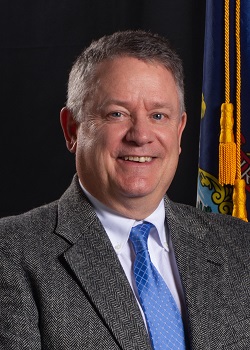
Bruce Van Note. Photo by the Maine DOT.
“At Maine DOT, we have always been early adopters of many safety-related practices, and these new tools represent an important step forward in the safety portion of our mission,” noted Maine DOT Commissioner Bruce Van Note in a statement.
“To keep improving safety for our customers, our team members continuously monitor national highway safety practices and programs to identify, test, and implement new measures that can make a real difference here in Maine,” he added.
The new online resource page includes several important key Maine DOT policies and tools, including:
Maine DOT’s new Roadway Context Classification System, including a map of context classifications statewide and an explanation of the different classifications.
Information regarding Maine DOT’s new speed-limit-setting process and speed management guidance including a set of traffic-calming measures and tools.
Maine DOT’s updated Complete Streets Policy, which now includes additional guidance regarding context-specific design elements that benefit safety, walking, and bicycling.
The page also includes information on Maine DOT’s updated Local Cost Share Policy. While not a safety initiative by itself, this policy does have impacts on how infrastructure and safety projects are funded, the agency said.
Other state departments of transportation are engaged in creating similar resources to address a host of mobility safety needs.
For example, the Maryland State Highway Administration (SHA) – a division of the Maryland Department of Transportation – is working to strengthen commitment to improve safety for vulnerable road users; defined as individuals walking, cycling or rolling, who are at a higher risk of injury or fatalities in crashes.
To better understand their challenges, the agency noted in a statement that it has launched an online statewide survey and is inviting public input through January 31, 2025.
The survey, conducted by the SHA’s Office of Traffic and Safety, will collect feedback to help guide future infrastructure decisions aimed at making Maryland’s roads safer for all users. Participants can use a digital map to pinpoint key locations, such as neighborhoods, workplaces and routes where enhanced biking and walking infrastructure would make a difference, Maryland DOT said.
Data from this survey will also play a key role within Maryland DOT’s “Complete Streets” policy, which prioritizes safe, reliable, equitable and sustainable travel across all modes to make roads safer and connect Marylanders to jobs, education and economic opportunity.
‘No Trash November’ Clears 70,000 Pounds of Litter
The fourth annual “No Trash November” cleanup event spearheaded by the Tennessee Department of Transportation removed nearly 70,000 pounds of litter from state roadways and waterways in 2024.
[Above photo by Tennessee DOT]
Part of the agency’s Nobody Trashes Tennessee campaign, the yearly “No Trash November” effort brings together Keep Tennessee Beautiful affiliates, Tennessee DOT grantees, Adopt-A-Highway groups, youth groups, water groups, and individuals who all work together to clean up trash as part of that state initiative.
All told, 2,412 volunteers participated in 175 “No Trash November” cleanups in 2024, collecting 3,207 bags of litter, weighing 69,776 pounds.
Photo by Tennessee DOT
The agency noted that litter on public roads and waterways has detrimental impacts on safety, the environment, and the economy. At any given time, there are 88 million pieces of litter on the state’s roadways and Tennessee DOT spends more than $23 million annually on litter pickup and prevention education; efforts funded through dedicated revenue from Tennessee’s Soft Drink and Malt Beverage industries.
“[These] community cleanups and individual actions taken [in November 2024] showcase what we can achieve when we work together to preserve our state’s beauty,” Michael McClanahan with Tennessee DOT’s Beautification Office noted in a statement.
“We encourage all residents to be a part of the solution to end littering,” he added. “Even small, simple actions can help, from reducing single-use plastics to recognizing that food waste is litter, every effort counts.”
State departments of transportation are involved in several beautification and trash removal efforts.
For example, three New Mexican state agencies – the New Mexico Department of Transportation, New Mexico Department of Tourism, and New Mexico Department of the Environment – recently awarded a total of $4.7 million in grants to 97 local entities to support litter removal and community cleanup projects as part of a new state beautification campaign.
New Mexico’s new “Breaking Bad Habits” campaign seeks to encourage state residents to preserve New Mexico’s “unparalleled landscape” by removing litter, preventing illegal dumping, and other related efforts.
In May, the Utah Department of Transportation launched a new volunteer litter removal program called “Keeping Utah Beautiful” – a program designed to make it easy for members of the public to go online and sign up for a one-time cleanup of state roads.
The agency said these volunteer cleanups will supplement the work of Utah DOT crews who regularly pick up litter statewide. To ensure volunteer safety, “Keeping Utah Beautiful” participants will not clean interstates or some state routes, the Utah DOT stressed – and requires that program volunteers be a minimum 14 years of age.
On another front, to make roadway debris removal operations faster and safer, the South Carolina Department of Transportation started installing “lane blades” on select highway incident response vehicles in 2023.
Meanwhile, the Mississippi Department of Transportation launched a new anti-litter webpage as part of a renewed statewide anti-littering campaign that kicked off in August 2023 – a “one-stop hub” that contains information about the state’s Adopt-a-Highway program, Mississippi litter statistics and resources, stormwater pollution information, anti-litter resources for school teachers, and much more.
And in April 2023, the Illinois Department of Transportation launched a new public outreach effort called “Think Before You Throw!” as part of its ongoing awareness campaign to reduce littering on state highways and roads.
That “Think Before You Throw!” initiative aims to reduce roadside litter along the state’s more than 150,000 miles of roads by raising awareness of the negative environment impact of trash, for both state residents and the nearly 100 million tourists who visit annually, the agency said.