
WSDOT Helping Launch New E-Bike Rebate Program

The Washington State Department of Transportation is launching a new program in April designed to make electrically-powered bicycles or “e-bikes” more affordable to state residents.

[Above photo by WSDOT]

WSDOT’s new program – launched with its newly-selected vendor, APTIM, LLC – will provide state residents with rebates  through point-of-sale discounts on e-bikes and associated safety equipment, with funding for the rebates from $5 million allocated by the state legislature within its 2024 supplemental transportation budget.

[Editor’s note: In early January, the Adventure Cycling Association, in partnership with the American Association of State Highway and Transportation Officials, recently announced a major expansion of the United States Bicycle Route System or USBRS, with four new routes being added in three states.]

”I am thrilled to share that following a competitive bid process in 2024, WSDOT identified APTIM to develop the technology and processes the agency needs to safely and securely manage the program,” said Adele Peers, who oversees WSDOT’s e-bike program, in a statement.

She added that APTIM has nationwide experience delivering e-bike rebate programs at the local and state levels for the cities of Boston, MA; Bentonville, AR; plus the Colorado cities of Boulder and Denver.

WSDOT noted that APTIM is currently finalizing the e-bike rebate program’s logistics – which includes training for bike shops participating in this endeavor – and is also building a secure online portal to accept rebate applications, distribute rebates, and reimburse bike shops for sales.

State departments of transportation across the country are involved in related “active transportation” efforts in support of various pedestrian and bicycling initiatives.
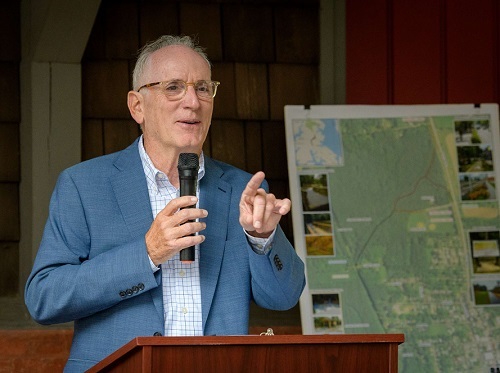
Maryland DOT’s Paul Wiedefeld. Photo by Maryland DOT.

For example, in September 2024, the Maryland Department of Transportation began developing what it calls a “landmark action plan” to improve and expand trail connectivity statewide.

The agency said this plan will guide future investment in shared-use paths, helping to advance efforts to reduce greenhouse gas emissions, boost alternatives to driving, and prioritize the safety of all road users across the transportation network.

And in May 2024, the Utah Department of Transportation issued nearly $95 million to support 19 trail projects – including the construction of new paved trails as well as funding for planning efforts to fill in existing trail gaps – as part of creating a regional “Utah Trail Network” across the state.

The agency said that it collaborated with communities statewide regarding the allocation of that funding – approved by the Utah Transportation Commission – to select the key projects for this statewide trail network.

Also, the Texas Department of Transportation is developing a Statewide Active Transportation Plan or SATP to gather recommendations for improving bicycling, walking, and rolling conditions across the Lone Star state.

TxDOT noted the SATP is being integrated with its other long-range mobility plans to help it maintain a safe, accessible, connected, and fully integrated multimodal transportation system for the future, since the population of Texas is expected to grow by 28 percent by 2050.

Environmental News Highlights – January 22, 2025

Oregon Issues $31M in ‘Safe Routes to School’ Funds

The Oregon Transportation Commission recently approved 28 Safe Routes to School projects, with a total investment exceeding $31 million, to help make travel safer for students within a two-mile radius of local schools.

[Above photo by Oregon DOT]

Those projects – funded through Oregon Department of Transportation’s “Safe Routes to School” competitive construction grant program – aim to address the “highest” transportation safety risks around local schools, remove barriers for students at low-income schools, and are the likeliest to be completed within five years. 

“It’s important to us to help students and their families get to school safely by foot or bike or mobility device,” said Suzanne Carlson, Oregon DOT’s Public Transportation Division administrator, in a statement.

“We are excited to support cities and counties who want to make these improvements in their communities,” she added – noting that the program has funded 104 construction projects since 2019, with nearly half of those projects completed and the other half in construction or design. “They’re making an amazing difference around the state,” Carlson noted.

Other state departments of transportation across the country support similar “Safe Routes to School” programs.

For example, in July 2024, the Ohio Department of Transportation issued more than $8 million to support 29 projects in 19 counties.

The agency noted that projects are selected by a committee made up of subject matter experts from Ohio DOT and the Ohio Department of Health based on the ability to demonstrate improved bike or pedestrian connectivity, improved safety, number of students impacted, economic need, and available funding.

And in June 2024, the Massachusetts Department of Transportation noted that 72 schools joined its “Safe Routes to School” program during the 2023-2024 academic year; boosting the total number of partner schools across Massachusetts to 1,171, facilities located in 284 communities and serving approximately 590,000 students.

NCDOT to Help Establish Wake Forest ‘Mobility Hub’

The North Carolina Department of Transportation is going to use federal grant funds to help the town of Wake Forest design and build a “mobility hub,” which will serve as the rail station for the S-Line passenger rail service​ starting in 2030 and provide last-mile connections to public transit and ride-sharing services, as well as walking and bicycling options. 

[Above photo by NCDOT]

The NCDOT is administering a $13.2 million Rebuilding American Infrastructure with Sustainability and Equity or RAISE grant from the U.S. Department of Transportation to help construct that “mobility hub” for Wake Forest; one of several serving towns in central North Carolina along the S-Line passenger rail corridor under development. 

That grant is one of 14 received state department of transportation projects in fiscal year 2025 round one RAISE grant funding issued by USDOT in early January.

NCDOT added that this recent funding builds on a more than $1 billion federal grant it received in December 2023 to design and construct the first segment of the S-Line from Raleigh to Wake Forest, which will create faster passenger rail service from Raleigh to Washington D.C. Using that grant, the NCDOT has already broken ground on plans to begin rail service to the town by 2030.  

NCDOT Secretary Joey Hopkins noted in a statement that this recent RAISE grant from USDOT will “help us provide more safe and reliable transportation options” for all state residents.

“We appreciate our federal partners for their work to prioritize transportation, which drives economic development and improves our quality of life,” he added.

“We’re grateful for this grant and the strong partnerships Wake Forest and all the towns along the S-Line have with the NCDOT,” noted Wake Forest Mayor Vivian Jones. “This grant secures some of the funding we need to build a mobility hub where passenger rail travelers will disembark and find ways to finish their travels through public transit, walking, biking and ride-sharing services.”   

Environmental News Highlights – January 15, 2025

Michigan DOT Turns Unused Land into Pollinator Habitat

The Michigan Department of Transportation is leveraging a grant to transform unused land near an interstate rest area into a 14-acre scenic strip of tallgrass prairie designed to attract pollinators.

[Above photo by Michigan DOT]

The agency-owned parcel is south of the Turkeyville rest area on southbound I-69, just west of the right of way, according to Michigan DOT Ecological Resources Specialist Kelsey Alvarado. The goal of the project is to create habitat for pollinators “to serve as a safe refuge and connector to other suitable habitat in the landscape,” she said.

Photo by the Michigan DOT

The 14 acres wasn’t serving any particular purpose, so the department decided to “allow it to function as a scenic strip once again and support pollinators at the same time,” Alvarado noted.

And, because the land is beyond the right of way, it is “an ideal location for a restoration project since it is not subject to the same roadside vegetation management standards as rights of way,” she added.

The $5,100 grant from the University of Illinois Chicago and Stantec will pay for a custom seed mix of grasses and flowering plants to attract bees, hummingbirds, and other pollinators, according to a Michigan DOT news release. The seed mix also will include native milkweed seeds that will be used to attract Monarch butterflies.

MDOT crews already have mowed and treated the scenic strip with a summer herbicide application. After applying a herbicide in the fall of 2024 and completing further treatment this spring, crews will sow seeds.

Alvarado said the wildflowers and other plants typically take up to three years to fully bloom. The scenic strip project “fits into Michigan DOT’s larger pollinator habitat management plan and conservation initiatives that aim to reduce negative impacts, improve existing habitat and create new habitat,” she noted.

This isn’t the first time Michigan DOT’s Pollinator Habitat Management program has utilized real estate near interstates for pollinators. Tall sunflowers flourish along I-75 near US 10 just west of Bay City, while wildflowers attract bees and hummingbirds at the Port Huron Welcome Center at westbound I-94.

Other state departments of transportation have developed programs to create habitat for and to protect pollinators, which play a critical role in the world’s food production.

For example, the Tennessee Department of Transportation mails milkweed seeds to state residents who request them to encourage Monarch butterfly activity; the Virginia Department of Transportation committed in 2024 to installing 135 acres of new pollinator habitats throughout the commonwealth; and the Texas Department of Transportation is studying the effectiveness of experimental butterfly diverters to save the nearly endangered Monarch butterflies from becoming roadkill.

FHWA Issues $635M in Electric Vehicle Charger Grants

The Federal Highway Administration issued $635 million in grants this week to 49 projects that support the ongoing effort to build out a national electric vehicle or EV charging and alternative fueling network.

[Above photo by PennDOT]

That grant funding flows from the $2.5-billion Charging and Fueling Infrastructure discretionary grant program and a 10 percent set-aside from the National Electric Vehicle Infrastructure or NEVI Formula Program.

The agency noted in a statement that $368 million of those grant funds will be allocated for 42 “community” projects that expand EV charging infrastructure in their respective locations, while $268 million will go towards seven “corridor” fast-charging projects that support a national charging and alternative-fueling network along designated Alternative Fuel Corridors.

Those grants – which support both electric charging and hydrogen refueling infrastructure – also dovetail with the U.S. Department of Transportation’s National Zero-Emission Freight Corridor Strategy that seeks  to reduce freight-related carbon emissions.

Several state department of transportation projects received funding from this latest round of grant awards:

  • The Maryland Department of Transportation – in partnership with the Pennsylvania Department of Transportation, the New Jersey Department of Environmental Protection, and the West Virginia Department of Transportation – will receive $18.6 million to deploy alternative fueling infrastructure along the I-81 and I-78 corridors across Maryland, Pennsylvania, New Jersey, and West Virginia. The project includes a plan to analyze medium and heavy-duty vehicle charging/fueling deployment, as well as the installation of six fast charging stations in locations that will serve local fleet needs and build out connections to a regional network of freight truck charging infrastructure.
  • The Massachusetts Department of Transportation will receive $14.4 million to install 472 EV charging ports, providing accessible charging for multi-modal transit trips and prioritizing disadvantaged communities near dense multi-family housing areas. The project addresses the lack of charging options for residents in multi-family dwellings, and includes education, workforce training, and community outreach.
  • The New Hampshire Department of Transportation will receive $15 million for a project to enhance public EV charging infrastructure across the state. The project will cover both urban and rural areas, aiming to improve access to EV charging across nine regions in the state. In total, the project will install 199 EV charging ports.

MassDOT Added 15 Miles of Shared Use Paths in 2024

The Massachusetts Department of Transportation added roughly 15 miles of new shared use paths in 2024; expanding multimodal connectivity and opportunities for recreation statewide while also enhancing pedestrian and bicyclist safety.

[Above image by MassDOT]

The 15 miles of new shared paths that opened in 2024 were the result of completed projects, either constructed by MassDOT or jointly funded through the MassTrails program, along 14 different trails statewide.

The agency added that, throughout the course of 2024, it also completed several roadway projects that added new bike lanes, sidewalks, shared use paths, and crosswalks.

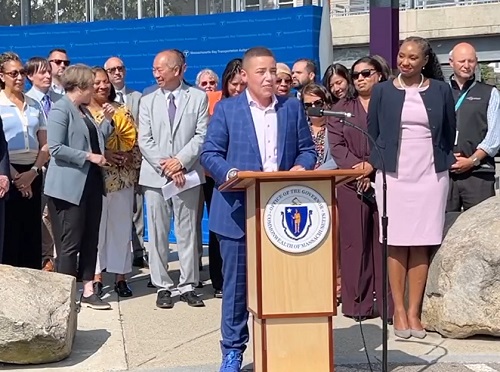
Monica Tibbits-Nutt at podium. Photo by MassDOT.

“Whether they are used for recreation or commuting to work, our multimodal paths play a vital role in making our transportation network cleaner, safer, and more inclusive,” noted Monica Tibbits-Nutt, MassDOT secretary and CEO, in a statement. “We are proud of the numerous tools and funding programs that we have put in place to keep fortifying our infrastructure in ways that benefit pedestrians and bicyclists across Massachusetts.”

“With these new routes, we are transforming how people move through their communities – offering pedestrians and cyclists safe, healthy, and sustainable ways to reach their destinations while actively contributing to Massachusetts’ ambitious climate goals,” added MassDOT Highway Administrator Jonathan Gulliver.

“This progress would not be possible without the vision and collaboration of stakeholders and community leaders, whose insights have been invaluable in creating a more connected and inclusive transportation network for all,” he said.

“Shared use paths provide the kind of connectivity that can foster better human interactions and revitalize communities,” pointed out Peter Sutton, bicycle and pedestrian coordinator at MassDOT.

“By removing barriers to walking and biking and making our roadways safer for all users, we are creating a more equitable transportation network for future generations of Massachusetts residents,” he said.      

MassDOT also plans to soon launch its Next Generation Bicycle and Pedestrian Vision Map; an initiative that will play a significant role in making walking and biking a more viable option for residents.

The agency said the development of this project has helped it identify “physical and quality gaps” when it comes to statewide multimodal connectivity, and this information will provide a roadmap for targeted multimodal investments in the future – supporting the strategy articulated in MassDOT’s “Beyond Mobility 2050” plan finalized in August 2024.

FHWA Issues Active Transportation Infrastructure Grants

The Federal Highway Administration recently issued $44.5 million in grants to 14 projects in 13 states and Puerto Rico via its Active Transportation Infrastructure Investment Program or ATIIP.

[Above image by FHWA]

The agency noted in a statement that ATIIP grants aim to support the planning, design, and construction of connected networks that lead to destinations and make communities safer for bicyclists and pedestrians while increasing access to public transit.

FHWA said state agencies, local and tribal governments, plus metropolitan and regional planning organizations can use ATIIP grants to plan, design, or construct safe and connected active transportation networks such as sidewalks, bikeways, and trails that connect schools, workplaces, transit, and other destinations within a community or metropolitan region.

Grants can also be used for projects to plan, design, and construct routes known as “transportation spines” that serve as backbones to connect two or more communities, metropolitan regions, or states.

Among the projects receiving grants via this round of ATIIP disbursements, the Puerto Rico Department of Transportation and Public Works received $2 million for its La Vereda Planning and Design project.

That project seeks to construct an active transportation network in the Hato Rey neighborhood of San Juan, which will include pedestrian and non-motorized connections linking jobs, schools, services, and recreational facilities to each other and the Tren Urbano rail system.

Environmental News Highlights – January 8, 2025