NCDOT Helps Activate Electric Aircraft Recharging Site
In late March, an electric aircraft charger was used to power up an all-electric airplane for the very first time in North Carolina at the Raleigh Executive Jetport in Sanford-Lee County.
[Above photo by NCDOT]
The Raleigh Executive Jetport and the North Carolina Department of Transportation helped BETA Technologies recharge its all-electric “ALIA” airplane as part of an electric aviation demonstration project.
The Charge Cube Level-3 fast-charger recharged the aircraft so it could take off and travel to BETA’s headquarters in Vermont. The Charge Cube is the state’s first station for charging electric aircraft, NCDOT noted.
“This is an exciting advancement for North Carolina’s aviation sector,” said Julie White, NCDOT’s deputy secretary for multimodal transportation, in a statement. “By embracing this infrastructure early, we are positioning our state to be a leader in advanced air mobility, attract business expansion and create new opportunities in aviation.”
This infrastructure site joins BETA’s expanding nationwide charging network, which now includes nearly 50 sites across the East, West and Gulf coasts.
[Editor’s note: The Utah Department of Transportation recently participated in a similar demonstration project with BETA’s ‘ALIA’ all-electric aircraft; an effort detailed in the video below.]
“A little over a year ago, we flew our prototype aircraft through Raleigh Exec [Jetport] on our way to our first military deployment,” said Thea Wurzburg, BETA’s state relations lead. “It’s special to be here … with our first production aircraft, charging at our new Charge Cube. North Carolina has long recognized the benefits of Advanced Air Mobility and we look forward to continuing to partner on this next phase of aviation.”
Environmental News Highlights – April 2, 2025
Utah DOT’s Five Decade Wildlife Protection Effort
When the Utah Department of Transportation built a wildlife bridge over the new Interstate 15 in 1975 near Beaver, it literally wasn’t front-page news. It merited only a brief mention on page five of the local paper, which called it “a project to aid reduction of deer highway mortality.”
[Above photo by Utah DOT]
Mirroring’s Utah’s reputation as a state of humble, hard-working pioneers (the state motto is “industry” after all), Utah DOT still tends to bypass the spotlight while quietly going about its work. It took 50 years for that I-15 overpass near Beaver to be widely recognized and celebrated as the first wildlife crossing over a highway in the United States.
Such projects have become almost commonplace in Utah; home to a variety of big mammals, reptiles, amphibians, birds – nearly everything from antelope to weasels. Today, it is estimated that Utah DOT has built more than 60 crossings and installed hundreds of miles of fencing across the state to keep wildlife and motor vehicles separated.
[The video below provides an overview of a wildlife crossing in Parley’s Canyon over I-80 opened by Utah DOT in 2018.]
“This is one of the most passionate issues we have. It really is a focus of the entire department,” said John Gleason, Utah DOT’s director of public relations. “You think about the destruction you can have if a vehicle hits a moose. These are the things we want to prevent.”
Preventing wildlife-vehicle collisions in Utah, however, isn’t simple. Long stretches of highways bisect arid deserts, mountain ranges, and dense pine forests in a state with more land mass than New England but less than a quarter of that region’s human population.
Recently, Utah DOT received a $9.6 million federal grant for wildlife safety improvements along US 40, which will pay for 23 miles of fencing and four wildlife underpasses. That news came weeks after the department installed three miles of fencing to funnel wildlife to an undercrossing near the I-80 and I-84 interchange, about 30 miles east of Great Salt Lake.
In southern Utah, the department will soon add three more wildlife underpasses and several miles of fencing along US 89, which crosses a natural migration route for the Paunsaugunt Plateau mule deer herd. In 2013, Utah DOT built seven wildlife underpasses along the route, and studies show thousands of animals have used them.
Not all the crossings are for big moose and deer, though. The department has built small culvert underpasses for the Mojave Desert tortoise, an endangered species only found in Utah, California, Arizona, and Nevada. Utah DOT also is planning tunnel-style crossings for Utah prairie dogs in the southern half of the state.
The fencing-and-crossing projects are successful because animals learn where the safe passages are, Utah DOT Natural Resource Manager Matt Howard said.
“Over time, they don’t even need the fencing. Once a few generations have passed, they go straight to the crossing,” he said. “We joke that it’s a lot easier to change wildlife behavior than human behavior.”
Utah DOT relies on wildlife behavior experts at the Utah Division of Wildlife Resources (UDWR) to help plan the projects. In fact, the Utah DOT-UDWR relationship goes far beyond the usual inter-agency cooperative agreements that are common on so many government projects.
“One of the keys to us having a successful program is our relationship with the wildlife agency,” Howard said. “It really started out as friendships, people who hunt and fish together. We never go more than three months without talking. We don’t have a lot of bureaucracy getting in the way.”
While Utah DOT has the engineering and construction know-how on these projects, UDWR understands animal migration, feeding, and mating patterns. Together, the agencies share expertise and research to plan the optimal types of crossing in the best locations.
“UDWR’s partnership with Utah DOT is critical in maintaining wildlife connectivity across the state by implementing projects that allow species to move freely across roads, which can be barriers to migration,” UDWR Migration Initiative Coordinator Makeda Hanson said. “Coordination and data-sharing between the two agencies help us work together to find solutions that improve both wildlife and human safety.”
For example, UDWR and Utah DOT wanted more data to plan the kinds of safety projects to build and exactly where to build them. One solution was The Utah Roadkill Reporter; a smartphone application introduced in 2022 that gets the public involved in reporting wildlife collisions.
Anyone can use the app to report where an animal was hit and killed by a motor vehicle in Utah. If it’s safe, a vehicle occupant can take a picture of the carcass and include it in the report, which alerts a crew to remove the carcass.
But the real payoff for Utah DOT and UDWR is that each roadkill report provides a wealth of information. The app prompts users to identify what kind of animal was killed, how old it appeared, and whether it was male or female. The agencies use that information to pinpoint when and where specific animals want to cross the road, which helps in project planning.
“The carcass pickups reported to the app have historically been the most-used data point to guide wildlife projects,” Howard said. “We also take into account collar data and law enforcement crash data.”
Citizens have filed almost 10,000 roadkill reports since the app was introduced in 2022.
While Utah DOT still spends the bulk of its budget on traditional road and bridge projects, Gleason said state residents are supportive of the wildlife safety projects. “With all the great work we’ve done in this area, the public wants more of these wildlife crossings, they want more wildlife fencing,” he said. “They want us to take the time to study the migration patterns and make sure, if we’re going to invest public dollars in a project, it makes sense to put a passing or fencing here. It’s all about making the best use of public funds.”
The Stream Podcast: Analyzing Recent NEPA Changes
The latest episode of the “The Stream by AASHTO” podcast features Ted Boling, who discusses recent changes to the National Environmental Policy Act, or NEPA, and the removal of regulations by the Council on Environmental Quality, or CEQ.
[Above image by AASHTO]
This podcast series is part of the AASHTO Environmental Management technical service program operated by the American Association of State Highway and Transportation Officials. It explores a wide array of environmental topics that affect state departments of transportation and the infrastructure programs they oversee.
In February 2025, the CEQ announced an Interim Final Rule that removes its longstanding NEPA implementing regulations from the Code of Federal Regulations. This shift places the responsibility for NEPA compliance directly on individual federal agencies, allowing them to follow their own procedures rather than a centralized set of rules.
In this podcast episode, Boling delves into how, if NEPA is revoked, it removes a “universal framework” that will prevent federal agencies working in tandem on environmental reviews.
Boling also outlines the potential impact of mass layoffs within the federal government, especially among senior leadership and recent hires, and how that could slow down decision-making regarding environmental reviews for infrastructure projects.
To listen to the full podcast episode, click here.
Environmental News Highlights – March 26, 2025
MassDOT Issues Rural Intercity Bus Grant Funding
The Massachusetts Department of Transportation recently issued $1.2 million in grants via its Rural Intercity Bus Connections program.
[Above photo by MassDOT]
The agency said this initiative aims to enhance accessibility and connectivity for residents in rural communities who depend on intercity bus services for essential travel to larger urban hubs. Since 2016, MassDOT noted it has awarded nearly $7 million through its Rural Intercity Bus Connections program.
“Reliable intercity bus service is a vital component of a comprehensive, equitable [transportation] network,” explained Monica Tibbits-Nutt, MassDOT secretary and CEO, in a statement. “We are fortunate to collaborate with partners who are both skilled and committed to delivering bus service that meets the needs of travelers.”
“Demand for intercity travel remains strong, which is why we want to identify and use every available tool to fill gaps in our transit network,” added Meredith Slesinger, MassDOT’s rail and transit administrator. “The routes that received funding are expected to significantly enhance regional connectivity, providing rural residents with more convenient and effective transportation options.”
Photo by MassDOT
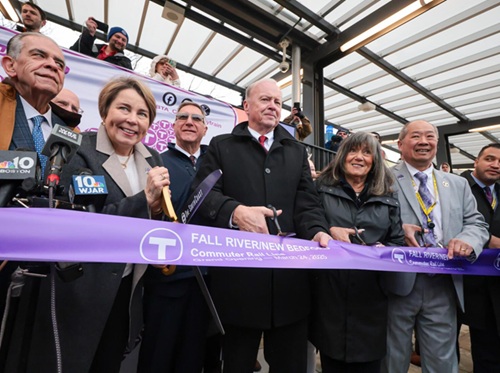
[Editor’s note: In a related effort, MassDOT and the Massachusetts Bay Transportation Authority recently launched the South Coast Rail commuter line. For the first time in over 65 years, the agency said cities and towns of southeastern Massachusetts will now have passenger rail service to and from downtown Boston.]
Slesinger also noted that eligible applicants for these MassDOT grants, including intercity bus carriers and regional transit authorities, can receive funding to subsidize services on routes serving rural areas – thereby improving links to urban centers for employment and healthcare access for residents living in those areas.
State departments of transportation across the country provide support to rural transportation providers in a variety of ways.
For example, in February, the West Virginia Department of Transportation started work on a major facility renovation project for Mountain State Transit Authority or MTA that includes overhauling the MTA’s headquarters and bus garage in Summersville, WV.
That renovation project aims to modernize and expand MTA’s Summersville headquarters, adding new office space and a room dedicated for bus driver training, as well as expanding the garage area to house more buses
And, in November 2024, the Ohio Department of Transportation issued grants of more than $17.5 million in grants to public transportation providers in rural and urban areas of the state to help improve workforce mobility.
Those grants went to transit agencies in 16 counties through its Ohio Workforce Mobility Partnership Program or OWMP; supporting 33 transit projects that increase the ease and efficiency of transporting residents to economically significant employment centers or places of employment outside of their home communities.
USFWS Seeks More Feedback on Butterfly Proposal
The U.S. Fish and Wildlife Service is reopening the public comment period for a proposed rule to list the Monarch Butterfly as a threatened species under the Endangered Species Act.
[Above photo by Martin Budd for USFWS]
Issued in December 2024, that USFWS proposal would not only add the Monarch to the list of threatened species covered by the Endangered Species Act but its habitats as well.
The proposed rule includes species-specific protections and flexibilities to encourage conservation of the Monarch under section 4(d) of the ESA. The comment period will be reopened for 60 days, until May 19, to give all interested parties an additional opportunity to comment on the proposed rule.
The agency emphasized in a statement that previously submitted comments do not need to be resubmitted as they are already incorporated into the public record and will be fully considered in the final listing determination.
The American Association of State Highway and Transportation Officials recently sent a letter to Paul Souza, USFWS director, regarding the agency’s proposal to designate the Monarch as an endangered species.
While AASHTO and the state departments of transportation it represents “support the protection of threatened and endangered species and the conservation of their habitat” – stressing that state DOTs have “a long-standing history” of supporting pollinator habitat and implementing pollinator and roadside beautification programs – there are situations where state DOTs need flexibility.
AASHTO highlighted several key issues with the USFWS Monarch endangerment proposal: a “lack of clear and concise details” that can create “ambiguity” for state DOTs due inconsistent interpretations of guidance; the addition of further “layers of review” during the environmental clearance process could lead to project delivery delays and budget uncertainty; and considerations involving “best management practices” for pesticide application, as state DOTs routinely apply pesticides as part of their standard roadside maintenance and vegetation management efforts.
AASHTO Comments on Butterfly Endangerment Proposal
The American Association of State Highway and Transportation Officials recently sent a letter to Paul Souza, director of the U.S. Fish and Wildlife Service (USFWS), regarding the agency’s proposal to designate the Monarch Butterfly (above) as an endangered species.
[Above photo via Wikipedia]
Issued in December 2024, that USFWS proposal would not only add the Monarch to the list of threatened species covered by the Endangered Species Act but its habitats as well. While AASHTO and the state departments of transportation it represents “support the protection of threatened and endangered species and the conservation of their habitat” – stressing that state DOTs have “a long-standing history” of supporting pollinator habitat and implementing pollinator and roadside beautification programs – there are situations where state DOTs need flexibility.
AASHTO highlighted several key issues with the USFWS Monarch endangerment finding: a “lack of clear and concise details” that can create “ambiguity” for state DOTs due inconsistent interpretations of guidance; the addition of further “layers of review” during the environmental clearance process could lead to project delivery delays and budget uncertainty; and considerations involving “best management practices” for pesticide application, as state DOTs routinely apply pesticides as part of their standard roadside maintenance and vegetation management efforts.
“AASHTO also recommends USFWS consider emergency repairs, upgrades, and replacement activities as exceptions so that during state or federally declared emergencies, state DOTs would follow emergency consultation procedures,” the organization added.
AASHTO also stressed that state DOTs have long been “actively involved” in the research and development of resources for the recovery and conservation of pollinators and their habitats; especially where the Monarch Butterfly is concerned.
For example, 19 state DOTs are currently enrolled in the nearly five-year-old Candidate Conservation Agreement with Assurances or CCAA. AASHTO supported this effort in a two-page letter to the U.S. Department of the Interior in March 2020; seeking “expedited approval” of voluntary national CCAAs to further encourage the creation of pollinator habitats in highway rights-of-way – especially the Monarch Butterfly.
“The regulatory protections provided by this CCAA allow transportation agencies to continue vegetation management practices with less concern that these actions will lead to an increase in the costs of regulatory compliance if the Monarch is listed under the ESA,” the organization said in its 2020 letter.
Additionally, AASHTO noted that state DOTs remain actively involved in the research and development of resources for the recovery and conservation of pollinators and their habitat – pointing to National Cooperative Highway Research Program Project 25-592, completed in 2022, that developed 16 regional guides and associated tools for implementing integrated pollinator programs.
“Even states without traditional pollinator programs still deploy best management practices, such as reduced mowing frequency, targeted herbicide application, strategic roadside maintenance to avoid breeding periods, and prioritizing native species for revegetation projects,” AASHTO noted in its letter to USFWS.
Additionally, the use of native plant species for pollinator habitats also provides “secondary benefits” to state DOT rights-of-way, AASHTO pointed out – notably by improving water infiltration, erosion control, roadside beautification, and weed control. “The current and ongoing conservation efforts of state DOTs, whether through the CCAA for the Monarch Butterfly or following standalone maintenance plans, will promote the mitigation of de minimis habitat loss [and] offset maintenance activities,” the organization stressed. “Subsequently, AASHTO believes USFWS should consider state DOT system maintenance activities as de minimis under these conditions and provide provisions for exceptions to those impacts.”
The Massachusetts Department of Transportation recently helped the MetroWest Regional Transit Authority or MWRTA acquire three new compressed natural gas or CNG-powered buses. Built by GILLIG, those buses will be assigned to MWRTA’s Route 4N – the busiest route in the MWRTA system – to provide service between downtown Framingham and the Natick Mall.
[Above photo by MWRTA]
The three buses were purchased with a combination of federal and state funds awarded to the MWRTA, including $392,000 through the Regional Transportation Authority or RTA Capital Program, which is funded through the annual state budget and is the primary means by which MassDOT supports RTA capital improvements and investments. Additional funding for this acquisition also came from partnership between the MWRTA, the Massachusetts State Legislature, MassDOT, and the Federal Transit Administration.
MWRTA – which plans to buy an additional 10 GILLIG buses over the next two years, including all-electric models – said its new CNG buses are 30-feet long and can hold approximately double the number of passengers compared to the units in the transit provider’s current fleet. The transit agency added that its new buses should start carrying passengers at some point over the next two months.
“As someone who relied on bus service to access a college education, I know firsthand the difference that better buses can make for commuters and those without personal vehicles,” noted Monica Tibbits-Nutt, MassDOT secretary and CEO, in a statement. “We congratulate the MWRTA on this important addition to their fleet and commend their commitment to improving the services that so many riders depend on to support themselves and their families.”
“We are pleased to help transit authorities like the MWRTA further modernize their bus fleets to better meet the needs of travelers,” said added Meredith Slesinger, MassDOT’s rail and transit administrator. “These investments are possible thanks to our ongoing collaborations with local, state and federal partners who are committed to making connectivity in Massachusetts better for the residents and communities who depend on it.”
State departments of transportation provide a wide range of support to transit providers and transit-related development in their respective regions of the country.
For example, the Maryland Department of Transportation recently created a new grant program to advance development projects near transit stations; a program that aims to spur economic activity and increase connectivity in communities statewide.
The agency said the first round of funding of the Transit-Oriented Development or TOD Capital Grant and Revolving Loan Fund includes $5 million to support local jurisdictions seeking to build “equitable and inclusive development” near transit hubs.
In January, the North Carolina Department of Transportation launched a new intercity bus route designed to coordinate with the Virginia Breeze bus service to better connect North Carolina and Virginia.
In November 2024, the Ohio Department of Transportation issued grants of more than $17.5 million to public transportation providers in rural and urban areas of the state to help improve workforce mobility.
Those grants went to transit agencies in 16 counties through its Ohio Workforce Mobility Partnership Program or OWMP; supporting 33 transit projects that increase the ease and efficiency of transporting residents to economically significant employment centers or places of employment outside of their home communities.
Also in November 2024, the Colorado Department of Transportation opened three new mobility hubs along I-25 between the cities of Longmont and Loveland. The agency said mobility hubs are places where multiple modes of transportation – cars, regional bus services, bicycles, pedestrians, and public transportation services, among others – seamlessly integrate to allow for quick “mode-to-mode” and “route-to-route” transitions, while enhancing the efficiency of first- and last-mile connections.