



TxDOT Environmental Review Uncovers ‘Megafauna’
During the environmental review for the Loop 88 highway project outside Lubbock, TX, planners with the Texas Department of Transportation made an interesting discovery – and promptly called in one of the agency’s archaeological teams to figure out what they found.
[Above photo by TxDOT]
“They found the bones of some large, prehistoric animals called ‘megafauna,’ which is not unusual in the region,” noted Chris Ringstaff, a project planner with TxDOT’s environmental affairs division, in a recent blog post.
He explained that the Panhandle area of Texas – where Lubbock is located – is home to many “playas” or remnants of lakes from the Ice Age. In prehistoric times, animals and humans used playas as water sources and these sites can sometimes contain evidence of human activity.
“If the site involves humans, we have to address road construction impacts under state and federal law,” Ringstaff said. “If the site has no artifacts and dates to a time well before humans, TxDOT will recommend no further work, and the project can proceed to construction.”
Given that Texas has other sites that show human activity with megafauna, TxDOT decided to take a closer look at the Loop 88 location. They opted for a process called “staged mitigation” that involves archeological excavation to look for human artifacts like chipped stone or spear points.
TxDOT said environmental staff and consulting archeologists excavated bones and took geologic and sediment samples for fine screening, with the agency also collaborating with the Museum of Texas Tech University for assistance with preparation, identification, and housing of the bones.
“We know we’ve found giant ground sloth by its distinctive tooth,” Ringstaff said. “Whether all the bones are giant ground sloth or there are different animals such as mammoth or mastodon, we’re not sure. Paleontologists will give us positive identification.”
Experts are examining the dirt collected around the bones for micro-artifacts and using geologic dating techniques to get a better idea of the chronology of the objects. Should the site reveal human activity with megafauna from the Ice Age, it would be first of its kind for a TxDOT project.
“Excavation is one of many steps we can take prior to road construction to ensure that Texas history is preserved,” added Rebekah Dobrasko, director of TxDOT’s cultural resources section.
Fortunately, even if further excavation is needed, TxDOT said work on the Loop 88 project is still well ahead of any physical construction deadlines – part of its planning work to ensure environmental reviews do not affect a project’s timeline.
“We’re here to get the road built,” Ringstaff said. “But who doesn’t love digging up big ol’ animals?”
Across the country, state departments of transportation are involved in a variety of cultural and archaeological efforts.
For example, in March, the Maryland Department of Transportation showed off a trove of “interesting artifacts” found at the Ben Ross home historical dig site; the place where the father of Civil War-era abolitionist Harriet Tubman lived and where she spent her teenage years in Dorchester County.
The agency said its archaeologists spent the past four years processing hundreds of artifacts collected from the Ross home, which is deep in the wetlands of the Blackwater National Wildlife Refuge.
In August 2024, the North Carolina Department of Transportation – in partnership with N.C. State University’s Institute for Transportation Research and Education – launched a two-year project aimed at mapping unmarked burial sites belonging to historically marginalized groups statewide.
In October 2022, the Kentucky Transportation Cabinet helped establish a new website highlighting more than 100 prehistoric and historic archaeological sites across the state’s 64 counties.
The agency launched that website – Discover Kentucky Archaeology – in collaboration with the Kentucky Heritage Council-State Historic Preservation Office, an agency of the Kentucky Tourism, Arts, and Heritage Cabinet.
And in January 2022, the Colorado Department of Transportation debuted a documentary called “Durango 550 – Path of the Ancestral Puebloans” to show how the agency worked with archaeologists and regional Native American tribes to document, study, and ultimately share the discoveries unearthed near Durango in southwest Colorado.
MassDOT Issues Millions in Community Transit Grants
The Massachusetts Department of Transportation recently issued more than $14.8 million through its fiscal year 2025 Community Transit Grant Program or CTGP to municipalities, Councils on Aging, Regional Transit Authorities, and various nonprofit organizations.
[Above photo by MassDOT]
In total, those grants will help 30 organizations purchase a total of 115 fully accessible vans and mini-vans to enhance mobility for older adults and people with disabilities.
MassDOT’s Rail and Transit Division manages the CTGP annually, with the funds for those operating and mobility management awards coming from the Federal Transit Administration and state Mobility Assistance Program or MAP funding.
The agency noted that, according to federal rules, federal 5310 funds can pay for up to 85 percent of the cost of each vehicle. Massachusetts’ Councils on Aging, nonprofits, and municipalities must pay a 15 percent match, while the state’s 15 Regional Transit Authorities are eligible for fully funded vehicles with state MAP funds providing a 15 percent match.
“Our administration is proud to partner with municipalities, non-profits, and local transportation providers to increase travel options for seniors and people with disabilities in every corner of the state,” said Governor Maura Healey (D) in a statement. “We look forward to seeing the impact these grants will have by making it easier for people to get to work, school, doctor’s appointments, the grocery store, and more.”
“[We are] deeply committed to expanding transportation options that support our age-friendly, accessible, and climate-resilient goals,” said Monica Tibbits-Nutt, secretary and CEO of MassDOT.
“This funding sends a clear and powerful message to older adults and people with disabilities: we see you, we hear you, and we are investing in your ability to travel safely, comfortably, and with dignity,” she said. “We are proud to partner with transit authorities, municipalities, Councils on Aging, and nonprofits who work tirelessly each day to ensure mobility and access for the people they serve.”
Environmental News Highlights – May 14, 2025
Maryland DOT Begins New Commuter Rewards Programs
The Maryland Department of Transportation recently launched two new regards programs via its Commuter Choice Maryland initiative, which is designed to lessen traffic congestion statewide while also reducing vehicle emissions.
[Above photo by David Trozzo for the Maryland DOT]
Under the new Baltimore Vanpool Incentive Program, vanpool commuters in the Baltimore area will now qualify for a $500 monthly incentive. Meanwhile, via the new Baltimore Carpool Incentive Program, commuters will receive a $5 daily incentive for 90 days.
Both programs are funded by the Maryland DOT and administered by Commuter Connections to encourage Baltimore-area commuters to start or join a carpool or vanpool.
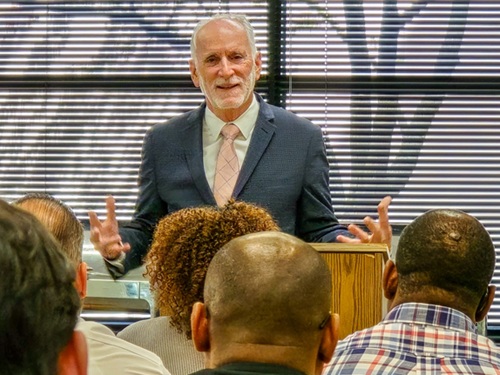
“Maryland commuters, business owners and commercial drivers continue to deal with the congestion impacts from the Francis Scott Key Bridge collapse,” noted Maryland DOT Secretary Paul Wiedefeld in a statement. “These new vanpool and carpool rewards programs are promoting and incentivizing alternative options to driving alone, saving commuters real money and reducing congestion impacts for the region.”
The agency added that state residents can also take advantage of CommuterCash as well; an all-new mobile application that helps travelers find optimal carpool, vanpool, transit, biking, and multimodal travel options.
Commuters can log their trips in CommuterCash and earn points that can be redeemed for cash, gift cards, or transportation credits, Maryland DOT said.
Across the country, state departments of transportation are working on a variety of commuter-related initiatives, often tied into emission-reduction efforts as well.
For example, in March 2025, the Massachusetts Department of Transportation issued $1.2 million in grants via its Rural Intercity Bus Connections program.
The agency said this initiative aims to enhance accessibility and connectivity for residents in rural communities who depend on intercity bus services for essential travel to larger urban hubs. Since 2016, MassDOT noted it has awarded nearly $7 million through its Rural Intercity Bus Connections program.
And, in March 2024, the Connecticut Department of Transportation opened a new parking garage at the Stewart B. McKinney Transportation Center in Stamford, CT; a garage that plays a key role in boosting multimodal links to the center’s transit options.
The new garage includes 92 electric vehicle charging stations; 120 bicycle parking spaces, including 50 e-bike charging stations. The project also included the reconstruction of the South State Street and Washington Boulevard intersection, making it safer for all roadway users; with upgrades that include new sidewalks, traffic signals, and thermal crosswalks.
Ohio DOT Distributing 13,000 Bicycle Helmets
This summer, the Ohio Department of Transportation will help distribute roughly 13,000 bicycle helmets to children statewide via the “Put A Lid On It” campaign – a statewide effort to get free bicycle helmets into the hands of kids who need them.
[Above photo by Ohio DOT]
With support from the Ohio Chapter of the American Academy of Pediatrics, the Ohio DOT, and American Honda Motor Company, the campaign is providing those helmets to 179 organizations in 61 counties across Ohio through pediatricians’ offices, local health departments, police and fire stations, schools, and many other community partners.
Since the program began in 2011, more than 100,000 helmets have been donated to help protect children while they ride bicycles, Ohio DOT noted.
Along with the helmets, groups receive bike safety training materials and guidance on how to properly fit helmets on children’s heads – making it easier for families to keep kids protected every time they ride a bike.
“Ohio DOT plays a key role in improving bicycle safety, from providing funding and other support to construct safe routes for bicyclists and pedestrians to supporting education and outreach,” said Ohio DOT Director Pamela Boratyn in a statement. “We’re proud to support the ‘Put A Lid On It’ campaign—it helps make helmet-wearing as routine as buckling a seatbelt and builds lifelong habits of safe riding.”
According to the Ohio State Highway Patrol, there were 1,337 bicycle-related crashes in the state in 2024, with 23 resulting in a fatality and 189 causing serious injuries.
Beyond this bike helmet program, Ohio DOT noted it also works with communities across Ohio to support active transportation through planning, education, and funding – part of a broader effort to help make it safer and easier for people of all ages to walk and bike where they need to go.
Environmental News Highlights – May 7, 2025
How TxDOT Preserved a Grove of Historic Trees
Six years ago, construction crews were preparing to remove a set of trees from alongside a highway project overseen by the Texas Department of Transportation. That is, until the agency learned that these weren’t just any trees; they were clones of the famous “Treaty Oak” in Austin, TX.
[Above photo by TxDOT]
Located in Treaty Oak Park in Austin’s West Line Historic District, the roughly 500-year-old “Treaty Oak” is the last living member of the Council Oaks; a grove of 14 trees that served as a sacred meeting place for Comanche and Tonkawa tribes.
Yet, as crews prepared to remove a grove of trees by a house along the US 281 Relief Route near Premont, TX, in 2019, TxDOT received a letter indicating that those trees were cuttings from the actual Treaty Oak made by local arborist Wash Storm, known as the “King of the Live Oaks.”
He made those cuttings after the poisoning of the original Treaty Oak in 1989 in act of vandalism – viewing the cuttings as a way to keep this piece of “living history” alive in some form.
“These trees are what I would consider to be one of the smaller stories that kind of make up Texas history,” noted Kimberly Amy, a TxDOT environmental project planner, in a recent blog post.
“So this is one of those smaller stories that I believe should be saved, should be retold,” Amy said. “Because you’re talking about someone that had an incredible amount of integrity and was selfless and wanted future generations to enjoy heritage trees. And we need people like that.”
Fortunately, the real Treaty Oak tree in Austin survived its poisoning – something that wasn’t expected when Storm planted his grove of Treaty Oak clones. [Incidentally, the vandal – Paul Cullen – was apprehended shortly after reportedly bragging about poisoning the tree to cast a spell. He was convicted of felony criminal mischief and sentenced to serve nine years in prison.]
However, even located far away from their biological parent, the cloned trees thrived in South Texas. And, after hearing about the historical significance of these cloned trees, TxDOT’s project team found a way to save them – shifting the new road and building a wall to protect them.
“We understood that this was something that was going to be important,” Amy said. “And I’m very proud [that TxDOT] was responsive to the fact that this was important to the community.”
Across the country, state departments of transportation are involved in a variety of efforts to preserve not only local history but local cultures as well.
For example, archaeologists with the Maryland Department of Transportation recently showed off a trove of “interesting artifacts” found at the Ben Ross home historical dig site; the place where the father of Civil War-era abolitionist Harriet Tubman lived and where she spent her teenage years in Dorchester County.
The agency said its archaeologists spent the past four years processing hundreds of artifacts collected from the Ross home, which is deep in the wetlands of the Blackwater National Wildlife Refuge.
In August 2024, the North Carolina Department of Transportation – in partnership with N.C. State University’s Institute for Transportation Research and Education – launched a two-year project aimed at mapping unmarked burial sites belonging to historically marginalized groups statewide.
In October 2022, the Kentucky Transportation Cabinet helped establish a new website highlighting more than 100 prehistoric and historic archaeological sites across the state’s 64 counties. The agency launched that website – Discover Kentucky Archaeology – in collaboration with the Kentucky Heritage Council-State Historic Preservation Office, an agency of the Kentucky Tourism, Arts, and Heritage Cabinet.
Additionally, in January 2022, the Colorado Department of Transportation debuted a documentary called “Durango 550 – Path of the Ancestral Puebloans” to show how the agency worked with archaeologists and regional Native American tribes to document, study, and ultimately share the discoveries unearthed near Durango in southwest Colorado.
Podcast: Michigan DOT Details Wildlife Crossing Efforts
On a recent episode of the “Talking Michigan Transportation” podcast, the Michigan Department of Transportation and Michigan Department of Natural Resources discussed efforts to implement a pilot program for analyzing wildlife-vehicle collisions (WVCs) and how to design safer roadway crossing infrastructure for wildlife.
[Above image by Michigan DOT]
Amanda Novak, a resource specialist in Michigan DOT’s Bay Region, discussed how the agency plans to use a recently awarded $476,000 federal grant to fund a WVC-prevention pilot program. She previously spoke about that grant award on the podcast in September 2024.
As laid out in the project abstract for the grant, the number of WVCs in Michigan continues to increase annually, worsening risks and costs to drivers. For example, white-tailed deer alone account for more than 55,000 WVCs and cost motorists an average of $130 million per year in Michigan. Additionally, WVCs are a major threat to many wildlife populations in the state, including documented impacts on several threatened and endangered species.
[Editor’s note: The video below from the New Mexico Department of Transportation explains the role wildlife crossings play in the protection both animals and the traveling public.]
“We are going to be looking at white-tailed deer across the state. There’s [also] one location we’ll be looking at elk crossings,” Novak said on the podcast. “In the UP [Michigan’s upper peninsula], a location we’ll be studying moose, black bear, wild turkeys, and the pine marten. Now, the pine marten falls in kind of that smaller species that doesn’t have as the impact on with wildlife-vehicle collisions, or on motorist safety, but collisions with these animals affects their population sizes. So that’s the pine marten, rattlesnakes, and the Blanding’s turtle specifically.”
Novak said her hope where this pilot project is concerned is that it encompasses all of Michigan DOT’s roadway corridors and figures out how to manage them for all species. “Not just looking at just these larger species where we have all the wildlife-vehicle collisions but mitigating for every [species] we can in those locations; managing all our corridors like this in some fashion,” she said.
Other state departments of transportation are involved in similar WVC mitigation efforts as well.
In October 2024, the California Department of transportation issued a Wildlife Connectivity Report that identifies more than 140 locations where roadways can be better integrated with the migration needs of animals statewide.
“Caltrans is seeking opportunities to better integrate our highway system with the state’s diverse natural environment” explained Tony Tavares, director of Caltrans, at the time.
“It is our responsibility to improve passageways for wildlife that live and migrate along our shared ecosystem, and remediation efforts highlighted in this report will help honor our goal to provide a world class transportation system that serves all people and respects the environment,” he said.
The Utah Department of Transportation recently outlined it’s nearly five-decade effort to mitigate WVCs statewide; a long-term effort by Utah DOT also included the recent development of The Utah Roadkill Reporter, which is a smartphone application introduced in 2022 that gets the public involved in reporting wildlife collisions.
And, in November 2023, the Wyoming Department of Transportation completed wildlife crossings built as part of its $15.1 million Dry Piney project.
The Dry Piney project – a joint effort between the Wyoming Game and Fish Department and the Wyoming DOT – includes nine underpasses and 16.7 miles of eight foot-high fencing on both sides of Highway 189 in the western part of the state to protect big game animals, primarily mule deer.