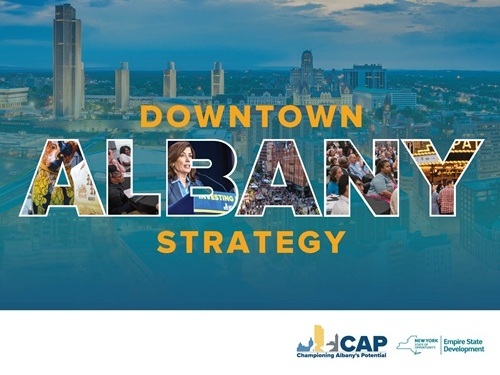
Governor Kathy Hochul (D) recently unveiled the Downtown Albany Strategy – a comprehensive, community-informed revitalization plan that is part of the $400 million Championing Albany’s Potential or “CAP” initiative – that includes funding devoted to projects focused on transportation improvements and enhancements to parks, public spaces, and neighborhood amenities.
[Above image via the New York Governor’s Office]
That strategy is backed by $200 million in state investments to guide coordinated action that will spur housing growth to attract new residents, create jobs, promote long-term redevelopment, enliven commercial corridors, and energize the public realm.
Developed with input from thousands of residents, workers, students, business owners, and community leaders, the Downtown Albany Strategy reflects extensive public engagement through workshops, stakeholder meetings, and focus groups and represents a vision for new economic growth guided by community priorities, the governor said.
“Downtown Albany has been a historic hub for more than 400 years, and I am committed to renewing its prominence not only to the region, but across our state and nation. This strategy will deliver transformational change and unlock its full potential,” Gov. Hochul said in a statement. “Through high-impact investments, strong partnerships, and clear growth targets, we are building a revitalized
downtown worthy of the Empire State’s capital city for residents, workers, and visitors alike.”
The strategy prioritizes focused investment in Albany’s downtown core to build momentum and leverage private development, serving as a foundation for broader revitalization beyond the city’s downtown boundaries. A central component of the plan is the redevelopment of Liberty Park, identified as a key opportunity for large-scale housing, public space, and neighborhood destinations.
The governor said the Downtown Albany Strategy is comprised of three targeted, high-impact public investments:
· Transformative Projects Fund ($120 million): Supporting major, marquee projects that elevate the downtown experience and energize public interest in downtown’s redevelopment progress.
· Housing Investment Fund ($40 million): Expanding housing options to keep and expand the number of downtown residents, creating a 24/7 community to support commercial growth and city services.
· Community Investment Fund ($40 million): Enhancing parks, public spaces, and neighborhood amenities.
Through strategic state investment and strong private-sector partnerships, the Downtown Albany Strategy will support housing development, small business growth, job creation, and safer, more active streets. The plan is designed to deliver visible, lasting improvements that strengthen Albany’s role as the economic and cultural center of the region, noted Marie Therese Dominguez, commissioner of the New York State Department of Transportation Commissioner.
“[NYSDOT] is proud to be working with the community on this initiative, which will have a multi-faceted, generational impact on the City of Albany and its residents,” she added. “Through transformative projects like the new Livingston Avenue Bridge and the re-imagining of the Interstate 787 corridor, we are already hard at work making it happen for the people who live and work in Downtown Albany.”
Several state departments of transportation have been involved in similar strategic initiatives that combine transportation improvements with other public enhancements.
For example, a new “street grid” reconnecting downtown Cincinnati to Queensgate, is one of several major “innovations” touted by the Ohio Department of Transportation and Kentucky Transportation Cabinet that is being incorporated into the $3.6 billion Brent Spence Bridge Corridor project. Meanwhile, in 2023, the Washington State Department of Transportation – in coordination with the City of Des Moines – provided a “much-needed makeover” to a popular 14-acre green space along Barnes Creek; an area used by local residents for a variety of outdoor activities.
This project also supported the city’s future plans for trail improvements through this corridor, while helping reduce impacts to wetlands and vegetated areas surrounding streams from the New Expressway Project.