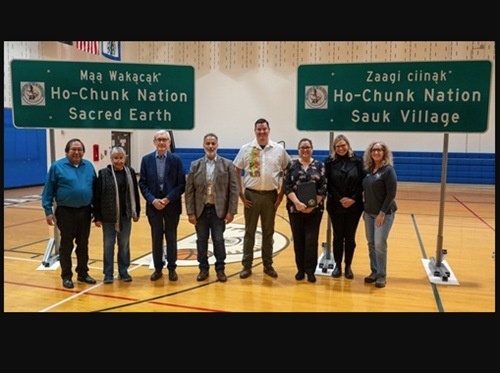
The Wisconsin Department of Transportation recently helped unveil the latest set of dual-language highway signs for placement on state highways to welcome travelers to Wisconsin’s tribal communities in both English and native languages.
[Above photo by Wisconsin DOT]
The sign unveiling took place at the Ho-Chunk House of Wellness in Baraboo with Governor Tony Evers (D) and Ho-Chunk Nation President Jon Greendeer. The event is part of a statewide dual-language sign initiative launched by Wisconsin DOT in 2021. Through this sign program, the Wisconsin DOT collaborates with the state’s tribal nations to install road signs on tribal lands in both English and Indigenous languages.
The new signs identify Ho-Chunk Nation communities and the Mississippi River in both the Ho-Chunk and English languages. The Ho-Chunk Nation is the ninth tribe in Wisconsin to install dual-language signs. In total, Wisconsin is home to 12 native nations, the agency said.
“We are honored to join the Ho-Chunk Nation in celebration of these dual-language signs and share the pride in their rich language and heritage,” said Kristina Boardman, Wisconsin DOT secretary, in a statement. “Our dual-language sign program is more than a transportation initiative; it’s a commitment to tribal sovereignty, cultural revitalization, and visibility.”
The sign-unveiling event builds upon ongoing work with the Ho-Chunk Nation, as earlier in 2025, Gov. Evers and Boardman joined the tribe to celebrate the designation of I-90 between La Crosse and Tomah as the “Ho-Chunk World War II Code Talkers Memorial Highway,” placing commemorative markers recognizing the individual Ho-Chunk Nation Code Talkers at the La Crosse and Sparta safety rest areas.