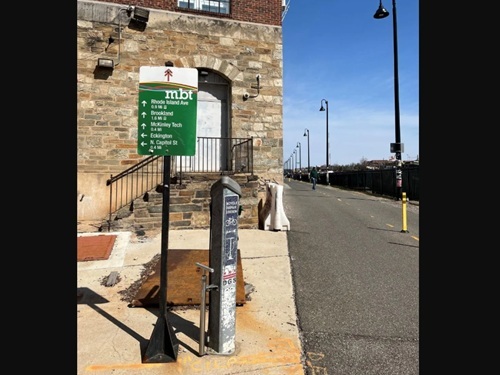
The District Department of Transportation, which oversees transportation for the City of Washington, D.C., recently launched a new pilot project to promote safety on the Metropolitan Branch Trail or MBT, one of the District of Columbia’s most popular multi-use trails.
[Above photo by DDOT]
The Lab @ DDOT, the agency’s in-house research team, is piloting two speed feedback signs at high-congestion points on the MBT: Alethia Tanner Park and the Rhode Island Avenue Metro entrance. Donated by Safer Streets Solutions, the signs use radar to anonymously detect vehicle speeds.
This pilot will test whether speed feedback signs can help slow vehicle speeds, reduce the concern for collisions, and enhance the experience for people using the trail – especially during busy hours.
As one of the District of Columbia’s most heavily used trails, the MBT plays a vital role in Washington, D.C.’s transportation network. As trail usage grows and faster, heavier e-bikes and e-scooters become more common, the risk of collisions and injuries – especially during peak hours – also increases.
In October, sensors detected approximately 5,000 trips per day during peak hours at high congestion points on the MBT from people walking, biking, and using micromobility devices. DDOT also noted that one out of five of those users travelled more than 15 miles per hour during that period.
The signs being used in this pilot test will display real-time messages to encourage users traveling faster than 15 MPH to slow down during peak hours. The Lab @ DDOT is measuring vehicle speeds before and after sign installation to assess the signs’ impact. They are testing different message formats such as text prompts like “SLOW DOWN” and visual icons like a frowny face to determine which are most effective in slowing vehicle speeds.
The belief is that promoting safer speeds can help ensure the trail remains a comfortable, accessible, and welcoming space for all users, explained Sharon Kershbaum, DDOT’s director.
“Expanding the MBT has been a huge priority and a major accomplishment for DDOT,” she said in a statement. “This pilot gives us an opportunity to test a simple, community-informed solution that could help reduce speeds and improve safety in some of the trail’s busiest areas.”
DDOT noted that this pilot program builds on insights gathered through interviews with trail users conducted over the summer by The Lab @ DDOT.
More than 40 trail users offered insights on how they felt about vehicle speeds on the MBT, how that influenced their sense of safety and wellbeing, and what they felt was their responsibility in keeping themselves and others safe on the trail. They also provided feedback on speed feedback signs and suggestions for messages that might resonate with trail users.
The DDOT said this pilot program will run through the end of 2025, with results expected in early 2026. If the signs are found to be effective at reducing speeds, DDOT said it may expand their use along the MBT and other multi-use trails across the District of Columbia.
 Active Transportation