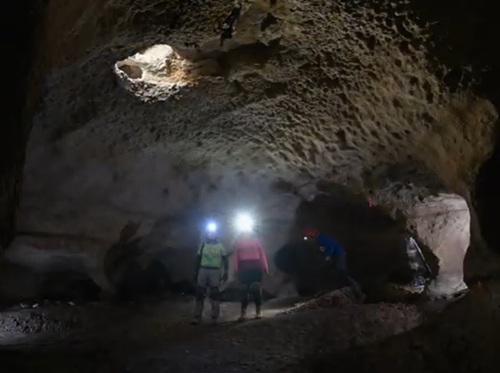
The Texas Department of Transportation recently detailed some of the broader insights gleaned from a bat cave mitigation project that the agency hopes to use for other endangered species across the state.
[Above image from TxDOT]
TxDOT shared that information during a webinar in February; part of a webinar series hosted by the American Association of State Highway and Transportation Officials Committee on Environment and Sustainability.
Texas is home to more than 300 federal and state listed endangered and threatened species, including millions of bats, invertebrates, birds, and large mammals. As a result, TxDOT always builds the state’s transportation infrastructure with one eye out for the needs of any such creatures living near it.
For example, a recent improvement project to State Highway 151 between Loop 1604 in San Antonio uncovered several types of endangered creatures living nearby – including rare species of spiders living in caves and karst features in the limestone bedrock.
To comply with the Endangered Species Act, offset their impacts, and keep the project moving, TxDOT got creative.
Enter the Wurzbach Bat Cave: an underground feature west of the project in a residential area. The cave provided the perfect spot to preserve and protect a space for the invertebrates and bats. However, there was a roadblock: the more than quarter-mile long cave sat 72 feet below a bustling neighborhood of houses and pools.
As a result, in 2023, TxDOT successfully purchased the undeveloped property with the cave’s entrance and most of the footprint of Wurzbach Bat Cave itself; marking the first time TxDOT bought residential land as part of a highway mitigation effort.
The department then transferred the deed for the cave area to the Texas Cave Management Association or TCMA, TxDOT’s partner, on the project.
[Editor’s note: TxDOT filmed a video about this project (seen below) as a part of its “Beyond the Road Campaign,” which tells stories about the agency’s natural, cultural, and community initiatives.]
With the Wurzbach Bat Cave successfully in the process of preservation, TxDOT and TCMA then had to figure out a way to attract bat colonies back to the cave’s ecosystem.
“At one time, [the cave] had 20,000 to 40,000 bats roosting here in the summer months,” explained Tim Kennedy, TCMA’s vice president, in a TxDOT video about the cave project.
Because of the cave’s fragile environment, Kennedy stressed that previous owners had built steel bars over its entrances to keep people from going in and damaging the area. However, those steel bars “also kept the bats out,” he said, forcing the winged mammal to search elsewhere to sustain their livelihood.
So TxDOT and TCMA joined forces once again, this time to design and install bat-friendly entrances on all four of the Wurzbach cave’s openings. With the new additions, Kennedy said that “we are just waiting to see if the bats will ever re-find the cave and recolonize this [area].”
Because of TxDOT’s partnership with TCMA, the cave will continue to be a safe haven for several of Texas’s endangered and threatened species, noted Juan Alacazar, a TxDOT environmental specialist and biologist, adding in the video that the habitat “is not going to be disturbed. It’s going to stay like this forever.”
 Wildlife and Ecosystems