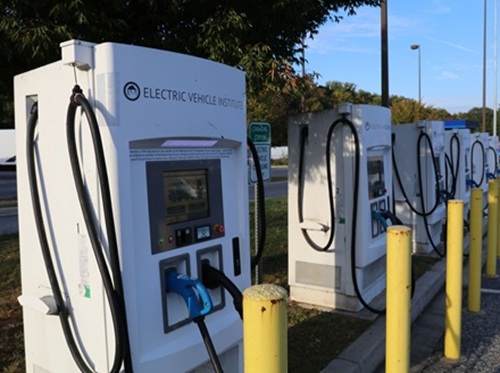
The Maryland Department of Transportation recently began soliciting applications for the third round of funding available through the federal National Electric Vehicle Infrastructure or NEVI program.
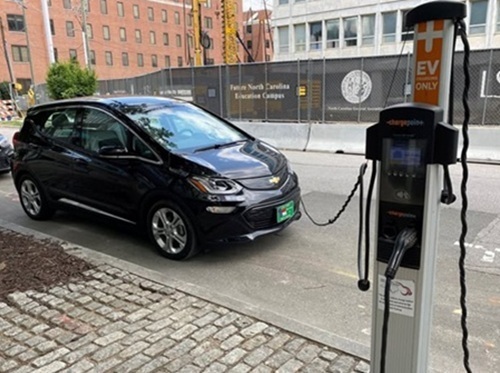
[Above photo by the Maryland DOT]
The latest round requests proposals for up to nine additional electric vehicle or EV fast charging projects along the state’s major highways and routes that are designated as EV Alternative Fuel Corridors.
Round three of the program will provide up to $10 million in federal formula funding to expand the statewide fast charging network, the agency said, with interested parties encouraged to submit a proposal no later than June 24.
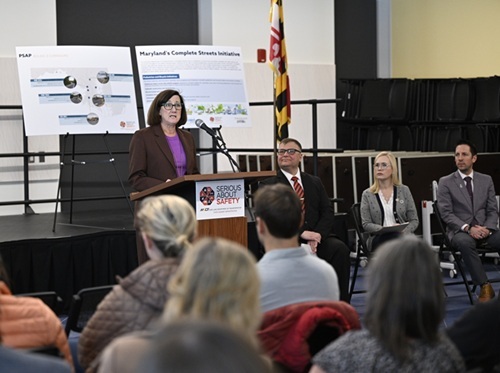
“Through [the] NEVI Program, Maryland is moving to make powering up an EV as easy as fueling up a gas-powered vehicle,” said Katie Thomson, Maryland DOT’s secretary, in a statement. “This is an exciting moment as Maryland helps meet the demand for wider access to sustainable EV charging across the state.”
Maryland DOT noted that its first two rounds of NEVI funding awarded a total of $19.1 million to 31 projects, supporting construction of 166 new Direct Current fast charging ports. To date, the agency said Maryland has seven NEVI funded EV charging sites open to the public located near major corridors in Anne Arundel, Cecil, Prince George’s, Wicomico, Carroll, Garrett, and Washington counties.
The department added that Maryland has more than 150,458 registered EVs and 5,302 public Level 2 and fast charging ports, according to the latest data compiled through the end of February 2026.
Other state departments of transportation has also recently made more NEVI funds available to support EV charger construction.
For example, in mid-March, the Pennsylvania Department of Transportation began funding 12 new projects to construct EV charging stations along major state roadways. That builds on the $54 million already committed to public charging stations across the Commonwealth through the NEVI program, with 30 EV charging stations already constructed and in operation. Additionally, there are 53 other EV charger stations in various stages of planning and construction, PennDOT noted.
“These projects will expand access to electric vehicle charging from our alternative fuel connections and bridge the gap between long-distance travel and community based chargers,” said Mike Carroll, PennDOT secretary, in a statement. “This is a critical step to improving relatability and access to meet the needs of EV drivers in the Commonwealth.”
 Electric Vehicles