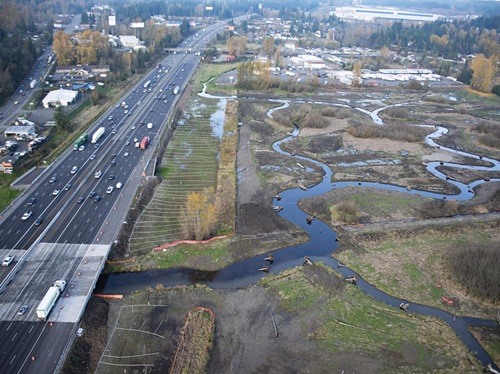
In September 2025, the Washington State Department of Transportation presented a case study analyzing the impact of toxic residue from tires on waterway environments at the Stormwater Summit hosted by the American Association of State Highway and Transportation Officials in Tempe, AZ.
[Above photo by WSDOT]
Tony Bush, stormwater branch manager for WSDOT, explained during a discussion about this case study that a particular type of contaminant from tires is the main cause of concern – 6PPD-Quinone or 66PD-Q.
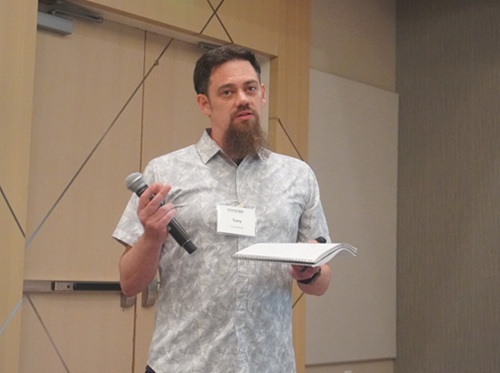
During this Stormwater Summit session, Bush highlighted an ongoing WSDOT project that seeks to protect Coho Salmon from exposure to 6PPD-Q as well as reduce pollution, address health disparities, and better protect waterway ecosystem health from 6PPD-Q contamination.
According to the U.S. Tire Manufacturers Association, 6PPD is a chemical considered critical for tire longevity and safety. It has been used in the tire industry for decades and is considered essential in protecting tire rubber from breaking down. It serves as an “anti-degradant,” in as such it protects tires from degradation due to exposure to ozone, oxygen, and ultraviolet light – preventing blowouts on the road and helping tires last longer.
However, Bush stressed that when 6PPD interacts with ozone, it transforms into 6PPD-Q – and that chemical composition is what harms waterway ecosystems. Bush added that stormwater runoff containing 6PPD-Q can expose a variety of aquatic organisms to this toxic chemical. Specifically, WSDOT said recent research studies found exposure to 6PPD-Q caused disorientation, injury, and even death of Coho Salmon attempting to swim upstream to their respective spawning areas.
Such poisoning and subsequent deaths would affect the longevity of Coho Salmon populations in affected waterways, that research indicated.
As a result, in 2023 the Washington State legislature dedicated $500 million over 16 years for WSDOT stand-alone stormwater retrofit projects with an emphasis on green stormwater infrastructure (GSI). Plans include retrofitting current high-priority untreated road segments for ecosystem health, salmon recovery, health disparities and cost effectiveness.
To address elevated roadways over salmon bearing waters, WSDOT is partnering with the Nature Conservancy and Stewardship Partners to design, implement and monitor bioretention planter boxes under bridge downspouts.
So far, three boxes have been installed in the greater Seattle area as part of a pilot project called “Box of Rain,” with the associated community maintenance effort entitled “Adopt-a-Downspout.” Both seek to reduce toxic pollutants from entering Washington State’s natural waterways. It entails deploying affordable, scalable, easy-to-install modular GSI under elevated roadways to treat stormwater and then return it back to the stormwater conveyance before entering the natural waterbody.
In 2027, WSDOT plans to construct its largest standalone regional stormwater treatment facility to date. This project will have the ability to treat both WSDOT and the City of Seattle’s stormwater under the I-5 Ship Canal Bridge in Seattle. WSDOT is also partnering with local organizations to build a community space – called the Georgetown Stormwater Interpretative Center – centered around GSI and extolling the co-benefits of such infrastructure initiatives.
Bush concluded by noting that WSDOT’s actions are “essential” to helping improve the viability of aquatic life in Seattle and Washington’s waterways and ensure they remain a thriving ecosystem for the future.
 Stormwater