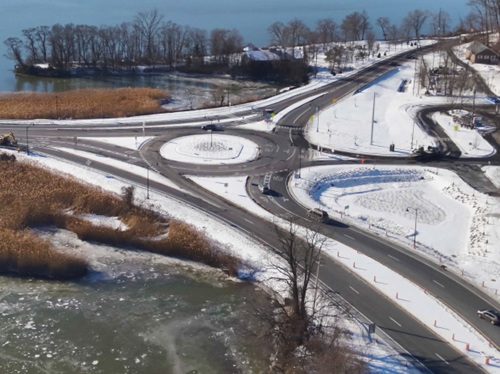
The New York State Department of Transportation recently completed a $25 million project in Westchester County that elevated a flood-prone roadway corridor through the use of recycled materials – a project that also created a new shared-use path for pedestrians and bicyclists as well.
[Above photo by NYSDOT]
U.S. Route 6/State Route 202 at Annsville Circle in Cortlandt is north of where Annsville Creek empties into the Hudson River and is part of a major commuter corridor for thousands of drivers in New York City’s northern suburbs. The roadway historically floods 10 to 15 times a year, usually during high tide, the agency said.
Floods and other climate consequences “can wreak havoc with our roads and bridges,” explained Governor Kathy Hochul (D) in a news release. “This flood mitigation project in Westchester County provides Hudson Valley travelers with a highway that’s better able to withstand severe weather events and will not continually fall victim to rising flood waters.”
Marie Therese Dominguez, NYSDOT commissioner, added that her agency is using “every tool in our arsenal to harden our infrastructure and make it more resilient. With this project at Annsville Circle, NYSDOT utilized its engineering prowess and state-of-the-art materials to elevate this important highway and give Hudson Valley travelers a road they can depend on in all kinds of weather.”
As a result, the department’s project elevated the traffic circle and a half-mile segment of roadway by using foamed glass – an aggregate material made of recycled glass. Using the lightweight material shaved one year of construction time off the project, which began in July 2024, the department said.
Foamed glass also has been used by several state departments of transportation in road construction and other applications. In 2024, the Arizona Department of Transportation used foamed glass to strengthen interstate culverts on I-17, and last year the Wyoming Department of Transportation used it to rebuild a 100-foot embankment lost in a landslide along Teton Pass highway near the Grand Teton National Park.
Foamed glass is lightweight, durable, fireproof, and waterproof, NYSDOT noted, and is manufactured by heating a mixture of crushed glass with foaming agents, which releases carbon dioxide, sealing the air cells in the glass and giving the material its durability.
To build the raised road, NYSDOT said it used geosynthetic reinforced soil technology, using the foamed glass, organic material, fabrics, grids, and meshes to strengthen the embankments and hold soil in place. The traffic circle was elevated by four feet and the adjoining highway by seven feet, the agency added.
During construction, the department also built a new shared-use path to give bicyclists and pedestrians access to the river and Annsville Creek Preserve, a trail along the Hudson River tributary that features scenic views and a fishing pier. The path also connects the Jan Peeck Bridge over the Annsville Creek to nearby businesses.
NYSDOT said the path totals 925 feet with a minimum width of five feet and a three-foot curb buffer to separate bikers and walkers from vehicle traffic. The new roundabout also features new LED street lighting and new pedestrian crosswalks, and in the spring, crews will add native trees, shrubs, and grasses.
The agency noted that this project was partially funded by a grant from the U.S. Department of Transportation’s Promoting Resilient Operations for Transformative, Efficient, and Cost-saving Transportation or PROTECT program. That grant also will help pay for a related initiative to raise an adjacent section of the roadway in 2027, NYSDOT said.
 Active Transportation