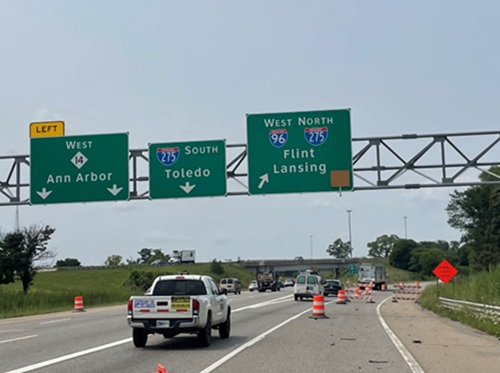
The Michigan Department of Transportation is studying noise levels from a four-lane divided highway in Ann Arbor, where residents complain that decibel levels have increased in the last few years – especially near an elementary school.
[Above photo by Michigan DOT]
That noise study is focused on a roughly one-mile stretch of M-14 in northwest Ann Arbor that encompasses an area where Wines Elementary School is located, Michigan DOT said. Two other schools are also in the study area, the agency added.
“We’re real excited that there’s potential action being taken because there’s a lot of noise here at Wines Elementary, inside and out,” noted David DeYoung, noted principle of Wines Elementary, in a Michigan DOT video about the project.
Michigan DOT has placed noise meters at the schools and in neighborhoods that are adjacent to the highway. The department said it will analyze the data and predict future noise levels through computer modeling that factors in traffic patterns, traffic speed, the number of commercial vehicles on the road, and geographic features.
Once the data are analyzed, the agency will prepare a study report that includes analytics on where along the route noise mitigation measures can help. The report will be presented to the public this spring, according to the noise study website.
[Editor’s note: In 2024, “The Steam by AASHTO” podcast aired a two-part series detailing how state DOTs are working to reduce roadway noise.]
“I heard from so many families that live in this area that the sound from the freeway was so distracting, disturbing and made it so that their kids couldn’t do their homework or go to sleep at night,” Michigan State Senator Sue Shink said in the Michigan DOT video, who pushed through a $3 million appropriation from the legislature for the agency to conduct this noise study and propose a remedy.
Although the noise study is still underway, Mike Davis Jr. – Michigan DOT’s project manager – said preliminary feasibility “is leaning toward a standard noise wall.” Because there is not yet a cost estimate on a noise wall or any other mitigation measure, Davis said the department’s goal “is to control the study and any design work costs as much as possible to have as much budget as possible for noise mitigation.”
The relatively recent reports of increased noise in the area are somewhat of a head-scratcher for Michigan DOT as well, Davis said, as the Wines Elementary school – built in 1960 – has been alongside the M-14 highway since it was built in 1965. The highway has also never been widened beyond its four lanes and traffic counts have remained steady at about 35,000 vehicles per day, he noted.
“Over the past several years, there have been many conversations concerning this section of roadway, with noise being one of those conversations,” Davis said.
The last major project on this part of M-14 was in 2024, when Michigan DOT applied a high-friction surface treatment on the roadway in response to a report showing 25 percent of crashes were occurring during wet conditions. Although the treatment was done as a safety project, it had the added benefit of reducing roadway noise.
“Our region does not have a solid theory why this became such a severe issue over the past few years,” Davis said. Their best guess is that the noise “has increased as the concrete pavement has continued to deteriorate.”
Despite having no definitive cause for the increased noise, Michigan DOT is moving forward with the noise study. “Like Mike said, there have been many conversations,” said Mark Sweeney, manager of Michigan DOT’s Brighton Transportation Services Center. “And, one way or another, they are all connected, and they all include a road noise component.”
 Traffic Noise
Hawaii DOT Installing Traffic Noise Detection Cameras
September 24, 2025 Traffic Noise