
North Carolina Shifting EV Charger Location Strategy

The North Carolina Department of Transportation is planning to reallocate National Electric Vehicle Infrastructure or NEVI formula program funds from building electric vehicle or EV charging stations along major interstates and highways to local communities, rural areas, and along highways where less EV charging coverage currently exists.        

[Above photo by NCDOT]

The agency said it is making this shift due to new U.S. Department of Transportation guidance for the NEVI program – established four years ago – issued in August 2025 that gives states greater flexibility to determine where EV charging stations can be placed.

“The revised guidance enables the department to focus its support for the build out of a statewide EV charging network in areas of the state where there are fewer chargers and greater needs,” said Daniel Johnson, NCDOT secretary, in a statement. “By focusing on areas of need, it helps ensure that all North Carolinians and those traveling in every corner of the state can access the EV charging network.”

The NCDOT noted it has received $109 million in total NEVI funding from the Federal Highway Administration to build out EV infrastructure along a network of approved alternative fuel corridors​ or AFCs and in communities.

The first round of the EV charging station buildout started in 2024, with five businesses now under contract to build and operate charging infrastructure along the state’s major highway corridors in those AFCs.

Those corridors are federally designated interstates and highways such as I-40 and U.S. 64 and as structured to strategically located to support alternative fuel vehicle travel, reduce EV owners’ range anxiety, and encourage cleaner transportation. 

NCDOT said it had originally planned to build 50 stations along the alternative fuel corridors. But the new NEVI guidance removed strict requirements like a stipulation that there be only 50-miles of space between charging stations along AFCs. 

Also, the new guidance allows states to consider where existing privately developed EV charging infrastructure exists so states can ensure the NEVI-funded projects will not be in direct competition with existing privately developed infrastructure. Since the NEVI program began, several private firms built and now operate EV charging infrastructure in areas within AFCs originally identified as possible sites for companies interested in applying for NEVI funds.         

“Most of North Carolina’s alternative fuel corridors are fully built out based on the existing charging stations and those charging contracts that have been awarded,” noted Heather Hildebrandt, NCDOT’s Statewide Initiatives manager. “We want to help ensure that the firms receiving NEVI funds will continue to be economically viable.”  

The agency plans in late March to issue a request for proposals for businesses interested in applying for NEVI funds to build and operate charging stations in those areas. Businesses interested in applying for funding will have 45 days to respond to the request. 

The NEVI Program is structured to reimburse private companies up to 80 percent of the cost to construct and operate electric vehicle charging stations for a five-year period, NCDOT noted. After five years, the charging stations will continue to operate without government support.
Arizona DOT Tallies Trash Collected by Volunteers

The Arizona Department of Transportation recently provided a summary of the litter collected and removed from state roads by its  Adopt a Highway volunteers during 2025.

[Above photo by Arizona DOT]

The agency noted that its Adopt a Highway groups receive two-year permits to clean up roadside litter on highway segments – usually a mile in each direction and largely in rural areas – that are deemed safe for volunteers. Those groups agree to pick up litter in an adopted stretch at least once per year but preferably three or more times a year – coordinating with Arizona DOT to arrange for safety vests, litter bags, and training for pickup events.

For 2025, Arizona DOT said 764 groups totaling 7,270 individuals spend 16,163 hours collecting and removing 12,876 bags of litter from state roadways – a cleanup effort worth $545,000, the agency said.

“We’re grateful to these civic-minded individuals and groups who dedicate time and effort to their adopted stretches of highway,” noted Mary Currie, Arizona DOT’s Adopt a Highway program manager, in a statement.

“We hope their contributions inspire others to follow their example by volunteering themselves, encouraging others not to litter and securing their loads,” she added. 

[Editor’s note: Currie detailed ways to get involved with Arizona DOT’s litter cleanup efforts during a December 2025 episode of the agency’s “On the Road With ADOT” podcast.]

Other state departments of transportation also recently shared the results of volunteer trash removal efforts for 2025.

For example, the Delaware Department of Transportation and its partners collected 82,467 bags of trash from roadsides statewide in 2025, along with 4,977 tires, 5,069 signs, and 196 appliances, as part of the ongoing Keep DE Litter Free cleanup campaign.

The agency noted that litter removal efforts in 2025 were conducted by its maintenance and operations employees, Adopt-A-Highway and Sponsor-A-Highway efforts, the Work a Day Earn a Pay Program, and with help from the Inmate Work Program overseen by the Delaware Department of Corrections.

Meanwhile, more than 77,000 pounds of litter were removed from roadsides and waterways across Tennessee as part of the 5th Annual “No Trash November” month-long campaign in 2025; an effort spearheaded by the Tennessee Department of Transportation.

Throughout November of last year, 2,470 volunteers participated in 205 cleanup events, the agency said in a statement – collecting 3,596 bags of litter weighing a total of 77,129 pounds.

Environmental News Highlights – January 28, 2026

Transportation Archaeologists Dig into History: Part 2

As the Alabama Department of Transportation plans to start work on the long-awaited $3.5 billion Mobile River Bridge and Bayway project to replace an outdated and overused tunnel and bridge along I-10, key archeology work is being completed. (To read part 1 of this story, click here.)

[Above photo courtesy of the University of South Alabama Center for Archaeological Studies.]

While different generations of the project have been on the drawing board for nearly three decades, ALDOT had to yield the site to a team of archaeologists to preserve any significant historical resources of Mobile – a city founded in 1702 that once served as the capital of French Louisiana.

It’s a scene repeated across the country as state department of transportation engineers work side-by-side with archaeologists to preserve the history beneath us before major infrastructure is built.

“All [state] DOTs make every effort to avoid any area with historical sensitivity,” explained Tony Harris, chief of the ALDOT Media and Community Relations Bureau. “When you can’t do that, it’s important to identify the history in the area, explore it and preserve it to the greatest extent possible.”

Because of the significance of the area, ALDOT called on the University of South Alabama Center for Archaeological Studies to manage the exploration. The archaeology team eventually excavated 15 sites, uncovering geographic changes along the Mobile River, long-forgotten buildings, and tons of artifacts, some dating back more than 2,000 years.

“We’re hoping that this project not only gives us a picture of the past, but tells us, ‘How did that past inform the present?’” said Dr. Philip Carr, director of the center. “We’re looking explicitly at that, even at what that past may tell us about the future. Decisions that were made in the 19th century about land filling have a lot to do with why Mobile floods today.”

Erica Schneider – assistant environmental administrator for the Ohio Department of Transportation, who also serves as chair of the Cultural Resources Subcommittee within the Committee on Environment and Sustainability for the American Association of State Highway and Transportation Officials – added that state DOT archaeologists work closely with their states’ historical preservation office to avoid shutting down transportation projects.

“If we find out a project will have an adverse effect on a site, we’ll work to develop mitigation efforts,” she said. “A lot of times, we can do data recovery, so we can go in and excavate the site. There’s often a public education component, too.”

In Alabama, Dr. Carr’s team eventually uncovered more than 400,000 artifacts from the site, including old military cadet uniform buttons, a dinner plate from the French Colonial period, thousand-year-old pottery shards, and Quin Dynasty coins from China. The center has created a website for the public to see some of the treasures.

Dr. Carr also said he received “great cooperation” from ALDOT during the process.

“They have been proactive, they have made sure the resources we needed…fencing, silt fencing, access to the properties, anything, that gave us access to the resources so we could do it right.”

The construction project – the largest in Alabama history – will include a 215-foot cable-stayed bridge, which would be the second-tallest cable-stayed bridge in the country, after the Golden Gate Bridge. Crews also will build a new bayway bridge over Mobile Bay that will be 10 feet taller and carry double the traffic of the old bayway.

A design-build team has been identified, and construction should get underway in 2026. Even though the archaeological work may have kept some construction from being done sooner, Harris said preserving the history of an area is “much more than a requirement” of the environmental process.

Sometimes, as in the Mobile project, work can continue once the cultural resources have been identified, catalogued, and preserved. Occasionally, sites prove to be too significant to be disturbed, and the only option is a no-build option.

Schneider was part of an assessment team in 2015, when Ohio DOT was planning a large corridor project in southwestern Ohio. The project footprint included several Native American sites, including a village that pre-dates European contact.

“It is essentially a multi-component prehistoric habitation, which means people lived there on and off during multiple prehistoric periods over hundreds of years,” she said. “We also know, based on previous excavations by others, that there are burials related to those occupations in this area. Based on geophysical surveys we conducted, we suspected the potential for hundreds of burials in our project area, alone.”

The archaeological finding was a big reason Ohio DOT chose the no-build option. The department later developed smaller, more targeted projects in the region, a decision that wound up serving the transportation needs of the region while respecting the history of the land.

“I think it’s important that we understand or try to understand the history of the people who came before us,” said Schneider, “I think we have an obligation to make that available to the public, to the masses. It’s like any other finite resource. When it’s gone, it’s gone.”

Dr. Carr said he was especially proud that his archaeological team was able to accomplish so much in less than two years of excavation.

“Not slowing down construction – that’s a point of pride for me,” he said. “I’m a Mobilian, and we need a new bridge. I didn’t want to slow it down.”

Maryland Launches MD 295 Commuter Pilot Program

The Maryland Department of Transportation, through its Commuter Choice Maryland Program,  recently launched a new transportation demand management initiative designed to promote alternative transportation options for businesses and commuters along a five-mile segment of MD 295 – helping improve travel reliability amid impacts from the collapse of the Francis Scott Key Bridge in 2024

[Above photo by the Maryland DOT]

Commuter Choice Maryland is a statewide Maryland DOT program dedicated to reducing traffic congestion and improving commutes for all Marylanders. The program supports employers and commuters with resources that make commuting easier, safer, cheaper and more sustainable.

The agency said that the MD 295 pilot program will partner with employers to encourage alternatives to driving alone; with Maryland DOT using targeted outreach and employer engagement to educate businesses and employees on available commuting options and incentives. The initiative is designed to help employers along the corridor, between West Nursery Road and I-95, provide best-in-class commuter benefits that support employee retention while identifying which strategies have the greatest impact on easing congestion.

[Editor’s note: This is the latest of several new initiatives launched by Maryland DOT under this program to encourage alternative commuting options in the City of Baltimore and other areas of the state.]

The MD 295 corridor is home to a diverse mix of work sites, including schools and medical facilities that support essential services. However, since the Key Bridge collapsed nearly two years ago, that corridor has experienced reduced travel reliability and slower speeds.

As a result, Maryland DOT adjusted construction schedules, modified traffic patterns, plus introduced new incentives to ease congestion and improve safety – with this corridor pilot program building on those efforts by promoting commuting alternatives.

“It is critical to help commuters find solutions to reduce stress and congestion – both after the Key Bridge collapse and during the rebuild,” said Katie Thompson, Maryland DOT’s acting secretary, in a statement. “That includes providing real-time information, expanding travel alternatives and connecting commuters with new resources and incentives.”

Environmental News Highlights – January 21, 2026

Transportation Archaeologists Dig into History: Part 1

Before a construction crew can build a road, a transportation archaeologist often must reconstruct the history of the ground it’s being built upon. This is the first of a two-part series that digs into that process.

[Above photo courtesy of the University of South Alabama Center for Archaeological Studies.]

The National Historic Preservation Act of 1966 mandates that states must consider a federally funded transportation project’s effects on any site that is listed or may be eligible for listing on the National Register of Historic Places. Usually, the only way to find out if a site is eligible is through an environmental assessment, which includes a survey of cultural resources.

“We first do a literature review and check the historic preservation office – all states have a historic preservation office,” said Erica Schneider, assistant environmental administrator for the Ohio Department of Transportation. “We’ll go out and do an archaeological survey of the area – that’s called identification. If we find sites, we have to determine if they’re eligible and if they’re significant, and what effect the project would have on the site.”

While this process has been characterized by some as a speed bump to faster project delivery, many of the United States’ artifacts and history would have remained buried if not for state department of transportation archaeologists.

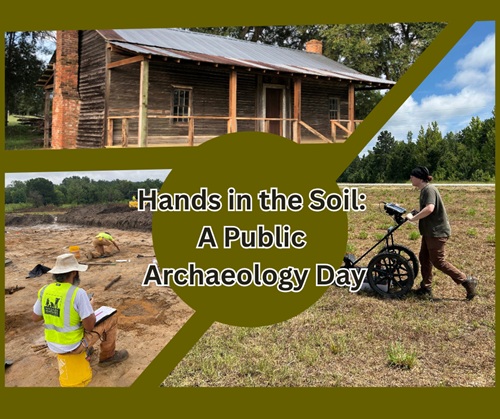
Image by Georgia DOT

[Editor’s note: Many state DOTs seek to engage the public more deeply in their archeological work. For example, in November 2025, the Georgia Department of Transportation and the Forest Grove Preserve hosted a “Public Archaeology Day” at the historic Harper House in Sandersville, GA, to offer new insights into the daily lives of people who lived and worked in rural Georgia over the past 150 years.]

“There’s a huge value in this, giving us a bigger, broader picture of what’s out there,” explained Schneider, who also serves as chair of the Cultural Resources Subcommittee within the Committee on Environment and Sustainability for the American Association of State Highway and Transportation Officials.

“I think transportation archaeology contributes – and continues to contribute – to archaeology as a whole,” she said.

A few examples of the notable intersections between transportation and archaeology include:

· In 1974, work halted on a planned expansion of U.S. 49 in Mississippi when a midden – an ancient refuse pile – was discovered. Further investigation revealed the pile may date back 6,000 years. Today, the site is known as the Pocohontas Mounds and bears a historical marker erected by the Mississippi Department of Transportation.

· In 2007, 16,000 artifacts from a 19th-century-era homestead were discovered in the path of highway project in Maryland. The findings revealed that the inhabitants of the homestead called on West African spirits to protect their home.

· In 2021, an archaeological dig at an interstate project in Idaho revealed evidence of Kootenai Indian tribal activity thousands of years earlier than first thought. The findings earned the Idaho Transportation Department the 2024 AASHTO President’s Transportation Award for Equity.

· From 2021 to 2023, archaeologists excavated 15 sites at the planned location of the I-10 Mobile River Bridge and Bayway Project in Alabama. The findings tell the story of Mobile from its days under French, Spanish, and British control in the 18th century to Native American communities from 2,000 years ago.

Transportation engineers’ jobs are to plan, build and maintain roads and bridges, and archaeologists’ jobs are to ensure history is not paved over. Occasionally but inevitably, there is a rub between them.

Schneider said conflicts are more likely to occur when state DOTs “are still siloed” but most agencies now encourage divisions to work together as one team.

“One of the things I’ve learned is the importance of communication and working with people in those other worlds, the engineers and the planners, and to communication with them early on,” Schneider said. “We can come in and say, ‘Maybe we can tweak the road just a bit.’ It can be a real challenge, but I think it’s probably gotten better over the years.”

In Mobile, the need for the bridge project was undeniable. The existing tunnel beneath the Mobile River and the adjacent bridge that crosses Mobile Bay were carrying three times the designed traffic capacity of the structures.

But false starts and intermittent opposition kept the project in various stages of planning for nearly 30 years. After Hurricane Katrina in 2005, new Federal Highway Administration guidelines meant the Alabama Department of Transportation would have to raise and replace the 7.5-mile bay bridge instead of simply adding lanes, adding even more costs until the project’s price tag seemed to settle at $3.5 billion.

Then, there was the history.

ALDOT knew the project site was in a culturally significant part of Mobile, the oldest permanent settlement in French Colonial Louisiana. Fort Conde, built by French explorers in 1723, “is a stone’s throw from the mouth of the tunnel,” ALDOT Media and Community Relations Bureau Chief Tony Harris said.

“I think there was every expectation that we’d find something,” Harris said.

The bridge project site temporarily turned into a major archaeological site that eventually would yield surprising insights into Mobile’s history.

In part two of this story, to be published next week, ALDOT details how its work on the I-10 Mobile River Bridge and Bayway Project unearthed interesting history about the region.

Delaware DOT Recaps 2025 Litter Cleanup Efforts

The Delaware Department of Transportation and its partners collected 82,467 bags of trash from roadsides statewide in 2025, along with 4,977 tires, 5,069 signs, and 196 appliances, as part of the ongoing Keep DE Litter Free cleanup campaign.

[Above photo via the Delaware DOT]

The agency noted that litter removal efforts in 2025 were conducted by its maintenance and operations employees, Adopt-A-Highway and Sponsor-A-Highway efforts, the Work a Day Earn a Pay Program, and with help from the Inmate Work Program overseen by the Delaware Department of Corrections.

“I would like to thank Delaware DOT and their partners for everything they do to help keep Delaware Beautiful,” noted Governor Matt Meyer (D) in a statement. “Their efforts are much appreciated, but unfortunately, their work is never done. If we all do our part, together we can truly keep our roadways litter-free.”

“There is never a shortage of litter in the First State, which is sad, because Delaware is such a beautiful place,” added Shanté Hastings, secretary of the Delaware DOT. “Since the inception of the Keep DE Free initiative, our employees, partners, and volunteers have removed 370,059 bags of trash from our roads.”

Other state departments of transportation are also witnessing success with similar statewide litter cleanup efforts.

For example, more than 77,000 pounds of litter were removed from roadsides and waterways across Tennessee as part of the 5th Annual “No Trash November” month-long campaign in 2025; an effort spearheaded by the Tennessee Department of Transportation.

Throughout November of last year, 2,470 volunteers participated in 205 cleanup events, the agency said in a statement – collecting 3,596 bags of litter weighing a total of 77,129 pounds.

This annual cleanup initiative also brings together Tennessee DOT’s litter prevention partners and organizations, including Keep Tennessee Beautiful affiliates, Litter Grant recipients, Adopt-A-Highway groups, youth organizations such as Girl Scouts and Scouting America, and many others.

Environmental News Highlights – January 14, 2026

AASHTO Comments on EPA’s Updated WOTUS Definition

The American Association of State Highway and Transportation Officials recently provided comments to the Environmental Protection Agency regarding the EPA’s updated definition of Waters of the United States or WOTUS; expressing “the need for clear standards to determine the jurisdictional status of their stormwater and drainage assets, ensuring that the rule clearly excludes them from the regulatory requirements of WOTUS.”

[Above photo by the SCDOT]

“Although AASHTO recognizes the intention of the proposed rule to exclude roadside ditches and stormwater control features from the definition of WOTUS, we believe the proposed rule’s use of

hydrology, topography, soils, and precipitation conditions as a characteristic for the definition fails to resolve the uncertainty in the definition’s application,” the organization said in its letter.

“Use of terms such as, ‘wet season,’ ‘dry land,’ and ‘upland’ without further definition, context, or guidance presents circumstances for state departments of transportation that will disrupt planning, construction, operation, and maintenance of their systems.”

In previous comment letters on this subject, AASHTO said it recommended language for a WOTUS definition that would be both “appropriately protective of aquatic resources” and “straightforward” for state DOTs to understand and apply – and the lack of such language could create an additional burden for state DOTs, hampering project delivery.

“Each year, state DOTs invest hundreds of billions of dollars in expanding and improving their systems. Further, state DOT projects often must address safety and operational issues by relocating,

widening and shaping ditches, making these operations critical to highway safety,” AASHTO said. “These projects often take months to years to plan and budget, with budgets and schedules heavily dependent on environmental permitting and compliance certainties.”

AASHTO also stressed that when deploying federally funded transportation projects, the “layering” of various requirements over the years – as seen in WOTUS regulations – has resulted in “time-consuming reviews and back-and-forth interactions” that not only delay projects but also substantially add to their cost.

“We believe this [WOTUS] rulemaking represents an opportunity to improve the federal project delivery timeline for the sake of our communities who are waiting on these important projects to improve their quality of life,” the organization noted.