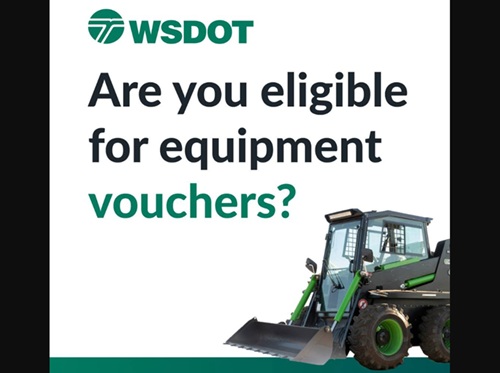
The Washington State Department of Transportation launched a $112 million program back on April 29 that seeks to help businesses and fleet operators acquire zero-emission or “clean” equipment.
[Above photo by WSDOT]
That program – officially called the Washington Zero-Emission Incentive Program or WAZIP – is funded by the state’s Climate Commitment Act and provides vouchers to businesses and fleets to help defray the cost of acquiring commercial truck and other equipment.
WAZIP vouchers – available on a first-come, first-served basis – reduce the upfront cost of 100 types of medium- and heavy-duty zero emission vehicles or ZEVs and related commercial equipment by funding about 40 percent of the purchase price. However, the amount varies based on the type of truck and/or equipment being bought.
The types of vehicles and equipment covered by the vouchers also include construction vehicles, agriculture machinery, airport loaders and tugs, commercial boats, forklifts, freight locomotives, refrigerated transportation units, freight-handling equipment and charging/dispensing stations.
“This program is an economic powerhouse for our state,” noted Governor Bob Ferguson (D) in remarks he made during a WAZIP launch event at the Port of Seattle at the time.
“It helps businesses modernize their fleets, dealerships increase their sales, and residents live healthier lives through reduced emissions,” he said. “We’re investing $112 million to make the purchase of cleaner commercial vehicles and equipment more affordable for a wide-range of companies – big and small – across the state.”
“Our state continues to be at the forefront of innovative opportunity with this program and opens up clean transportation to those who otherwise may not have thought about it before,” added Julie Meredith, WSDOT secretary.
According to a report by the NW Energy Coalition, the transportation sector is the number one industry for the release of greenhouse gas emissions, accounting for around 40 percent of greenhouse emissions statewide. It stems from exhaust from cars, trucks, ships and other gas and diesel burning equipment.
The types of pollutants generated by the transportation sector include:
- Carbon dioxide is considered a “primary” greenhouse gas generated by transportation sector activity. Though it is naturally present in the atmosphere as part of the Earth’s carbon cycle, carbon dioxide is also the result of combustion of natural gas, petroleum fuels, and coal. It accounts for 35 percent of total U.S. CO2 emissions and 28 percent of total U.S. greenhouse gas emissions.
- Nitrogen Oxide, or NOx, is a gaseous air pollutant composed of nitrogen and oxygen and forms when coal, petroleum fuels such as gasoline or diesel, and natural gas are burned at high temperatures. NOx in the outdoor air contributes to particle pollution and to the chemical reactions that make ozone, which – when it forms at ground level – can damage lung tissue when breathed in.
- Particulate matter is comprised of black carbon, heavy metals, ammonia, volatile organic compounds, or VOCs and is sometimes referred to as “soot.” It is a mixture of tiny liquid and solid particles that are released during fuel combustion, particularly with diesel fuel.
- VOCs are often components of petroleum fuels, hydraulic fluids, paint thinners, and dry-cleaning agents. Some produce harmful effects such as eye and throat irritation, can in some cases cause live and kidney damage, and even cause cancer. However, the Environmental Protection Agency said that extent and nature of such negative health effects will depend on many factors, including level of exposure and length of time exposed to VOCs.
Reducing the emissions of those and other harmful pollutants into the atmosphere is the ultimate goal of this new program, noted Gov. Ferguson.
“This program is a really wonderful example of how our Climate Commitment Act not only reduces harmful pollution, [but] also helps lower costs by helping people and businesses switch to affordable clean [equipment],” he said.
 Fuel Efficiency