The Vermont Agency of Transportation – known as VTrans – recently issued approximately $6.2 million in grants to municipalities statewide to support a variety of bicycle and pedestrian infrastructure improvement projects.
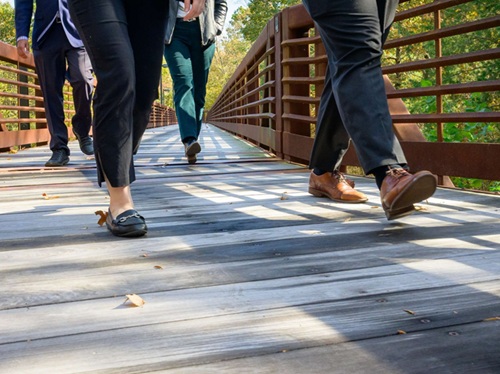
[Above photo by VTrans]
That funding – which will support a combination of construction projects and planning initiatives – aims to benefit cities and towns statewide with improved transportation connectivity and safety, tangible economic benefits, and additional transportation options for commuters, visitors, and recreational users.
The agency added that those awards also include state funds for small-scale active transportation improvement projects that address critical safety needs, such as pedestrian crossings and filling critical sidewalk gaps. VTrans added that it plans to assist municipalities with implementation of those small projects quickly with minimal delays.
“Pedestrian and bicycle infrastructure has valuable positive effects on public health, property values, tourism, business growth, and personal transportation costs,” noted Joe Flynn, VTrans secretary, in a statement.
Many state departments of transportation are involved in a variety of projects that seek to improve bicycle and pedestrian travel as well as safety. For example, in early October, the board of directors of the Massachusetts Department of Transportation approved a $78.7 million design-build contract to construct the Mystic River Pedestrian and Bicycle Bridge – creating a new cross-river connection between the towns of Everett and Somerville.
MassDOT said the new bridge will cross the Mystic River between Draw Seven Park in Somerville and the Gateway Park trail and public boardwalk in Everett – closing a critical gap in the region’s walking and biking network by connecting trails, neighborhoods, businesses, public transportation, and recreational opportunities on both sides of the river.
Meanwhile, the South Carolina Department of Transportation and Coastal Carolina University are moving forward on a joint effort to improve safety for motorists and pedestrians alike on the main roadway that serves the school’s campus: The SC-544 corridor.
SCDOT said those improvements will include reducing the roadway’s speed limit to 35 mph, installing a High-Intensity Activated Crosswalk or HAWK pedestrian-activated signal, and enhancing the road’s pavement markings: changes the agency expects to complete by the end of 2026. And in mid-September, the Maryland Department of Transportation issued $11.3 million in grants to 24 bicycle, pedestrian, and trail projects statewide – grants supported by a combination of state and federal funding.
The agency said those fiscal year 2027 grants include $9.3 million in federal funding for six projects through the Transportation Alternatives Program and another six projects via the Recreational Trails Program, along with $2 million in state funding for 12 projects through the Maryland DOT Kim Lamphier Bikeways Network Program.
 Active Transportation