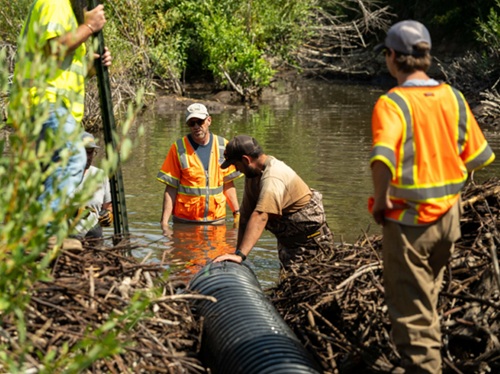
The Utah Department of Transportation recently began testing what it describes as “a different approach” that allows beavers to remain in their habitat while protecting nearby roads and bridges from water damage caused by their natural dam-building instincts.
[Above photo by Utah DOT]
The agency explained that beavers build dams to expand their access to food and habitat, and while such dams can benefit the surrounding environment, the water behind them can rise high enough to seep beneath roads – eroding roadways and creating safety concerns.
To manage that risk, Utah DOT recently partnered with the Utah Division of Wildlife Resources (DWR), the Sageland Collaborative non-profit environmental group, and Utah State University’s Beaver Ecology and Relocation Collaborative to install three pond “levelers” in Beaver Creek in Logan Canyon.
Those levelers use pipes to carry water through the beaver dams, keeping the water levels with those ponds at safer levels for nearby roadways. Because the intakes are designed so beavers do not detect the flowing water, they are less likely to block them, noted Matt Howard, Utah DOT’s natural resources manager.
“This gives us another tool to protect our transportation system while allowing the beavers to stay,” he said in a statement. “If the levelers work as intended, we can manage the water level without repeatedly relocating beavers or removing dams.”
In the past, managing “conflicts” at sites at such beaver habitats often meant trapping and relocating the creatures or removing the dams. However, when the habitat remains attractive, other beavers may move in and begin rebuilding. Thus Utah DOT and DWR hope the pond leveler will help break that cycle by reducing the threat to infrastructure without removing the animals.
Beaver ponds also offer broad environmental benefits, Utah DOT said; they retain water, support native plant communities, reduce erosion and create habitat for many fish and wildlife species. Water stored across the landscape may also create natural firebreaks and help surrounding areas withstand dry conditions, stressed Shane Hill, riverscape restoration project manager at Sageland Collaborative.
“What I see in this work is an opportunity to expand Logan Canyon’s capacity to support wildlife habitat, hold water, create wetlands, improve water quality and make the area more resistant to fire,” said Hill. “The challenge is the conflict beavers can have with our infrastructure. These pond levelers give us a way to coexist with beavers and keep their benefits on the landscape.”
Utah DOT noted that it will monitor the three pond levelers to see how well they manage water levels and protect the nearby road. The results will help the department determine where pond levelers or similar approaches may be useful in the future, the agency said.
“This is about finding practical solutions that protect both Utah’s transportation system and its natural resources,” stressed Utah DOT’s Howard. “The beavers can stay in a productive habitat, and we can help keep the road safe for everyone who uses it.”

 Wildlife and Ecosystems