In the second of this two-part series, state departments of transportation explain why – even as they battle against the high cost of litter collection – without the efforts of volunteer groups, their respective roadside trash removal problems would be infinitely worse.
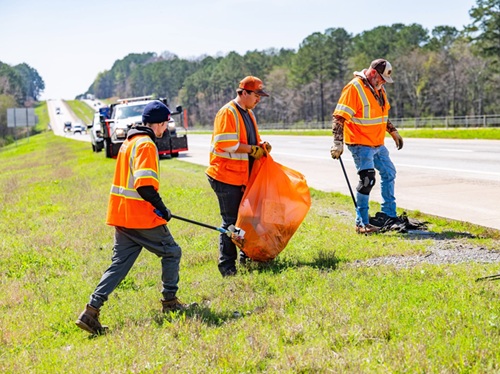
[Above photo by ARDOT]
In most states, volunteer groups organize or supply volunteers to pick up litter, helping to defray many of the costs. For example, People Against a Littered State (PALS) – a non-profit group that contracts with the Alabama Department of Transportation (ALDOT) – cleans up about 1,000 miles of roadway annually in Alabama four times a year.
PALS estimates each mile of highway has about 16,000 pieces of litter, and the value of picking up a single piece of litter is about 30 cents. At that valuation, PALS volunteers are providing $19.2 million worth of litter pickup services – a bargain for ALDOT on a $320,000 annual contract.
“I shudder to think how much litter we might have it weren’t for them,” noted George Conner, ALDOT’s deputy director for operations, who added that his agency has a similar arrangement with Keep Alabama Beautiful.
Besides the monetary costs, there are other considerations for state DOTs that are picking up litter. “When we have crews that do maintenance to the roadways, they’re doing that on the right of way, adjacent to traffic,” Conner said. “It’s a high-risk setting.”
State DOT employees and contractors who are picking up litter usually are on the busiest roads and interstates, often with only a
warning sign and safety vest for protection. “The more times we have to put crews out picking up litter, the more risks they’re taking” Conner said. “All [state] DOTs put up signs, saying ‘Workers Ahead,’ but by the nature of the work, they’re mobile, they’re moving around. The more time they spend on the detail, the more risk you have.”
There’s also an environmental cost to litter. “Litter on the roadside makes its way into drainage ditches and then into rivers and streams,” Conner said. “It clogs drainage features, facilitates flooding, it makes its way to our waterways. That’s an impact of litter that goes beyond the budget impact.”
Meanwhile, although every state has litter laws on its books, enforcing them is not a top priority for law enforcement and convictions are hard to come by. A report by the North Carolina Department of Transportation, entitled “Final 2025 Yearly Interagency Report on Litter Cleanup,” indicated that while there were 3,108 litter citations issued statewide in 2025, they only resulted in 722 convictions – a 23.2 percent conviction rate.
“There are lots of laws, but enforcement is very difficult,” Conner said. “You ultimately have to catch the person in the act. Secondly, law enforcement isn’t overflowing with resources, either.”
So, what is the answer for money-strapped state DOTs that are spending money picking up after a littering public that complains the departments aren’t putting more money into roads?
“A good starting point is to bring that out in public awareness campaigns,” said Dennis Palmer, program manager for traffic engineering and maintenance at the American Association of State Highway and Transportation Officials. “The educational part of the public is the best place to start. To an extent, though, some people will do what they want.”
ALDOT’s Conner is more blunt. “The solution is for people to stop littering,” he stressed. “There are huge [public awareness] campaigns already out there. Thank goodness we have them because there’s no telling how bad litter would be without them.”
 Litter
TxDOT Highlights ‘Trash Off’ Highway Cleanup Effort
June 10, 2026 Litter