New Jersey Dredging Project Supports Habitat Enhancement

A side benefit of the latest channel dredging project overseen by the New Jersey Department of Transportation will result in shoreline stabilization and habitat enhancement for Boot Island; a barrier island near Atlantic City.

[Above photo by New Jersey DOT]

The $1.8 million Brigantine Channel Spur dredging project, conducted by New Jersey DOT contractor Mobile Dredging & Video Pipe Inc., will restore safe navigation to the Brigantine Channel Spur by lowering the channel’s authorized project depth down to five feet below mean low water.

The approximately 22,000 cubic yards removed as a result of that dredging work will then be transported via pipeline to improve Boot Island’s habitat: part of a series of coastal habitat restoration projects using Beneficial Use of Dredged Material or BUDM across three wildlife management areas in southern New Jersey.

[Editor’s note: New Jersey DOT has overseen several similar dredging projects along the Atlantic City coastline, including one to restore the St. George’s Thoroughfare in 2025.]

According to the New Jersey Department of Fish and Wildlife, those projects aim to enhance coastal resilience, restore degraded marsh habitats, and support both species of greatest conservation need and popular game species managed under the Wildlife and Sport Fish Restoration nexus through “nature-based solutions,” which includes BUDM.

In a statement, the New Jersey Department of Fish and Wildlife said BUDM repurposes clean sediment from navigation channels to restore degraded coastal habitats – particularly critical for New Jersey, as many saltmarshes are experiencing net habitat loss due to sea-level rise and erosion.

By strategically placing dredged sediment to raise marsh elevations, BUDM helps restore proper tidal inundation, promotes the growth of native saltmarsh vegetation, and enhances habitat resilience, the agency said.

Environmental News Highlights – January 7, 2025

Colorado DOT Completes I-25 Greenland Wildlife Overpass

The Colorado Department of Transportation recently completed construction of the new I-25 Greenland Wildlife Overpass near Larkspur, which is among North America’s largest wildlife overpasses; work that included covering the structure’s surface with dirt and vegetation.

[Above photo by the Colorado DOT]

Some 76 girders hold up the deck of this overpass – completed in less than a year, ahead of schedule and on budget – which spans six lanes of interstate traffic and connects 39,000 acres of habitat on both sides of I-25 between the towns of Larkspur and Monument.

Colorado DOT said more than 100,000 vehicles a day travel this area and that the wildlife expected to use this overpass include big game animals such as moose, bear, mountain lions, elk, mule deer, and pronghorn deer – along with smaller animals as well

A multi-agency partnership with the Federal Highway Administration, Colorado Parks and Wildlife, Douglas County, the Douglas Land Conservancy and the Colorado Cattleman’s Agricultural Land Trust made the Greenland wildlife crossing possible. As part of the Wildlife Crossings Pilot Program, a federal grant award provided the bulk of the funding for the project, Colorado DOT said.

[Editor’s note: The Wyoming Department of Transportation recently produced a video detailing some of the hazards posed when wildlife traverse highways and how state departments of transportation are working to mitigate those hazards.]

The overpass is strategically located to address the 3.7-mile gap from other wildlife crossings and completes the wildlife crossing system of underpasses and fencing as a part of the I-25 South Gap project that improved 18 miles of I-25 from Castle Rock to Monument.

Prior to the system being built, there was an average of one wildlife-vehicle crash a day in the fall and spring wildlife movement seasons. Colorado DOT said its research shows that the five underpasses are successfully being used by large and small mammals.

“Colorado is leading the way in reducing wildlife-vehicle collisions and improving safety for both our motorists and wildlife,” noted Governor Jared Polis (D) in a statement. “The I-25 Greenland wildlife overpass is a momentous feat, in our continued work to expand safe transportation options for both humans and wildlife, protecting critical habitat and our amazing outdoor spaces for generations to come.”

“The I-25 Greenland wildlife overpass is critical to the safety of both wildlife and motorists,” added Shoshana Lew, Colorado DOT’s executive director. “The overpass is an essential component of the wildlife crossing system in this area, which is expected to reduce wildlife-vehicle crashes by 90 percent.”

PennDOT Seeks More ‘Sponsor-A-Highway’ Support from Businesses

The Pennsylvania Department of Transportation is encouraging  businesses statewide to join the department’s Sponsor-A-Highway program and keep the state’s roadways clean as the 2026 tourism season is expected to bring more than 209 million travelers to Pennsylvania.

[Above photo by PennDOT]

Some 55 businesses currently participate in the program, which began in 2000; cleaning more than 375 miles of roadway on an annual basis. Beginning in 2026, Sponsor-A-Highway vendors will increase litter clean-ups along sponsored roads from six to eight times per year, the agency said.

Mike Carroll. Photo by PennDOT.

“From the World Cup to the MLB All-star Game, the NFL Draft and the 250th Anniversary of the Declaration of Independence, 2026 will put Pennsylvania centerstage,” said Mike Carroll, PennDOT’s secretary, in a statement. “With so many travelers coming to our cities, now is the opportunity to show the world what makes the Commonwealth the ‘Great American Getaway.’”

Through PennDOT’s Sponsor-A-Highway program, local businesses and organizations can secure agreements with a PennDOT vendor who uses skilled maintenance forces to remove litter on roadways such as interstates and expressways, especially in areas where volunteer litter groups cannot safely pick up litter.

Sponsors are recognized with a roadside acknowledgement sign displaying their business name and logo, while also receiving a listing on PennDOT’s website. 

The Sponsor-A-Highway program signs have also been redone to feature the “Let Freedom Ring” design unveiled in 2025.

“With 2026 putting Pennsylvania on the world stage, we get one chance to make a first — and lasting — impression,” said Anne Ryan, deputy secretary of tourism for the Pennsylvania Department of Community and Economic Development.

“Roadside signage may seem simple, but it’s one of the very first touchpoints that tells visitors who we are, what we value, and what the Great American Getaway stands for,” she added. “This investment helps us welcome millions of travelers with pride, clarity, and a sense of place the moment they cross our borders.”

Environmental News Highlights – December 31, 2025

PA Turnpike Opens NEVI Funded EV Charging Stations

The Pennsylvania Department of Transportation recently opened the first of two federally-funded electric vehicle charging stations on the Pennsylvania Turnpike built using funds from the National Electric Vehicle Infrastructure or NEVI program

[Above photo via PennDOT]

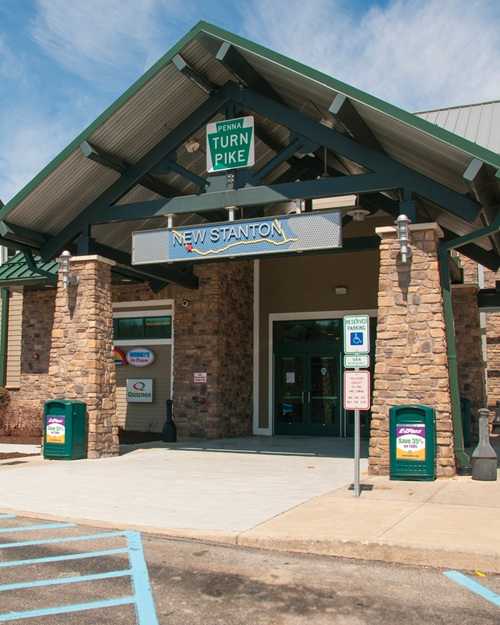
The first new station is located at the Blue Mountain Service Plaza at Exit 202 westbound on the Pennsylvania Turnpike. The second NEVI-funded EV charging station is at New Stanton, located at Exit 77 westbound.

Photo by the PA Turnpike

This project was awarded from Alternative Fuel Corridor Round 1 of the PennDOT NEVI program. The next stage of NEVI funding, Corridor Connections, focuses on implementing EV charging stations along major roadways to strengthen long-distance travel outside of previously designated Alternative Fuel Corridors.

The two new EV charging stations are part of the PA Turnpike’s systemwide EV charging initiative. In partnership with Applegreen Electric, this program looks to add 80 new universal EV stations at all 17 service plazas by the end of 2027.

Beyond those new additions funded through the NEVI program, the PA Turnpike recently opened up new electric vehicle charging stations at North Somerset, South Somerset, and Hickory Run service plazas funded through the Pennsylvania Department of Environmental Protection’s “Driving PA Forward” program. All of those sites offer high-speed chargers, with a total of four charging ports per location, that support all EV types without the need for adapters.

“The Shapiro Administration’s goal is to use federal NEVI funds to build out an accessible and reliable EV charging network by meeting EV drivers where they are,” explained Mike Carroll, PennDOT secretary, in a statement

“The Pennsylvania Turnpike is one of the state’s busiest roads for long-distance travelers, especially over the holiday season, and opening the first NEVI-funded charging station on the Turnpike exemplifies that goal,” he said.

“We are excited to continue offering more options for customers who want accessible, on-route EV charging,” added Mark Compton, CEO of the PA Turnpike.

“Our EV charging program offers reliable and convenient options along our roadway, improving customer experience while also reflecting our long-term commitment to being a good neighbor across the Commonwealth,” he noted. “Beyond meeting customer demand, supporting electric vehicle adoption enhances infrastructure resilience, supports renewable energy goals and reduces vehicle emissions.”

Tennessee DOT Heralds Success of ‘No Trash November’

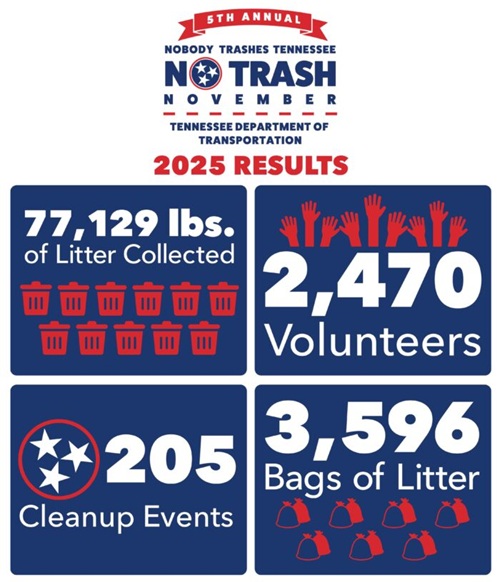
More than 77,000 pounds of litter were removed from roadsides and waterways statewide as part of the 5th Annual “No Trash November” month-long campaign sponsored by the Tennessee Department of Transportation.

[Above image by Tennessee DOT]

Throughout the month, 2,470 volunteers participated in 205 cleanup events, the agency said in a statement – collecting 3,596 bags of litter weighing a total of 77,129 pounds.

Image via Tennessee DOT

This annual cleanup initiative also brings together Tennessee DOT’s litter prevention partners and organizations, including Keep Tennessee Beautiful affiliates, Litter Grant recipients, Adopt-A-Highway groups, youth organizations such as Girl Scouts and Scouting America, and many others.

Tennessee DOT noted that youth groups can earn patches for their cleanup efforts through its Youth Patch Program: receiving a “Nobody Trashes Tennessee” logo patch for a scout’s first cleanup; the “Trashsquatch” patch, awarded for a second cleanup; and now the “Rocco the Raccoon” patch, for Scouts who complete their third cleanup service project.

The agency added that litter cleanup participants aged 13 and older may earn rewards for their litter prevention efforts through the Trash Masters Rewards program, which offers points for attending cleanup events, completing litter prevention quizzes, and spreading awareness. Points may be redeemed for discounts at local businesses and exclusive “Nobody Trashes Tennessee” merchandise, Tennessee DOT said.

Environmental News Highlights – December 17, 2025

Latest Dual-Language Wisconsin Highway Signs Unveiled

The Wisconsin Department of Transportation recently helped unveil the latest set of dual-language highway signs for placement on state highways to welcome travelers to Wisconsin’s tribal communities in both English and native languages.

[Above photo by Wisconsin DOT]

The sign unveiling took place at the Ho-Chunk House of Wellness in Baraboo with Governor Tony Evers (D) and Ho-Chunk Nation President Jon Greendeer. The event is part of a statewide dual-language sign initiative launched by Wisconsin DOT in 2021. Through this sign program, the Wisconsin DOT collaborates with the state’s tribal nations to install road signs on tribal lands in both English and Indigenous languages.

The new signs identify Ho-Chunk Nation communities and the Mississippi River in both the Ho-Chunk and English languages. The Ho-Chunk Nation is the ninth tribe in Wisconsin to install dual-language signs. In total, Wisconsin is home to 12 native nations, the agency said.

“We are honored to join the Ho-Chunk Nation in celebration of these dual-language signs and share the pride in their rich language and heritage,” said Kristina Boardman, Wisconsin DOT secretary, in a statement. “Our dual-language sign program is more than a transportation initiative; it’s a commitment to tribal sovereignty, cultural revitalization, and visibility.”

The sign-unveiling event builds upon ongoing work with the Ho-Chunk Nation, as earlier in 2025, Gov. Evers and Boardman joined the tribe to celebrate the designation of I-90 between La Crosse and Tomah as the “Ho-Chunk World War II Code Talkers Memorial Highway,” placing commemorative markers recognizing the individual Ho-Chunk Nation Code Talkers at the La Crosse and Sparta safety rest areas.

Arkansas DOT Building ‘Anti-Littering’ Highway Displays

The Arkansas Department of Transportation is building new “anti-litter displays” that will be rotated among several highway locations statewide in the coming months.

[Above photo by ARDOT]

Travelers along Arkansas highways will see a series of blue highway signs – made in-house by ARDOT employees – with anti-litter messaging. The first sign will read, “ARDOT spends over $8 million per year combatting litter.” A second one will say, “Are you part of the problem or the solution?” The third sign will read, “Please help us keep Arkansas natural.”

At the end of the three signs, the public will see five-foot-tall wire mesh letters spelling out “NATURAL?” The wire letters are hollow and will be filled with litter that has been picked up by crews in the area, the agency said.

“The average taxpayer may not know how much ARDOT spends each year picking up litter from our highways,” noted Steve Frisbee, ARDOT assistant chief engineer for maintenance, in a statement. “Our goal is to raise awareness for all Arkansans and travelers in our state.”

“Arkansas is ‘The Natural State,’ and we, as the Arkansas DOT, have a unique responsibility to help preserve the beauty that surrounds our infrastructure,” added Jared Wiley, ARDOT’s director. “In addition to the money we spend on litter pickup each year, we are always exploring new ways to combat the litter problem. We hope these litter letters resonate with the traveling public and spur positive change.”