



New York Unveils Albany Revitalization Strategy
Governor Kathy Hochul (D) recently unveiled the Downtown Albany Strategy – a comprehensive, community-informed revitalization plan that is part of the $400 million Championing Albany’s Potential or “CAP” initiative – that includes funding devoted to projects focused on transportation improvements and enhancements to parks, public spaces, and neighborhood amenities.
[Above image via the New York Governor’s Office]
That strategy is backed by $200 million in state investments to guide coordinated action that will spur housing growth to attract new residents, create jobs, promote long-term redevelopment, enliven commercial corridors, and energize the public realm.
Developed with input from thousands of residents, workers, students, business owners, and community leaders, the Downtown Albany Strategy reflects extensive public engagement through workshops, stakeholder meetings, and focus groups and represents a vision for new economic growth guided by community priorities, the governor said.
“Downtown Albany has been a historic hub for more than 400 years, and I am committed to renewing its prominence not only to the region, but across our state and nation. This strategy will deliver transformational change and unlock its full potential,” Gov. Hochul said in a statement. “Through high-impact investments, strong partnerships, and clear growth targets, we are building a revitalized
downtown worthy of the Empire State’s capital city for residents, workers, and visitors alike.”
The strategy prioritizes focused investment in Albany’s downtown core to build momentum and leverage private development, serving as a foundation for broader revitalization beyond the city’s downtown boundaries. A central component of the plan is the redevelopment of Liberty Park, identified as a key opportunity for large-scale housing, public space, and neighborhood destinations.
The governor said the Downtown Albany Strategy is comprised of three targeted, high-impact public investments:
· Transformative Projects Fund ($120 million): Supporting major, marquee projects that elevate the downtown experience and energize public interest in downtown’s redevelopment progress.
· Housing Investment Fund ($40 million): Expanding housing options to keep and expand the number of downtown residents, creating a 24/7 community to support commercial growth and city services.
· Community Investment Fund ($40 million): Enhancing parks, public spaces, and neighborhood amenities.
Through strategic state investment and strong private-sector partnerships, the Downtown Albany Strategy will support housing development, small business growth, job creation, and safer, more active streets. The plan is designed to deliver visible, lasting improvements that strengthen Albany’s role as the economic and cultural center of the region, noted Marie Therese Dominguez, commissioner of the New York State Department of Transportation Commissioner.
“[NYSDOT] is proud to be working with the community on this initiative, which will have a multi-faceted, generational impact on the City of Albany and its residents,” she added. “Through transformative projects like the new Livingston Avenue Bridge and the re-imagining of the Interstate 787 corridor, we are already hard at work making it happen for the people who live and work in Downtown Albany.”
Several state departments of transportation have been involved in similar strategic initiatives that combine transportation improvements with other public enhancements.
For example, a new “street grid” reconnecting downtown Cincinnati to Queensgate, is one of several major “innovations” touted by the Ohio Department of Transportation and Kentucky Transportation Cabinet that is being incorporated into the $3.6 billion Brent Spence Bridge Corridor project. Meanwhile, in 2023, the Washington State Department of Transportation – in coordination with the City of Des Moines – provided a “much-needed makeover” to a popular 14-acre green space along Barnes Creek; an area used by local residents for a variety of outdoor activities.
This project also supported the city’s future plans for trail improvements through this corridor, while helping reduce impacts to wetlands and vegetated areas surrounding streams from the New Expressway Project.
Protecting Monarch Migration Across Texas Highways
In this episode of ‘The Stream by AASHTO’ podcast, Darlene Goehl (above) – research engineer and research group lead at Texas A&M University’s Transportation Institute or TTI – discusses the joint work of TTI and the Texas Department of Transportation in building Monarch Flight Diverters or MFDs – a series of tall, mesh barriers placed along busy roads that motivate the butterflies to fly above the roadway, well above vehicles traveling on the highway below.
[Above photo by TTI]
This podcast series is part of the AASHTO Environmental Management technical service program operated by the American Association of State Highway and Transportation Officials. It explores a wide array of environmental topics that affect state departments of transportation and the infrastructure programs they oversee.
In this episode, Goehl explains that researchers recently noted sharp declines in Monarch populations, specifically during their migration periods in the fall.
[Editor’s note: In November 2024, The Leaflet by AASHTO newsletter published a two-part series about TxDOT’s Monarch protection efforts. Part One of that series can be accessed by clicking here and Part Two by clicking here.]
In some years, researchers found that nearly 3 percent of the Monarch’s fall migratory population were lost after being struck by vehicles traveling on roads; this number represents about half of the population decline in a given year.
Goehl discusses the importance of Monarch butterflies to the ecology and cultural symbology of the southern U.S. and northern Mexico, the role transportation in protecting them, and how TTI identifies “hot spots” for Monarch roadkill. From there, Goehl explains the implementation and feasibility of MFDs in Texas and how the project will fare into the future. To listen to the full podcast, click here.
Environmental News Highlights – February 18, 2026
Where Rubber Meets the Road in Texas – Literally
The Texas Department of Transportation’s San Angelo District recently received recognition for turning old vehicle tires into smoother, longer-lasting roads.
[Above photo by TxDOT]
In recent construction projects in the San Angelo area, TxDOT said it repurposed 135,389 recycled tires into road pavement treatment materials – helping divert thousands of tires from city and county landfills while simultaneously improving roadway durability and performance.
“By repurposing materials typically discarded in a landfill, we’re enhancing the durability and performance of our roads while also safeguarding the environment,” explained Chris Cowen, an engineer with the TxDOT San Angelo District, in a statement.
The agency noted that it works closely with a variety of industry partners statewide to incorporate recycled and environmentally responsible materials into different construction and maintenance projects – collaborating to promote environmentally responsible construction and maintenance practices wherever possible.
Several state departments of transportation have incorporated recycled materials into a number of transportation projects.
For example, in 2024, the Utah Department of Transportation detailed how it recycled old concrete on the site of its Bangerter Highway project to help build the highway’s new interchanges.
Also in 2024, the Idaho Transportation Department explained how it uses biodegradable erosion control loose weave “blankets” without joints that allow snakes and other wildlife to easily move over or through them. Those “blankets” play a key role in the agency’s Erosion and Sediment Control or ESC practices that prevent soil loss and reduce sediment-laden stormwater runoff in and around transportation infrastructure.
In 2022, the Arizona Department of Transportation outlined in a blog post how it reuses a variety of highway construction materials – such as asphalt, concrete, and steel – to reduce overall transportation project costs and preserve the environment.
Maryland DOT Funding New Pedestrian Safety Projects
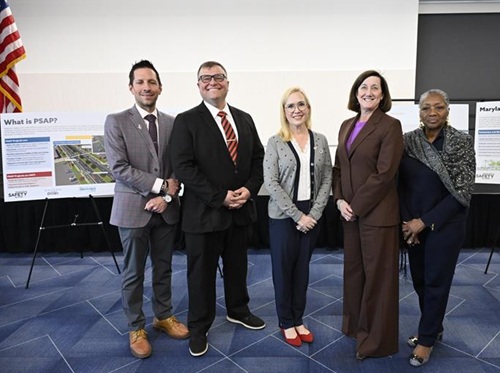
The Maryland Department of Transportation and its Maryland State Highway Administration (MSHA) division recently hosted an event with local officials to unveil the latest pedestrian safety projects being funded by the state’s Pedestrian Safety Action Plan or PSAP.
[Above photo by Maryland DOT]
Published in May 2023, the PSAP resulted from an MSHA review of existing conditions across Maryland to identify areas of need – prioritizing select corridors for pedestrian and bicycle safety improvements. Currently, MSHA has launched planning and design efforts for 13 PSAP projects across Maryland. The state’s first PSAP project began construction in the summer 2025 and should be completed in 2026.
This latest round of funding will add five projects to boost the number of PSAP corridors to 18 statewide, the agency said – noting that planning and design concepts for each PSAP project will include proven safety countermeasures supported by the Federal Highway Administration.
“Every Marylander, no matter whether they travel by bus, bicycle, car, rail or on foot, deserves safe and reliable transportation for their everyday needs and to pursue education, jobs and other opportunities,” noted Katie Thomson, acting Maryland DOT secretary, in a statement.
“The projects that emerge from our Pedestrian Safety Action Plan, and the collaborations we’re forming with communities across MaThe Maryland Department of Transportation and its Maryland State Highway Administration (MSHA) division recently hosted an event with local officials to unveil the latest pedestrian safety projects being funded by the state’s Pedestrian Safety Action Plan or PSAP.
[Above photo by Maryland DOT]
Published in May 2023, the PSAP resulted from an MSHA review of existing conditions across Maryland to identify areas of need – prioritizing select corridors for pedestrian and bicycle safety improvements.
Currently, MSHA has launched planning and design efforts for 13 PSAP projects across Maryland. The state’s first PSAP project began construction in the summer 2025 and should be completed in 2026.
This latest round of funding will add five projects to boost the number of PSAP corridors to 18 statewide, the agency said – noting that planning and design concepts for each PSAP project will include proven safety countermeasures supported by the Federal Highway Administration.
“Every Marylander, no matter whether they travel by bus, bicycle, car, rail or on foot, deserves safe and reliable transportation for their everyday needs and to pursue education, jobs and other opportunities,” noted Katie Thomson, acting Maryland DOT secretary, in a statement.
“The projects that emerge from our Pedestrian Safety Action Plan, and the collaborations we’re forming with communities across Maryland, will help us realize our shared goals and will pay dividends for generations to come,” she added.ryland, will help us realize our shared goals and will pay dividends for generations to come,” she added.
Environmental News Highlights – February 11, 2026
‘Kitchen Table’ Bat Box Idea Takes Flight in Pigeon River Gorge
Kenny McCourt, a North Carolina Department of Transportation engineer, recently found inspiration from an unlikely source to help bats roost underneath I-40 bridges in Haywood County: his kitchen table, by way of his daughter.
[Above photo by NCDOT]
McCourt – overseeing the replacement of those I-40 bridges, which were severely damaged in 2024 due to heavy flooding in the Pigeon River Gorge – sought ways to address a delicate situation: Roosting boxes that accommodated endangered bats underneath an old Pigeon River bridge near Exit 15 didn’t fit into the new bridge design.
Roosting boxes are critical to help support bat species living in the area; animals that help disperse large amounts of seed and pollen, which aids in plant reproduction and forest regrowth. Northern bat species can have a major impact on controlling harmful insect populations as well, NCDOT noted.
Yet with a little help from his daughter, Harper, McCourt found a solution that just might be replicated across the state and maybe even the nation.
“Me and my little girl, Harper, were sitting around the kitchen table actually watching Animal Planet,” he said in a statement. “And I was sitting with the notebook drawing up some ideas on how to take it [the roosting box] off the bridge – and it hit me.”
McCourt realized the natural aesthetics NCDOT already planned to incorporate into the side wall that supports the bridge approach could be the answer. “We took a piece of paper and started drawing these bat habitats right into the wall of the bridge to give them more of a natural habitat,” McCourt said.
The idea gained traction at McCourt’s office and beyond. Engineers and wildlife experts soon started collaborating to design these roosting spaces for different species – including the endangered gray bat – all built into the new bridge wall for what locals call the High Bridge.
“Bats have been observed roosting in the bridge here crossing the Pigeon River, and the new bridge isn’t going to have suitable roosting habitat like the old one,” said Holland Youngman, a U.S. Fish and Wildlife biologist. “So, we’re putting bat roosts in this retaining wall to give the bats somewhere else to go. I think it’s very new and innovative and creative.”
This project brought together NCDOT, the U.S. Fish and Wildlife Service, the North Carolina Wildlife Resources Commission, prime contractor Kiewit Construction, sub-contractor Boulderscape, and others.
NCDOT said Kiewit crews used excess materials to shape and build the small habitats before a Boulderscape crew added a layer of “shotcrete” to the outside – a method of applying concrete projected at high velocity primarily on to a vertical or overhead surface that helped create a natural-looking space the bats could call home.
“This has been a phenomenal collaboration just to make sure we’re all on the same page,” said Katherine Etchison, wildlife diversity biologist with the North Carolina Wildlife Resource Commission. “We can all brainstorm and give our ideas about how this should go together.”
Within days of installing the roosting holes, several bats flew in to explore the new space, including an endangered gray bat. While most of the bat species living in the area have migrated for the winter to locations in Tennessee, they return in the spring. Before then, NCDOT will add a half-acre flower bed near the bridge that will be full of native flowers that bloom at night and attract insects – bat food.
“A project as successful as this – for the bats, for our bridge maintenance teams, for our construction team, and wildlife partners – is something that I can see growing in western North Carolina, across the state and when word gets out, across the country,” McCourt said. “It’s pretty cool that so many folks are supportive of thinking outside the box.”
WSDOT Opening $112M Clean Truck Program in April
The Washington State Department of Transportation plans to roll out a new program in April to help businesses and fleet operators transition to cleaner medium- and heavy-duty vehicles.
[Above photo via WSDOT]
Via the new program, potential truck buyers can request vouchers through the Washington Zero-Emission Incentive Program or WAZIP. A total of $112 million in voucher incentives will be available through the state’s Climate Commitment Act; incentives that lower the upfront purchase price of the unit.
WSDOT said many types of medium- and heavy-duty equipment qualify, including trucks, construction vehicles, agriculture machinery, airport loaders and tugs, commercial boats, forklifts, freight locomotives, refrigerated transportation units, freight-handling equipment and charging/dispensing stations.
The amount of the voucher incentives varies, based on the type of equipment purchased. Small businesses will be eligible for enhanced incentives and buyers must also work with pre-approved vehicle and equipment dealerships across the state.
[Editor’s note: This new program follows on the heels of $12.16 million WSDOT recently awarded to expand electric vehicle charging infrastructure statewide.]
WSDOT noted it has selected operations partner CALSTART to administer the program. Together, WSDOT and CALSTART have developed a detailed program implementation manual so interested parties can learn more about its guidelines, buyer eligibility, and funding rules. A list of eligible vehicles and equipment will be published online in March, with a more detailed catalog available following program launch, the agency noted.
Vehicle and equipment dealerships interested in participating will be required to register online and complete required training. Both dealers and potential buyers are encouraged to review the implementation manual and sign up for program updates on the WAZIP website, which also allows potential buyers to express interest early, with technical assistance available throughout the buying process to help choose the right vehicles and plan for charging needs.
“We’re accelerating the switch to zero-emission vehicles by helping businesses afford new equipment that will benefit them for years to come,” said Julie Meredith, WSDOT secretary, in a statement. “Potential buyers are encouraged to plan now for the availability of these voucher incentives. We anticipate funding will be in great demand and vouchers will be issued on a first-come, first-served basis.”