
Maryland DOT Issues More NEVI Funds to Build EV Chargers

The Maryland Department of Transportation recently began soliciting applications for the third round of funding available through the federal National Electric Vehicle Infrastructure or NEVI program.

[Above photo by the Maryland DOT]

The latest round requests proposals for up to nine additional electric vehicle or EV fast charging projects along the state’s major highways and routes that are designated as EV Alternative Fuel Corridors.

Round three of the program will provide up to $10 million in federal formula funding to expand the statewide fast charging network, the agency said, with interested parties encouraged to submit a proposal no later than June 24.
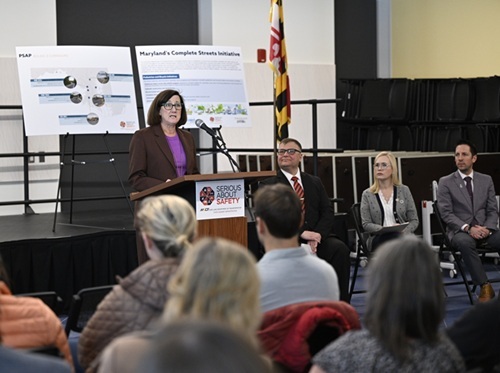
Katie Thomson (at podium). Photo by Maryland DOT.

“Through [the] NEVI Program, Maryland is moving to make powering up an EV as easy as fueling up a gas-powered vehicle,” said Katie Thomson, Maryland DOT’s secretary, in a statement. “This is an exciting moment as Maryland helps meet the demand for wider access to sustainable EV charging across the state.”

Maryland DOT noted that its first two rounds of NEVI funding awarded a total of $19.1 million to 31 projects, supporting construction of 166 new Direct Current fast charging ports. To date, the agency said Maryland has seven NEVI funded EV charging sites open to the public located near major corridors in Anne Arundel, Cecil, Prince George’s, Wicomico, Carroll, Garrett, and Washington counties.

The department added that Maryland has more than 150,458 registered EVs and 5,302 public Level 2 and fast charging ports, according to the latest data compiled through the end of February 2026.

Other state departments of transportation has also recently made more NEVI funds available to support EV charger construction.

For example, in mid-March, the Pennsylvania Department of Transportation began funding 12 new projects to construct EV charging stations along major state roadways. That builds on the $54 million already committed to public charging stations across the Commonwealth through the NEVI program, with 30 EV charging stations already constructed and in operation. Additionally, there are 53 other EV charger stations in various stages of planning and construction, PennDOT noted.

“These projects will expand access to electric vehicle charging from our alternative fuel connections and bridge the gap between long-distance travel and community based chargers,” said Mike Carroll, PennDOT secretary, in a statement. “This is a critical step to improving relatability and access to meet the needs of EV drivers in the Commonwealth.”
Environmental News Highlights – March 18, 2026

WSDOT: Toxic Tire Residue Can Threaten Waterways

In September 2025, the Washington State Department of Transportation presented a case study analyzing the impact of toxic residue from tires on waterway environments at the Stormwater Summit hosted by the American Association of State Highway and Transportation Officials in Tempe, AZ.

[Above photo by WSDOT]

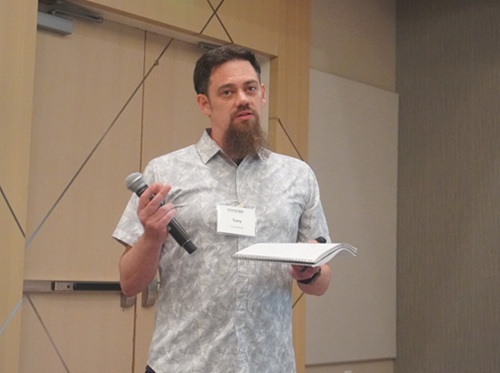
Tony Bush, stormwater branch manager for WSDOT, explained during a discussion about this case study that a particular type of contaminant from tires is the main cause of concern – 6PPD-Quinone or 66PD-Q.

Tony Bush. Photo by AASHTO.

During this Stormwater Summit session, Bush highlighted an ongoing WSDOT project that seeks to protect Coho Salmon from exposure to 6PPD-Q as well as reduce pollution, address health disparities, and better protect waterway ecosystem health from 6PPD-Q contamination. 

According to the U.S. Tire Manufacturers Association, 6PPD is a chemical considered critical for tire longevity and safety. It has been used in the tire industry for decades and is considered essential in protecting tire rubber from breaking down. It serves as an “anti-degradant,” in as such it protects tires from degradation due to exposure to ozone, oxygen, and ultraviolet light – preventing blowouts on the road and helping tires last longer.

However, Bush stressed that when 6PPD interacts with ozone, it transforms into 6PPD-Q – and that chemical composition is what harms waterway ecosystems. Bush added that stormwater runoff containing 6PPD-Q can expose a variety of aquatic organisms to this toxic chemical. Specifically, WSDOT said recent research studies found exposure to 6PPD-Q caused disorientation, injury, and even death of Coho Salmon attempting to swim upstream to their respective spawning areas.

Such poisoning and subsequent deaths would affect the longevity of Coho Salmon populations in affected waterways, that research indicated.

As a result, in 2023 the Washington State legislature dedicated $500 million over 16 years for WSDOT stand-alone stormwater retrofit projects with an emphasis on green stormwater infrastructure (GSI). Plans include retrofitting current high-priority untreated road segments for ecosystem health, salmon recovery, health disparities and cost effectiveness.

To address elevated roadways over salmon bearing waters, WSDOT is partnering with the Nature Conservancy and Stewardship Partners to design, implement and monitor bioretention planter boxes under bridge downspouts.

So far, three boxes have been installed in the greater Seattle area as part of a pilot project called “Box of Rain,” with the associated community maintenance effort entitled “Adopt-a-Downspout.” Both seek to reduce toxic pollutants from entering Washington State’s natural waterways. It entails deploying affordable, scalable, easy-to-install modular GSI under elevated roadways to treat stormwater and then return it back to the stormwater conveyance before entering the natural waterbody.  

In 2027, WSDOT plans to construct its largest standalone regional stormwater treatment facility to date. This project will have the ability to treat both WSDOT and the City of Seattle’s stormwater under the I-5 Ship Canal Bridge in Seattle. WSDOT is also partnering with local organizations to build a community space – called the Georgetown Stormwater Interpretative Center – centered around GSI and extolling the co-benefits of such infrastructure initiatives. 

Bush concluded by noting that WSDOT’s actions are “essential” to helping improve the viability of aquatic life in Seattle and Washington’s waterways and ensure they remain a thriving ecosystem for the future. 

ARDOT Launches ‘Adopt A Highway’ Program Website

The Arkansas Department of Transportation recently launched a new website for the Adopt-A-Highway program. The new website, now live on the ardot.gov main menu, is designed to make it easier for state residents to get involved in keeping Arkansas roadways and rights-of-way clean and beautiful.

[Above photo by ARDOT]

The agency said the new website allows the public to view current Adopt-A-Highway volunteer locations across the state, identify opportunities to participate, and submit requests to adopt specific highway segments for cleanup efforts.

[Editor’s note: Click here to learn how to use Arkansas DOT’s new Adopt-A-Highway website.]

“This new website reflects our commitment to making it as simple as possible for Arkansans to engage with the Adopt-A-Highway program,” noted Jared Wiley said, Arkansas DOT’s director, in a statement.

“The easier we make it for people to find opportunities and sign up, the more volunteers we can put along our highways,” he said. “Cleaner roadways enhance the natural beauty of our state. Every Arkansan who wants to contribute has a place in this effort.”

Across the country, state departments of transportation are engaged in a variety of efforts aimed at keeping highways free of litter and other debris.

For example, the Idaho Transportation Department is planning to launch its second annual “Operation Clean Sweep” in North Idaho on March 25; a two-day effort that seeks to clean up the US-95 corridor from Granite Hill to I-90. The agency said the 2025 event yielded 376 bags of trash, totaling over 13,000 pounds of litter and debris.

“It’s frustrating to have to pull our crews off their regular maintenance work to deal with trash dumped by people who just don’t care,” explained Nick Primmer, ITD foreman supervisor, in a statement. “Unfortunately, it’s become a routine part of spring. Once the snow melts, the amount of litter we uncover is pretty overwhelming.”

That frustration is exactly what inspired Operation Clean Sweep in 2025 and why ITD is bringing it back for a second year, the agency noted, as keeping highways clean isn’t just about appearances. Roadside litter poses real risks to wildlife, to the environment as a whole, and to the maintenance workers who have to manage it, ITD said. Every hour an agency work crew spends collecting trash is an hour not spent on safety improvements, pothole repairs, or the maintenance work that keeps North Idaho’s roads in good condition, ITD stressed.

“We thought it would be a great opportunity [with Operation Clean Seep] to let the public get involved, to work alongside the hardworking men and women of ITD and make a real, visible difference,” Primmer said. “It takes all of us.”

Environmental News Highlights – March 11, 2026

NYSDOT ‘Road-Raising’ Project Adds Shared-Use Path

The New York State Department of Transportation recently completed a $25 million project in Westchester County that elevated a flood-prone roadway corridor through the use of recycled materials – a project that also created a new shared-use path for pedestrians and bicyclists as well.

[Above photo by NYSDOT]

U.S. Route 6/State Route 202 at Annsville Circle in Cortlandt is north of where Annsville Creek empties into the Hudson River and is part of a major commuter corridor for thousands of drivers in New York City’s northern suburbs. The roadway historically floods 10 to 15 times a year, usually during high tide, the agency said.

Floods and other climate consequences “can wreak havoc with our roads and bridges,” explained Governor Kathy Hochul (D) in a news release. “This flood mitigation project in Westchester County provides Hudson Valley travelers with a highway that’s better able to withstand severe weather events and will not continually fall victim to rising flood waters.”

Marie Therese Dominguez, NYSDOT commissioner, added that her agency is using “every tool in our arsenal to harden our infrastructure and make it more resilient. With this project at Annsville Circle, NYSDOT utilized its engineering prowess and state-of-the-art materials to elevate this important highway and give Hudson Valley travelers a road they can depend on in all kinds of weather.”

As a result, the department’s project elevated the traffic circle and a half-mile segment of roadway by using foamed glass – an aggregate material made of recycled glass. Using the lightweight material shaved one year of construction time off the project, which began in July 2024, the department said.

Foamed glass also has been used by several state departments of transportation in road construction and other applications. In 2024, the Arizona Department of Transportation used foamed glass to strengthen interstate culverts on I-17, and last year the Wyoming Department of Transportation used it to rebuild a 100-foot embankment lost in a landslide along Teton Pass highway near the Grand Teton National Park.

Foamed glass is lightweight, durable, fireproof, and waterproof, NYSDOT noted, and is manufactured by heating a mixture of crushed glass with foaming agents, which releases carbon dioxide, sealing the air cells in the glass and giving the material its durability.

To build the raised road, NYSDOT said it used geosynthetic reinforced soil technology, using the foamed glass, organic material, fabrics, grids, and meshes to strengthen the embankments and hold soil in place. The traffic circle was elevated by four feet and the adjoining highway by seven feet, the agency added.

During construction, the department also built a new shared-use path to give bicyclists and pedestrians access to the river and Annsville Creek Preserve, a trail along the Hudson River tributary that features scenic views and a fishing pier. The path also connects the Jan Peeck Bridge over the Annsville Creek to nearby businesses.

NYSDOT said the path totals 925 feet with a minimum width of five feet and a three-foot curb buffer to separate bikers and walkers from vehicle traffic. The new roundabout also features new LED street lighting and new pedestrian crosswalks, and in the spring, crews will add native trees, shrubs, and grasses.

The agency noted that this project was partially funded by a grant from the U.S. Department of Transportation’s Promoting Resilient Operations for Transformative, Efficient, and Cost-saving Transportation or PROTECT program. That grant also will help pay for a related initiative to raise an adjacent section of the roadway in 2027, NYSDOT said.

Knowledge Session: States Should Consider NEPA Assignment Duties

The American Association of State Highway and Transportation Officials recently hosted a knowledge session at its 2026 Washington Briefing in Washington, D.C., that examined how many states are working to assume more National Environmental Policy Act or NEPA responsibilities from the federal government.

[Above photo by AASHTO]

Jim Ray, corporate president for engineering consulting firm HNTB – which presented this session – moderated a panel discussion that featured Will Reid, commissioner of the Tennessee Department of Transportation; Ed Sniffen, director of the Hawaii Department of Transportation; and Jay Payne, deputy administrator of the Federal Highway Administration.

“We have to be committed to this process of expediting project delivery,” explained Reid, who became the first career staff member of the agency to become commissioner after his appointment by Governor Bill Lee (R) to that position in July 2025.

“We’ve gotten caught up a lot in the push and pull between authority and accountability and in the process lost sight of our ‘North Star,’ which is project delivery,” he explained. “We got bogged down in process; bogged down in a lot of back and forth that really didn’t affect project outcomes.”

For that reason, taking on more NEPA assignment duties from the federal government helps states move from a more “risk averse” project development process to a more project delivery-driven organization.

“We need to manage risk and align accountability between our people and our goals – and be judged on our ability to deliver projects,” Reid stressed. “And we need leadership committed to doing that so we create a clear line of sight down to our staff so they see that. Also, what [processes] we put in place must stand the test of time, because leadership comes and goes.”

Hawaii DOT’s Sniffen echoed Reid’s assessment, noting that “for far too long, the vision of what project delivery looked like in our state was affected by process. Now we are getting closer to the vision we have by taking on NEPA assignment [from the FHWA]. We are all in on this so we can guide and control our future.”

Sniffen said one advantage for Hawaii DOT is that “many states have gone through this [NEPA assignment] already so we have learned from them.”

That’s also helped in terms of tackling “one of the biggest discussion points” Hawaii DOT has had with state legislators regarding taking on NEPA assignment duties, he said: waiving sovereign immunity.

“Many of our legislators were worried. But we knew we could defend ourselves better, take on risks better, by doing this,” Sniffen pointed out. He added that showing legislators how taking on NEPA assignment helps the agency “three times over” by reducing the number of environmental reviews really helped. “That made it easy to move forward,” Sniffen said.

FHWA’s Payne stressed that because state DOTs are “much more sophisticated now,” the state-federal relationship needs to be “recast” to reflect that new reality.

“We need to empower our state DOTs,” he said. “Our goal is to empower you and to give you the tools to build. That means focusing on the proper federal role in project delivery because the real work is done by the state – the state DOTs know their roads better than we do.”

Payne added that states taking on more NEPA responsibilities will ultimately decrease project timelines and increase value to taxpayers.

“The proper federal role is to help things run smoothly in a simplified and standardized way,” he explained. “State DOTs are incredibly valued partners for building roads and bridges; they can deliver projects better on their own internal timelines. We can’t do that from desk in Washington.”

Environmental News Highlights – March 4, 2026

Michigan DOT Study Seeks Quieter Ann Arbor Highway

The Michigan Department of Transportation is studying noise levels from a four-lane divided highway in Ann Arbor, where residents complain that decibel levels have increased in the last few years – especially near an elementary school.

[Above photo by Michigan DOT]

That noise study is focused on a roughly one-mile stretch of M-14 in northwest Ann Arbor that encompasses an area where Wines Elementary School is located, Michigan DOT said. Two other schools are also in the study area, the agency added.

“We’re real excited that there’s potential action being taken because there’s a lot of noise here at Wines Elementary, inside and out,” noted David DeYoung, noted principle of Wines Elementary, in a Michigan DOT video about the project.

Michigan DOT has placed noise meters at the schools and in neighborhoods that are adjacent to the highway. The department said it will analyze the data and predict future noise levels through computer modeling that factors in traffic patterns, traffic speed, the number of commercial vehicles on the road, and geographic features.

Once the data are analyzed, the agency will prepare a study report that includes analytics on where along the route noise mitigation measures can help. The report will be presented to the public this spring, according to the noise study website.

[Editor’s note: In 2024, “The Steam by AASHTO” podcast aired a two-part series detailing how state DOTs are working to reduce roadway noise.]

“I heard from so many families that live in this area that the sound from the freeway was so distracting, disturbing and made it so that their kids couldn’t do their homework or go to sleep at night,” Michigan State Senator Sue Shink said in the Michigan DOT video, who pushed through a $3 million appropriation from the legislature for the agency to conduct this noise study and propose a remedy.

Although the noise study is still underway, Mike Davis Jr. – Michigan DOT’s project manager – said preliminary feasibility “is leaning toward a standard noise wall.” Because there is not yet a cost estimate on a noise wall or any other mitigation measure, Davis said the department’s goal “is to control the study and any design work costs as much as possible to have as much budget as possible for noise mitigation.”

The relatively recent reports of increased noise in the area are somewhat of a head-scratcher for Michigan DOT as well, Davis said, as the Wines Elementary school – built in 1960 – has been alongside the M-14 highway since it was built in 1965. The highway has also never been widened beyond its four lanes and traffic counts have remained steady at about 35,000 vehicles per day, he noted.

“Over the past several years, there have been many conversations concerning this section of roadway, with noise being one of those conversations,” Davis said.

The last major project on this part of M-14 was in 2024, when Michigan DOT applied a high-friction surface treatment on the roadway in response to a report showing 25 percent of crashes were occurring during wet conditions. Although the treatment was done as a safety project, it had the added benefit of reducing roadway noise.

“Our region does not have a solid theory why this became such a severe issue over the past few years,” Davis said. Their best guess is that the noise “has increased as the concrete pavement has continued to deteriorate.”

Despite having no definitive cause for the increased noise, Michigan DOT is moving forward with the noise study. “Like Mike said, there have been many conversations,” said Mark Sweeney, manager of Michigan DOT’s Brighton Transportation Services Center. “And, one way or another, they are all connected, and they all include a road noise component.”

State DOTs Continue Building EV Charging Infrastructure

Across the country, state departments of transportation continue to build out electric vehicle (EV) charging infrastructure, supported largely by funding provided from the federal National Electric Vehicle or NEVI formula program established four years ago.

[Above photo by TxDOT]

For example, using NEVI funds, the Texas Department of Transportation has built 14 EV charging stations, with 23 under construction and another 28 in the planning phase. Overall, TxDOT is planning have a total of 300 EV charging locations available for use this year.

“Alternatively fueled vehicle sales are breaking records,” said Michael Chamberlain, TxDOT’s Data Management Section director, in a statement. “But fortunately, Texas has the infrastructure and electric capacity to meet that demand for many years to come.”

He noted that, between July 2022 and the end of 2025, the number of EVs registered in Texas – including plug-in hybrids and fully electric vehicles – more than tripled to 456,667. Every week, TXDOT said the state sees an additional 1,500 EVs on the road, according to vehicle registration data from Alternatively Fueled Vehicle Report issued by the Texas Department of Motor Vehicles.

In Pennsylvania, federal NEVI funds have helped the state open eight new EV charging stations since October – bringing the Commonwealth’s total number of NEVI-funded charging stations to 28.

Additionally, the Pennsylvania Department of Transportation noted in a statement that it is “powering forward” with more investments through the NEVI program, beginning with the Corridor Connections Funding Opportunity, which was released in October 2025.

That funding round focuses on implementing EV charging stations along major roadways to strengthen long-distance travel beyond the previously designated Alternative Fuel Corridors, the agency said. Projects funded from the Corridor Connections program will improve range confidence for drivers who are considering travel with an EV across and throughout the Commonwealth, PennDOT added.

Meanwhile, the North Carolina Department of Transportation is planning to reallocate NEVI formula program funds from building EV charging stations along major interstates and highways to local communities, rural areas, and along highways where less EV charging coverage currently exists. The agency said it is making this shift due to new U.S. Department of Transportation guidance for the NEVI program issued in August 2025 that gives states greater flexibility to determine where EV charging stations can be placed. And in late November 2025, the Georgia State Transportation Board approved $24.4 million worth of grants to fund construction of EV charging stations statewide.

The Georgia Department of Transportation is overseeing the award of those grants – funded via the second round of NEVI program awards – to 26 locations through public-private partnerships or P3s that will support the construction and operation of new fast-charging stations along the state’s Alternative Fuel Corridors.

Selected private-sector partners will design, install, finance, operate and maintain stations equipped with Direct Current Fast Charging ports for at least five years in accordance with federal requirements, the agency said.