From mid-April through late June this year, the Illinois Department of Transportation will host 18 workshops statewide to help local governments and communities learn about a variety of funding opportunities and how to apply for them.
[Above image by Illinois DOT]
The agency said its Special Programs Assistance Conferences are designed to help potential grantees take part in the department’s Economic Development Program, Illinois Transportation Enhancement Program, and Safe Routes to School Program.
“Thanks to [Illinois] Governor Pritzker’s Rebuild Illinois capital program, there is more opportunity than ever for our local partners to work with us to accomplish projects that improve mobility, safety and quality of life in their communities,” explained Gia Biagi, acting Illinois DOT secretary, in a statement.
“These workshops are a one-stop shop to learn about some of our more popular programs, as well as to get help tapping into the tools and resources that can make a positive impact in cities, towns and neighborhoods across Illinois,” she added.
Illinois DOT said these two-day conferences are geared to help local stakeholders understand the competitive funding programs it offers, as well as identify projects they can submit for consideration and provide instruction on how to craft applications. Illinois DOT staff will lead each conference, with group presentations occurring on the morning of the first day, followed by one-on-one appointments and networking opportunities the afternoon of the first day and on the second day.
The Illinois DOT hosts a variety of events geared to help local communities and businesses.
For example, in February, the agency held its 34th “Today’s Challenge, Tomorrow’s Reward” conference – sponsored by its Office of Business and Workforce Diversity – to provide minority- and women-owned businesses with opportunities to make connections and develop skills to grow and succeed.
The agency noted that its “Today’s Challenge, Tomorrow’s Reward” meeting offers workshops to build skills, seminars on best practices and networking opportunities for firms and contractors wanting to do business with Illinois via the state’s Disadvantaged Business Enterprise or DBE program.
New Native American Art Decorates Ferry Terminal
A pair of 10-foot-tall hand-carved Native American-themed “welcome poles” were recently installed in the passenger walkway at the Washington State Ferries (WSF) Bainbridge Island terminal.
[Above photo by WSDOT]
According to Native American lore, the poles represent the concept that “all humans may travel and have great strength to go wherever they desire and have protection and power within.” Local community members selected this artwork through a process managed by the Washington State Arts Commission in partnership with the Washington State Department of Transportation’s WSF.
In a blog post, WSF said it consults with federally-recognized tribes with treaty rights where its projects are located so it can include tribal cultural design elements at its ferry terminals. While these pieces add beauty, their presence signals something deeper, WSF emphasized – providing a link to the Native American culture in the Salish Sea and often telling a story of the place or history of the tribe.
Native American artist Andy Wilbur-Peterson – who grew up in Shelton, WA, and earned a Bachelor of Arts degree in Native American studies from Evergreen State College in Olympia – created the two welcome poles; which are called “Crossing the Water.”
Across the country, state departments of transportation are involved in a variety of cultural and archaeological efforts – many involving Native American communities.
For example, in September 2024, the Iowa Department of Transportation – with support from the Wisconsin Department of Transportation and the Federal Highway Administration – released a 25-minute film about the Black Hawk Bridge and that of the local communities surrounding it.
Named after Chief Black Hawk of Lansing, IA, the bridge connected Wisconsin and Iowa communities – including Native American tribes – on either side of the Mississippi River
Created as a compliance requirement with the National Historic Preservation Act, the short film – entitled “Bridging Generations: The Story of the Black Hawk Bridge” – details the history of the 1,700-foot bridge that spans the Mississippi River, connecting Iowa Highway 9 in Lansing, IA, to Wisconsin Highway 82 in rural Crawford County.
And in September 2023, the Wisconsin Department of Transportation received federal funding to help create a Tribal Technical Assistance Program or TTAP Center for 65 tribal nations across 30 states.
Environmental News Highlights – April 9, 2025
Video: Inside DDOT’s Wood Reclamation Program
A new video highlights the wood reclamation program established by the District of Columbia Department of Transportation (DDOT) in Washington, D.C.; a program that turns trees cut down, due to age, health, or construction projects into a wide variety of useful products – everything from benches and doors to birdhouses.
[Above photo by DDOT]
“We’re trying to save trees that are removed in the city for a variety of reasons and give them a second life,” explained Shaun McKim, an arborist with DDOT’s Urban Forestry Division, in the video.
“These trees are taken down because they’ve become dead or hazardous. Or maybe there’s some impending road construction that won’t allow them to be there,” he added. “[But] this wood is still very useful and it can have a second life. [We can] make stuff with the wood that is removed in the city.”
Launched in 2019, DDOT’s Urban Forestry Division specifically seeks to work with local schools and students to teach them about tree biology and decomposition.
Many state departments of transportation are involved in programs and projects to recycle and/or reuse the wood from trees removed for a variety of reasons – especially after major weather events, such as floods or hurricanes.
For example, the Kentucky Transportation Cabinet worked with the Kentucky Energy and Environment Cabinet and other state agencies on a “debris-to-mulch” project that turned thousands of trees downed by major flooding across Eastern Kentucky in early 2023 into beneficial mulch made available for commercial sale.
Nearly 100,000 tons of wood debris were sent to one of two Kentucky mulching facilities for re-use as part of this program, KYTC said; wood debris ultimately produced about 160,000 cubic yards of mulch, equivalent to almost 2.1 million bags of the mulch product typically sold in home improvement stores.
Meanwhile, the Maryland Department of Transportation helps sponsor a tree-planting grant program that supports a broad initiative to plant five million trees across Maryland by 2031.
The Urban Tree Grant Program – which is a partnership between the Maryland DOT, the Maryland Urban and Community Forest Committee, and the Maryland Department of Natural Resources – has awarded over $120,000 across more than 40 communities since launching in 2022, resulting in the planting of about 2,000 trees.
That program supports the “Growing 5 Million Trees” initiative – established by the “Tree Solutions Now Act” passed by the state legislature in 2021 – that is led by a commission chaired by the Maryland Department of the Environment.
NCDOT Helps Activate Electric Aircraft Recharging Site
In late March, an electric aircraft charger was used to power up an all-electric airplane for the very first time in North Carolina at the Raleigh Executive Jetport in Sanford-Lee County.
[Above photo by NCDOT]
The Raleigh Executive Jetport and the North Carolina Department of Transportation helped BETA Technologies recharge its all-electric “ALIA” airplane as part of an electric aviation demonstration project.
The Charge Cube Level-3 fast-charger recharged the aircraft so it could take off and travel to BETA’s headquarters in Vermont. The Charge Cube is the state’s first station for charging electric aircraft, NCDOT noted.
“This is an exciting advancement for North Carolina’s aviation sector,” said Julie White, NCDOT’s deputy secretary for multimodal transportation, in a statement. “By embracing this infrastructure early, we are positioning our state to be a leader in advanced air mobility, attract business expansion and create new opportunities in aviation.”
This infrastructure site joins BETA’s expanding nationwide charging network, which now includes nearly 50 sites across the East, West and Gulf coasts.
[Editor’s note: The Utah Department of Transportation recently participated in a similar demonstration project with BETA’s ‘ALIA’ all-electric aircraft; an effort detailed in the video below.]
“A little over a year ago, we flew our prototype aircraft through Raleigh Exec [Jetport] on our way to our first military deployment,” said Thea Wurzburg, BETA’s state relations lead. “It’s special to be here … with our first production aircraft, charging at our new Charge Cube. North Carolina has long recognized the benefits of Advanced Air Mobility and we look forward to continuing to partner on this next phase of aviation.”
Environmental News Highlights – April 2, 2025
Utah DOT’s Five Decade Wildlife Protection Effort
When the Utah Department of Transportation built a wildlife bridge over the new Interstate 15 in 1975 near Beaver, it literally wasn’t front-page news. It merited only a brief mention on page five of the local paper, which called it “a project to aid reduction of deer highway mortality.”
[Above photo by Utah DOT]
Mirroring’s Utah’s reputation as a state of humble, hard-working pioneers (the state motto is “industry” after all), Utah DOT still tends to bypass the spotlight while quietly going about its work. It took 50 years for that I-15 overpass near Beaver to be widely recognized and celebrated as the first wildlife crossing over a highway in the United States.
Such projects have become almost commonplace in Utah; home to a variety of big mammals, reptiles, amphibians, birds – nearly everything from antelope to weasels. Today, it is estimated that Utah DOT has built more than 60 crossings and installed hundreds of miles of fencing across the state to keep wildlife and motor vehicles separated.
[The video below provides an overview of a wildlife crossing in Parley’s Canyon over I-80 opened by Utah DOT in 2018.]
“This is one of the most passionate issues we have. It really is a focus of the entire department,” said John Gleason, Utah DOT’s director of public relations. “You think about the destruction you can have if a vehicle hits a moose. These are the things we want to prevent.”
Preventing wildlife-vehicle collisions in Utah, however, isn’t simple. Long stretches of highways bisect arid deserts, mountain ranges, and dense pine forests in a state with more land mass than New England but less than a quarter of that region’s human population.
Recently, Utah DOT received a $9.6 million federal grant for wildlife safety improvements along US 40, which will pay for 23 miles of fencing and four wildlife underpasses. That news came weeks after the department installed three miles of fencing to funnel wildlife to an undercrossing near the I-80 and I-84 interchange, about 30 miles east of Great Salt Lake.
In southern Utah, the department will soon add three more wildlife underpasses and several miles of fencing along US 89, which crosses a natural migration route for the Paunsaugunt Plateau mule deer herd. In 2013, Utah DOT built seven wildlife underpasses along the route, and studies show thousands of animals have used them.
Not all the crossings are for big moose and deer, though. The department has built small culvert underpasses for the Mojave Desert tortoise, an endangered species only found in Utah, California, Arizona, and Nevada. Utah DOT also is planning tunnel-style crossings for Utah prairie dogs in the southern half of the state.
The fencing-and-crossing projects are successful because animals learn where the safe passages are, Utah DOT Natural Resource Manager Matt Howard said.
“Over time, they don’t even need the fencing. Once a few generations have passed, they go straight to the crossing,” he said. “We joke that it’s a lot easier to change wildlife behavior than human behavior.”
Utah DOT relies on wildlife behavior experts at the Utah Division of Wildlife Resources (UDWR) to help plan the projects. In fact, the Utah DOT-UDWR relationship goes far beyond the usual inter-agency cooperative agreements that are common on so many government projects.
“One of the keys to us having a successful program is our relationship with the wildlife agency,” Howard said. “It really started out as friendships, people who hunt and fish together. We never go more than three months without talking. We don’t have a lot of bureaucracy getting in the way.”
While Utah DOT has the engineering and construction know-how on these projects, UDWR understands animal migration, feeding, and mating patterns. Together, the agencies share expertise and research to plan the optimal types of crossing in the best locations.
“UDWR’s partnership with Utah DOT is critical in maintaining wildlife connectivity across the state by implementing projects that allow species to move freely across roads, which can be barriers to migration,” UDWR Migration Initiative Coordinator Makeda Hanson said. “Coordination and data-sharing between the two agencies help us work together to find solutions that improve both wildlife and human safety.”
For example, UDWR and Utah DOT wanted more data to plan the kinds of safety projects to build and exactly where to build them. One solution was The Utah Roadkill Reporter; a smartphone application introduced in 2022 that gets the public involved in reporting wildlife collisions.
Anyone can use the app to report where an animal was hit and killed by a motor vehicle in Utah. If it’s safe, a vehicle occupant can take a picture of the carcass and include it in the report, which alerts a crew to remove the carcass.
But the real payoff for Utah DOT and UDWR is that each roadkill report provides a wealth of information. The app prompts users to identify what kind of animal was killed, how old it appeared, and whether it was male or female. The agencies use that information to pinpoint when and where specific animals want to cross the road, which helps in project planning.
“The carcass pickups reported to the app have historically been the most-used data point to guide wildlife projects,” Howard said. “We also take into account collar data and law enforcement crash data.”
Citizens have filed almost 10,000 roadkill reports since the app was introduced in 2022.
While Utah DOT still spends the bulk of its budget on traditional road and bridge projects, Gleason said state residents are supportive of the wildlife safety projects. “With all the great work we’ve done in this area, the public wants more of these wildlife crossings, they want more wildlife fencing,” he said. “They want us to take the time to study the migration patterns and make sure, if we’re going to invest public dollars in a project, it makes sense to put a passing or fencing here. It’s all about making the best use of public funds.”
The Stream Podcast: Analyzing Recent NEPA Changes
The latest episode of the “The Stream by AASHTO” podcast features Ted Boling, who discusses recent changes to the National Environmental Policy Act, or NEPA, and the removal of regulations by the Council on Environmental Quality, or CEQ.
[Above image by AASHTO]
This podcast series is part of the AASHTO Environmental Management technical service program operated by the American Association of State Highway and Transportation Officials. It explores a wide array of environmental topics that affect state departments of transportation and the infrastructure programs they oversee.
In February 2025, the CEQ announced an Interim Final Rule that removes its longstanding NEPA implementing regulations from the Code of Federal Regulations. This shift places the responsibility for NEPA compliance directly on individual federal agencies, allowing them to follow their own procedures rather than a centralized set of rules.
In this podcast episode, Boling delves into how, if NEPA is revoked, it removes a “universal framework” that will prevent federal agencies working in tandem on environmental reviews.
Boling also outlines the potential impact of mass layoffs within the federal government, especially among senior leadership and recent hires, and how that could slow down decision-making regarding environmental reviews for infrastructure projects.
To listen to the full podcast episode, click here.
Environmental News Highlights – March 26, 2025
MassDOT Issues Rural Intercity Bus Grant Funding
The Massachusetts Department of Transportation recently issued $1.2 million in grants via its Rural Intercity Bus Connections program.
[Above photo by MassDOT]
The agency said this initiative aims to enhance accessibility and connectivity for residents in rural communities who depend on intercity bus services for essential travel to larger urban hubs. Since 2016, MassDOT noted it has awarded nearly $7 million through its Rural Intercity Bus Connections program.
“Reliable intercity bus service is a vital component of a comprehensive, equitable [transportation] network,” explained Monica Tibbits-Nutt, MassDOT secretary and CEO, in a statement. “We are fortunate to collaborate with partners who are both skilled and committed to delivering bus service that meets the needs of travelers.”
“Demand for intercity travel remains strong, which is why we want to identify and use every available tool to fill gaps in our transit network,” added Meredith Slesinger, MassDOT’s rail and transit administrator. “The routes that received funding are expected to significantly enhance regional connectivity, providing rural residents with more convenient and effective transportation options.”
Photo by MassDOT
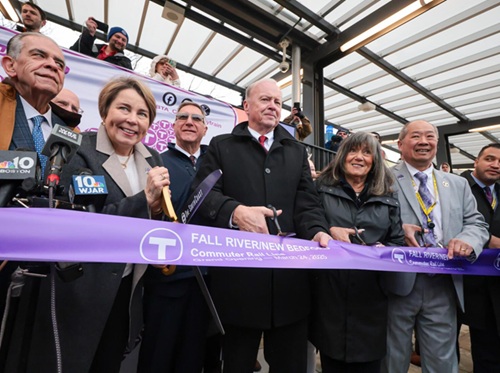
[Editor’s note: In a related effort, MassDOT and the Massachusetts Bay Transportation Authority recently launched the South Coast Rail commuter line. For the first time in over 65 years, the agency said cities and towns of southeastern Massachusetts will now have passenger rail service to and from downtown Boston.]
Slesinger also noted that eligible applicants for these MassDOT grants, including intercity bus carriers and regional transit authorities, can receive funding to subsidize services on routes serving rural areas – thereby improving links to urban centers for employment and healthcare access for residents living in those areas.
State departments of transportation across the country provide support to rural transportation providers in a variety of ways.
For example, in February, the West Virginia Department of Transportation started work on a major facility renovation project for Mountain State Transit Authority or MTA that includes overhauling the MTA’s headquarters and bus garage in Summersville, WV.
That renovation project aims to modernize and expand MTA’s Summersville headquarters, adding new office space and a room dedicated for bus driver training, as well as expanding the garage area to house more buses
And, in November 2024, the Ohio Department of Transportation issued grants of more than $17.5 million in grants to public transportation providers in rural and urban areas of the state to help improve workforce mobility.
Those grants went to transit agencies in 16 counties through its Ohio Workforce Mobility Partnership Program or OWMP; supporting 33 transit projects that increase the ease and efficiency of transporting residents to economically significant employment centers or places of employment outside of their home communities.