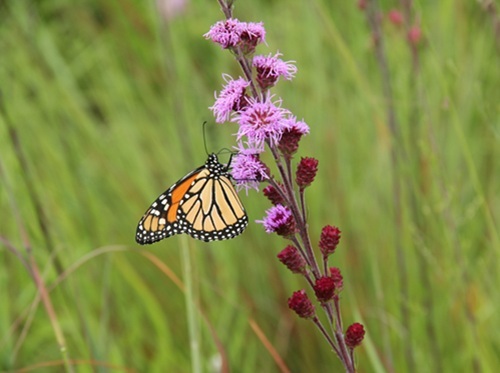
The Georgia Department of Transportation and The Ray recently partnered to establish monarch butterfly pollinator meadows at nine of agency-owned highway right-of-way sites statewide.
[Above photo via Georgia DOT]
Those nine meadows represent Georgia DOT’s first installed acres banked through the Nationwide Candidate Conservation Agreement with Assurances (CCAA) for the Monarch Butterfly on Energy and Transportation Lands – a voluntary conservation initiative that encourages transportation agencies to create, maintain and manage monarch butterfly habitat on transportation lands.
“Monarch butterfly populations have been declining in recent years, and these pollinator sites demonstrate how transportation infrastructure and environmental stewardship can create meaningful conservation opportunities,” noted Russell McMurry, commissioner of the Georgia DOT, in a statement.
“The Ray has long been a valued and trusted partner of the department, and we are pleased to continue our collaboration to help protect and preserve monarch butterfly habitats,” he said.
[Editor’s note: The Ray is currently working with several state departments of transportation – including the Connecticut Department of Transportation and the Montana Department of Transportation – on a number of research projects including everything from installing solar energy collection sites to evaluating sites for wildlife crossings.]
McMurry – who also serves as president of the American Association of State Highway and Transportation Officials – added that, through this collaborative effort, his agency has prepped those roadside meadow sites by implementing “conservation mowing practices” that allow native vegetation and flowering plants to grow and provide habitat and nectar for monarch butterflies and other pollinators.
Concurrently, The Ray – a corporate venture engaged in testing a variety of infrastructure-related technologies, primarily along an 18-mile-long strip of I-85 in Georgia – will coordinate the planting and evaluation of the habitats; monitor plant growth and coverage, as well pollinator activity; and track how well native vegetation performs under different roadside conditions.
“Installing these meadows across Georgia gave us the opportunity to take what we’ve learned through years of roadside research on The Ray Highway and apply it at a much larger scale,” noted Josh Weaver, natural capital manager for The Ray. “Each site presents different soils, slopes and growing conditions, so this work is about more than planting wildflowers,” he added. “We’re demonstrating how Georgia’s highway rights-of-way can be intentionally managed to provide meaningful monarch and pollinator habitat while also evaluating native vegetation as a practical tool for slope stabilization, erosion control and long-term roadside management.”