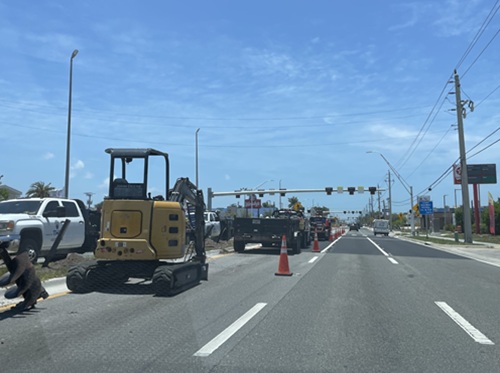
The Florida Department of Transportation is investing $4.6 million in safety improvements for a southwest suburban highway corridor to better accommodate pedestrians and bicyclists who travel along or cross the busy roadway.
[Above photo by Florida DOT]
The project site along U.S. 41 in Bradenton – about 45 miles south of Tampa – is home to shopping centers, restaurants, gas stations, and retail shops. FDOT traffic data show the six-lane highway has an average daily traffic count of about 45,000 vehicles.
“As part of the Florida DOT Safety Office constant review, this corridor was identified due to the number of fatal and serious injury crashes,” noted Patricia Pichette, a communications specialist with the agency. “Specifically, this project is intended to address the bicycle and pedestrian crashes along the corridor.”
Florida DOT noted that two-thirds of the 34 fatal crashes in the area from 2018 through 2024 involved a pedestrian or cyclist.
To make active transportation safer along a key 1.27-mile section of U.S. 41, the agency is installing seven mid-block crosswalks with pedestrian hybrid beacons; vehicle detection systems; signage and pavement markings; raised medians; new curbs and gutters; new ramps; sidewalks; signalization; and improved lighting.
The high-visibility crosswalks will also have patterns that are visible to drivers and pedestrians from farther away compared to traditional crosswalks, the agency said – mid-block crosswalks that will be installed on the roadway below the pedestrian hybrid beacons.
The overhead beacons have two red lenses above a single yellow lens, Florida DOT noted, which remain dark until a pedestrian or bicyclist pushes the call button to activate the beacon. When activates, the beacon goes from yellow-to-red flashing and steady-light sequence that directs traffic to slow or stop.
Nearly 74 percent of pedestrian fatalities occur at non-intersection locations, and vehicle speeds are often a major contributing factor, according to a Federal Highway Administration report on pedestrian hybrid beacons. The beacon is “an intermediate option between a flashing beacon and a full pedestrian signal because it assigns right of way and provides a positive stop control,” that FHWA report found.
The vehicle detection systems will include cameras and roadway-embedded loops to help with signals and traffic flow, Florida DOT’s Pichette said.
Though project construction is scheduled to wrap up at the end of the year, Florida DOT will “continue to seek funding to install other proven safety counter measures,” she stressed.
“Pedestrian and bicyclist infrastructure matters to the Florida DOT because protecting people who walk and bike is essential to reducing serious injuries and deaths on Florida’s roads,” Pichette noted. “Florida DOT recognizes that these travelers are the most vulnerable users in the transportation system, so improving safety supports the state’s broader goals of building connected, healthy and accessible communities.”
 Active Transportation