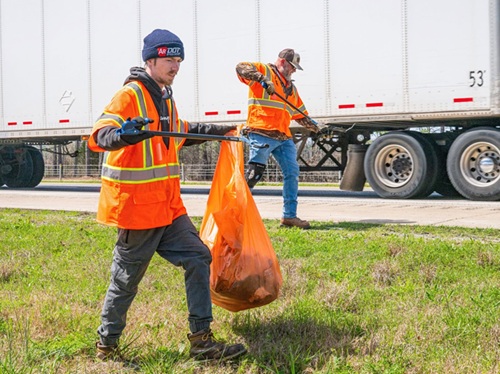
In recent years, several state departments of transportation have adopted a new public messaging position about roadside litter pickup that does not include images of sun-lit fields of daisies or shiny-faced volunteers happily filling garbage bags.
[Above photo by Arkansas DOT]
Instead, the modern-day anti-littering message is all about the money – more specifically, the cold, hard cash state DOTs must part with to clean up roadsides instead of improving transportation infrastructure. It’s a frustrating issue for state DOTs, who must deal with an increasingly irate citizenry that loves to trash the cost of state DOT cleanup efforts while simultaneously dumping their trash on those very same roads.
“The public expects the state DOTs to keep the roads clean,” said Dennis Palmer, program manager for traffic engineering and maintenance at the American Association of State Highway and Transportation Officials. “I think that is why state DOTs want the public to understand the costs of littering.”
For example, in 2025, the Alabama Department of Transportation (ALDOT) spent $9.67 million on in-house crews and contractors just to pick up litter. The department believed the cost was getting out of hand and issued a news release to bring the issue front and center.
“Littering isn’t just unsightly – it is illegal and creates avoidable costs for taxpayers,” the release said. “Every dollar spent picking up trash is a dollar not spent on paving roads, improving intersections or enhancing safety.”
George Conner, ALDOT’s deputy director for operations, stressed sending his personnel out on litter cleanup detail has a direct
impact on road maintenance operations. For example, in Tuscaloosa – home of the University of Alabama – Connor maintains a four-person crew dedicated to full-time litter pickup.
“Litter generally is proportional to the amount of traffic out there. On a football weekend, there is a large increase in traffic and a lot of litter,” he explained. “If nobody threw litter out, then the people who are picking up litter could be doing other things. And, that list of other things is growing quite large. So, I want to say this in a nice way: state DOTs don’t put out the litter. It’s third parties.”
Other states are also publicly venting about the growing cost of litter cleanup.
The North Carolina Department of Transportation recently pointed out that the $22.85 million it spent on litter management in 2025 was money “that could be used to fix potholes, build bridges and improve our transportation system.”
Meanwhile, the Mississippi Department of Transportation reported that it spends more than $3 million a year picking up litter. “This money could be used to build and repair roads and bridges, improving our state’s infrastructure and economy,” the department said in a news release.
In Maryland, Governor Wes Moore (D) took to social media to bemoan the fact that the Maryland Department of Transportation must spend more than $17 million a year on trash removal.
“That state funding could have instead gone to things like critical infrastructure projects, projects to improve public safety and drive economic growth in our communities,” he said.
Specifically, Gov. Moore said that $17 million could have resurfaced 113 lane miles, installed 1,700 crosswalks, or filled 136,000 potholes. “Your trash,” he concluded, “is costing Maryland cash.”
An informal AASHTO survey of 23 states indicates that state DOTs across the nation are collectively spending $631 million a year on litter pickup. If Maryland’s estimates are correct, that’s enough money to overlay a road stretching from New York to Los Angeles,
install a crosswalk every quarter mile of that road, and still have $100 million in cash for other needs.
That survey showed that state DOTs spend, on average, an estimated $1.84 per citizen just on litter pickup. These estimated numbers do not include the cost of litter picked up by other state or local agencies or by non-contracted volunteer groups.
Some state DOTs, such as the Arkansas Department of Transportation (ARDOT), spend the largest amount money on litter pickup per capita.
In 2025, ARDOT spent $9.7 million, or $3.13 a year for every man, woman and child in the state, said Dave Parker, head of the department’s communications division.
“It’s a growing concern for us, financially,” Parker said, noting that litter costs have risen more than 50 percent in just three years.
[Next week, part two of this feature story will outline the key role volunteers play in helping state DOTs manage the roadside trash removal issue.]